Flight troubles not likely to end when shutdown does
With Congress on track to end the ongoing government shutdown, the mass flight delays and cancellations Americans have experienced could soon abate, Transportation Secretary Sean Duffy said Tuesday.
But aviation groups said it will take time to resolve the issues even after the government reopens.
“Airlines’ reduced flight schedules cannot immediately bounce back to full capacity right after the government opens. It will take time, and there will be residual effects for days,” Airlines for America, a lobbying group for major airlines, said in a statement posted on its website Monday.
Duffy projected cautious optimism on the 42nd day of the record-long government shutdown, noting that the U.S. House could pass a funding deal as soon as Wednesday. The U.S. Senate approved a deal on Monday to end the shutdown.
Air traffic controllers and other federal employees deemed “essential” have been forced to work without pay for over a month. Many have not returned and have found odd jobs while the shutdown dragged on.
If air traffic controllers return to work quickly, Duffy told reporters, “I think we’re going to be back to regular flight schedules” in time for the Thanksgiving travel rush.
“I want you all to travel on time, I want your flights to not be delayed or canceled, but that is not the primary concern. The primary concern is safety,” Duffy added. “We’re trying to manage risk in the system so that people fly, and fly safely.”
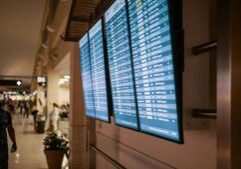
Millions of U.S. travelers have already faced thousands of flight delays and cancellations since Nov. 5, when the Federal Aviation Administration ordered 40 major U.S. airports to incrementally reduce flight volumes by 10% as a safety measure.
Airports have faced increasingly severe staffing shortages since federal funding ran dry on Oct.1, after Senate Democrats filibustered Republicans’ bill to keep the government open.
Even before the shutdown, a shortage of air traffic controllers and an aging system caused delays at major airports across the nation, prompting Congress to approve $12.5 billion to modernize it.
Duffy said the FAA will alleviate its flight restrictions “only when the data says we should.” In the meantime, passengers whose flights are cancelled due to the FAA’s order are entitled to refunds from airlines.
President Trump on Monday demanded that all air traffic controllers return to work or face a substantial dock to their pay. He also said controllers who work through the entire shutdown should receive a $10,000 bonus.
Duffy said he “couldn’t agree more” with Trump about the bonus but took a softer stance on how to deal with absent employees.
“I think what we have to realize is, we have some controllers who are put in a very difficult position,” Duffy said. “They were confronted with a real problem: ‘Do I not feed my family, or do I try to find another pathway to put food on the table?’ And that was very real. And I’m cognizant of that; I don’t want to be unfair to people.”
The FAA will investigate any “continual bad actors,” such as those who skipped work before their first missed paycheck and used the shutdown as an excuse not to return, Duffy said.





Chance Showers And Thunderstorms then Slight Chance Showers And Thunderstorms
Latest News Stories

Americans could face ‘sticker shock’ as once-small tax exemption ends
‘Pro-taxpayer’ law requires operators to clean up abandoned Illinois oil wells

Black-only medical directory must open to all races after lawsuit
Embattled Fed governor sues Trump over ‘illegal’ firing

Watch: Cook County gun ban plaintiffs petition SCOTUS; Pritzker hasn’t heard from White House

Illinois quick hits: Man on pretrial release accused of murder; holiday weekend impaired driving patrols

Beecher Library Schedules New Window Installation for Early August
Illinois quick hits: Gun ban challengers petition SCOTUS; man sentenced for COVID fraud
WATCH: Trump: Illinois’ ‘slob of a governor’ should call for help with public safety
Beecher Library Awarded Over $10,000 in State Per Capita Grant
WATCH: Legislator says Illinois’ child welfare agency uses interns, has legal exposure

Economic index shows reduced uncertainty, more stability in Midwest