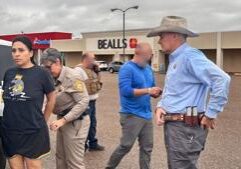
EXCLUSIVE: First Nation police chiefs want to participate in border security efforts
First Nation tribal police chiefs in Canada say want to participate in border security efforts. Many already are on the front lines, living at the U.S.-Canada border, they told The Center Square.
“National security doesn’t exist without First Nation policing at the border,” Dwayne Zacharie, president of First Nations Chiefs of Police Association, told The Center Square in an exclusive interview while participating in border security operations with Texas Operation Lone Star sheriffs. Zacharie also serves as Chief Peacekeeper of Kahnawake Peacekeepers located near Montreal.
One of the biggest problems First Nation communities face is a lack of funding and the Canadian government refusing to designate policing as essential services, he argues.
“We’re not regarded as essential service,” but considered “as an enhancement to” the Royal Canadian Mounted Police (RCMP) and other provincial police services, he said.
There are more than 630 indigenous communities in Canada and only 36 self-administered policing services, he says. The 35 serve roughly 150 indigenous communities; the RCMP and provincial police are supposed to serve the rest, he said. First Nation police receive roughly 40 percent less salaries than federal and provincial police organizations that “don’t share information with us, don’t provide us with opportunities for advanced training or resourcing commensurate with our needs,” he said.
As a result, he said he’s looking for help outside of Canada, including from U.S. federal, state and local partners to help him and First Nation police fight crime, including border crime.
“We’re going to find the partners that we need to have,” he said. He’s hoping new partnerships will help “because we do see the impacts in our communities as police officers. We see MS-13, the Sinaloa Cartel, Hell’s Angels and organized crime entities that come into our communities because in their minds, the picking is ripe because we don’t have the resources, we’re understaffed.”
President Donald Trump “has a different reality about the way he looks at things,” including telling Canadian authorities to improve border security, he said. Canada’s $1.3 billion border plan claims to surge resources to law enforcement but “First Nation policing didn’t see any influx of resources, didn’t see any upgrades in training,” Zacharie told The Center Square.
First Nation challenges are compounded by systemic underfunding and policies that led to multiple lawsuits. They’re using expired bullet proof vests, don’t have enough vehicles and safety equipment to perform their jobs, and can’t hire or retain personnel due to lack of resources, they say. Their working conditions “would never be accepted by the provincial police or the Montreal police or any other police department,” Shawn Dulude, president of the Quebec Association of First Nation and Inuit Police Directors, told City News.
In Quebec, 22 First Nation police officers filed a complaint against Public Safety Canada with the Canadian Human Rights Commission alleging “persistent underfunding of Indigenous police forces,” which has created serious security risks. This is after Pekuakamiulnuatsh First Nation sued Quebec officials arguing they underfunded their police for years. Canada’s Supreme Court ruled in their favor last year.
In British Colombia, the Heiltsuik Tribal Council also sued, arguing the RCMP aren’t protecting residents from organized crime, including drug trafficking and sexual violence. The region is dealing with cartel and CCP-related crime, The Center Square reported.
These problems are compounded by “a stigma attached to policing because of the old concepts and the way that the RCMP enforced the Indian Act, which created residential schools, which was a way to indigenous people and take their culture and their language and basically eradicate native people from the land,” Zacharie told The Center Square.
The 1876 Indian Act defined Indian status, created the reservation system and kept several colonial-era laws designed to “eliminate First Nations culture in favour of assimilation into Euro-Canadian society.” It “enabled trauma, human rights violations and social and cultural disruption for generations,” the Canadian Encyclopedia states.
Canadian police enforced a pass system regulating indigenous travel, a permit system regulating the sale of goods and farm equipment prohibitions on reservations.
From 1831 to 1996, more than 130 government-sponsored residential schools sought to “westernize” indigenous children. They were “overcrowded, underfunded, and rife with disease, leading to the deaths of many children, who were often buried in unmarked graves,” IndoCanada Professional explains. An estimated 150,000 children attended them; an estimated 6,000 died at them, the encyclopedia states.
In 1951, the Indian Act was amended to authorize the forcible removal of indigenous children. Now referred to as the “Sixties Scoop,” under the guise of “child welfare,” Canadian police accompanied “social workers” to forcibly take children from their parents, place them in non-indigenous foster care and adopt them out worldwide.
By the early 1980s, investigations were conducted; the Provincial Court of Manitoba detailed examples of “cultural genocide.” A class action lawsuit was filed by survivors, including those still searching for family members. In 2018, a settlement was approved.
The Indian Act also created an unequal legal status for women based on marital status. It was amended in 1985 to address the issue, which critics argue is still discriminatory.
Indigenous women were also forcibly sterilized in two provinces from 1928 to 1972.
Similar to the United States, thousands of indigenous women and girls suffer from violent crime and are missing, prompting national inquiries.
First Nation challenges are ongoing. In 2023, more than 100 First Nations sued the government for failing to provide housing and running water on reservations.
Zacharie is hoping with the help of Americans there’s a “chance for us to build a partnership … and educate people about the realities we are facing.”





Slight Chance Rain Showers then Slight Chance Showers And Thunderstorms
Latest News Stories
Speed Limits Reduced on Two Township Roads
Will County Finance Committee Approves Juvenile Detention Center Upgrades
Major Grade Separation Projects Advance with Engineering Contracts
County Authorizes Condemnation for Francis Road Project
Solar Farm Access Approved for Manhattan-Arsenal Road
Will County Finance Committee Meeting Briefs
Public Works Committee Briefs
Capital Improvements & IT Committee Briefs
Washington Township Approves $13,260 Security Overhaul, Opts for Local Vendor with 24/7 Service
Washington Township Board Appoints Teresa Peterson to Fill Vacancy
Washington Township Board Passes 2025-2026 Town Budget

Meeting Summary and Briefs: Washington Township Board of Trustees for June 2, 2025