Supreme Court hears arguments on Fed firing case
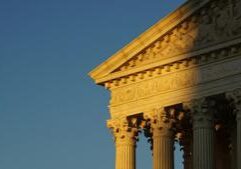
The U.S. Supreme Court heard oral arguments on Wednesday in a case over whether President Donald Trump can immediately remove Lisa Cook, a member of the Federal Reserve Board of Governors.
Trump v. Cook focuses on a lower court judges decision to allow Cook to remain in her job after Trump delivered a letter calling for her “immediate removal from office.” Trump accused Cook of committing mortgage fraud before she joined the Federal Reserve.
“At a minimum, the conduct at issue exhibits the sort of gross negligence in financial transactions that calls into question your competence and trustworthiness as a financial regulator,” Trump wrote in a letter to Cook in August 2025.
Justices on the Supreme Court appeared skeptical of the Trump administration’s arguments to immediately remove Cook. Several justices questioned whether the president had proper cause to call for Cook’s removal, and pointed out longstanding legal principles that upheld the Federal Reserve’s independence.
“The independence of the agency is very important and that independence is harmed if we decide these issues too quickly and [without] due consideration,” Justice Sonia Sotomayor said.
The Federal Reserve is the central bank of the United States and is responsible for monetary policy in the country. According to the Federal Reserve Act, members of the board of governors can only be fired by the president “for cause.”
Justice Brett Kavanaugh questioned the kind of precedent for other administrations the Supreme Court would be setting if it allowed firings to continue. He said allowing Trump’s action to continue would “weaken if not shatter” the Fed’s independence.
Kavanaugh cautioned against giving the president broad discretion in determining “for cause” as applied by the Federal Reserve Act. He said it would give future administrations the authority to consider positions on the Fed as “at will” employment.
“Once these tools are unleashed they are used by both sides and usually more the second time around,” Kavanaugh said.
John Sauer, solicitor general of the United States, argued that the president has always had the power to remove governors on the Fed for financial issues. He said Cook’s alleged mortgage fraud displays a disregard for Americans who rely on the policy set forward by the Fed for their own mortgages.
“No court should hold that the misconduct that’s alleged here, which is at least gross negligence … is not cause to remove a principal officer of the United States,” Sauer said. “That sends the wrong message to the American people.”
Paul Clement, a lawyer for Cook, pointed out that Congress does not include the Fed in its appropriations process because the central bank is funded by its own earnings. He argued that this shows how the body is independent from other executive branch agencies.
“Its less important that the president have full faith in every single governor and its more important that the markets and the public have full faith in the independence of the Fed,” Clement said.
Justices on the court also called for a hearing to determine the facts of mortgage fraud charges against Cook. One of Clements primary arguments hinged on the lack of a hearing to determine mortgage fraud allegations.
Sauer argued keeping Cook on the Fed caused irreparable harm.
“One step you could take to reduce your irreparable harm is to have a hearing,” Justice Ketanji Brown Jackson said.
“Even on the best reading of the evidence, this is at most an inadvertent mistake,” Clement said of the mortgage fraud claims against Cook.
Jackson argued the allegations against Cook involved conduct that had occurred before her tenure on the Fed and should not be considered to affect her job performance.
Clement argued an ideal firing situation would include notice, a hearing and the opportunity for a decision maker that has not prejudged the issue. He conceded the decision maker could be the president, but argued that the decision would have to be based on facts in the hearing.
Chief Justice John Roberts appeared hesitant to allow further litigation in lower courts on the issue. He said that the same issues heard before the justices would be argued in lower courts if the nation’s highest court allowed for additional review.
“I don’t quite understand what sending it back would be for other than airing other issues we’ve been airing this morning,” Roberts said.
Both Sauer and Clement urged justices on the court to quickly issue a decision in the case. While the justices on the court weigh the case, they could take until June or July to arrive at a final decision.






Chance Showers And Thunderstorms then Slight Chance Showers And Thunderstorms
Latest News Stories

WATCH: Pritzker expects feds soon; appeals court affirms transit concealed carry ban

Illinois quick hits: Economic conditions show stability; EPA recruitment efforts
WATCH: Pritzker focuses on violence intervention; VP won’t confirm deployments
House committee investigating Dem governors for ‘illegal alien’ Medicaid spending
Illinois quick hits: House investigating Medicaid for illegal immigrants; transit concealed carry case decided by appeals court

WATCH: Chicago hearing addresses police workload; resident calls for federal help

Arrest of Mexican national for 2023 murder called ‘long overdue’ justice

Meeting Summary and Briefs: Beecher Board of Education for August 13, 2025

Meeting Summary and Briefs: Village of Beecher Board of Trustees for August 25, 2025

Beecher School Board Tables $14,000 High School Window Graphics Project

Beecher Board Sets New Rules for Electric Scooters, Opens Ponds to Fishing
Trump says appeals court ruling rejecting tariffs ‘highly partisan’