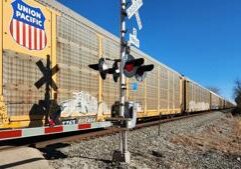
Union Pacific, Norfolk Southern submit new merger application
Union Pacific and Norfolk Southern on Thursday submitted a new merger application to the U.S. Surface Transportation Board that would create the country’s first transcontinental railroad.
The $85 billion acquisition of Norfolk Southern by Union Pacific would “drive growth, enable substantial cost savings for shippers and strengthen the U.S. supply chain,” Norfolk Southern said.
“After completing the additional work requested by the STB, the facts remain clear: This merger enhances competition and delivers real public benefits that make America’s supply chain stronger,” Union Pacific CEO Jim Vena said in a statement. “Our analysis uses complete systemwide traffic data provided by all Class I railroads to identify even more opportunities for our combined railroad to grow and compete.”
The Surface Transportation Board declined to approve the rail companies’ initial application, saying it needed more information on how the merger would impact the competitive balance in the industry.
Supporters argue that the deal would create a freight rail network spanning from the East Coast to the West Coast, modernize freight transportation, and improve the country’s supply chain, reducing transportation times and cutting shipping costs.
President Donald Trump has endorsed the merger, saying it “sounds good to me.”
The International Association of Sheet Metal, Air, Rail and Transportation Workers – Transportation Division (SMART-TD), the country’s largest rail union, also supports the deal, saying it would save industry jobs and create stability.
“SMART-TD evaluates every merger based on how it will affect our members’ jobs, livelihoods, and long-term stabilty,” SMART-TD President Jeremy Ferguson wrote in a letter to lawmakers. ““Union Pacific has committed that employees of both Union Pacific and Norfolk Southern will not face involuntary furloughs, guaranteeing job protection for the duration of their careers,”
Opponents of the merger say it would give one company control over nearly half of U.S. rail traffic and reduce competition.
“This did not begin with a customer asking for a UP-NS merger to happen,” President and Chief Executive Officer of BNSF Railway Katie Farmer said in a news release. “It’s driven by Wall Street on the promise of a big shareholder payout. It will eliminate competition, raise costs for consumers, and destabilize the supply chain that powers the American economy.”
BNSF Railway is a competitor of Union Pacific and Norfolk Southern, whose CEO said the merger will lead to growth.
“This merger is fundamentally about growth,” Norfolk Southern President and CEO Mark George said in a Thursday statement. “Shippers have been clear about what they value, and the data backs it up. When single-line rail service is available, they choose it. Our combined network will deliver seamless freight moves within and across the Mississippi watershed markets with one Class I railroad accountable from origin to destination.”
The Surface Transportation Board oversees railroad mergers and must decide whether the deal serves the public interest.



Chance Showers And Thunderstorms
Latest News Stories
Zinc Leaching and Flooding Concerns Dominate Testimony at Will County Solar Hearing

Meeting Summary and Briefs: Will County Board Special Planning and Zoning Commission for May 12, 2026

Access Will County Dial-A-Ride Reports Massive Growth After Consolidating Paratransit Services
Trade, Taiwan top priorities for Trump, Xi as two leaders wrap first meeting

Critics question unions after $1B in political spending
Will County Planning and Zoning Commission Recommends Denial of 6,099-Acre Earthrise Solar Project After Court-Ordered Hearing

Judge sets up high stakes baby formula NEC trial vs Mead Johnson
Trade court to rule on tariff stay by next week

FeaturingBeecher Village Board Adopts FY26/27 Budget Police Expansion and Drone Program
Johnson defends Trump ballroom as ‘a donation to the country’
Vance cuts $1.3 billion in California Medicaid, pauses hospice care
Groups urge House leaders to reject E15 expansion, calling it a hidden tax