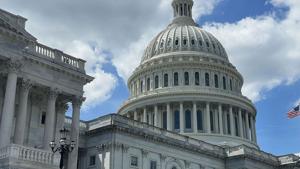
WATCH: Report says national student debt is over $1.6 trillion
The college student loan balance in the United States is $1.66 trillion, according to a WalletHub report.
To determine the best and worst states with student debt, the WalletHub’s report compared all 50 states and the District of Columbia. WalletHub also graded on a 100-point scale focusing on metrics such as the state’s cost of living, unemployment rates and paid internship opportunities for students.
The state with the most student debt is Mississippi.
The average amount of student loans owed, according to the report, equals 56% of the median income in the state. Mississippi residents hold a total of $17 billion in student loan debt.
Additionally, Mississippi has the 14th-highest default rate of debt, meaning people are having trouble paying the loans they borrow, the report stated.
The report indicates Mississippi has the fourth-worst availability of jobs to students, and the second-lowest share of paid internships, behind Louisiana.
“In a state like Mississippi, they may not have the highest balance, student loan balance per resident, but because it’s such a low-income state, the economy is in pretty poor shape right now, so they’re devoting more of their income towards student loan debt,” WalletHub Analyst Chip Lupo told The Center Square. “Now juxtapose that with a state like, say, California at 49. They have the highest student loan debt, the highest amount of debt, but because it’s a pretty high-income state, residents aren’t allocating as much of their income towards the debt.”
In California, $151.5 billion in student debt is owed by state residents. At the same time, the state has a multitude of grant and loan forgiveness programs.
Following Mississippi, states with the most student debt, with the average amount owed per student, are New Hampshire, $34,860; Pennsylvania, $36,120; Delaware, $38,856, and South Dakota, $31,171.
The states with the least amount of student debt are Washington, with the average student owing $36,709; New Mexico, $34,246; California, $38,300; Utah, $33,872; and Hawaii, with $38,929.
Lupo said the rise in student debt has been a cause of the rise in the cost of tuition, which has doubled in the past two decades.
“I do think that in a lot of states if we shift more of the student loan programs back to the banks, create some more competition, I do think that college would be a little bit more affordable, and students would have a little bit more leeway and maybe not have to borrow as much,” Lupo said.
In recent years, the student loan forgiveness program, strongly advocated by the Biden administration, provided relief for over 5 million borrowers, upward of $190 billion. That is only 11% of the current national student loan debt relieved.
“I think there were all kinds of legal issues involved with the Biden administration’s effort to forgive student loans,” Lupo said. “You can’t erase the debt.”





Partly Sunny then Slight Chance Showers And Thunderstorms
Latest News Stories

Sen. Kelly sues Hegseth over effort to reduce retirement pay

Illinois interstate shootings decline

WATCH: State sues Trump admin over enforcement tactics; No tax on tips proposal filed

Will the Clintons testify on Epstein relationship this week?

Dems move to almost entirely block fed immigration enforcement in IL

Capital Imp Committee: Facilities Director Reports on VAC Progress and Critical Health Department Elevator Repairs

‘Good Food For All’ Initiative Proposes Local Agricultural Asset Mapping for Will County

Public Works Committee Advances $3.2 Million Engineering Contract for Mills Road Reconstruction
Theis abruptly retires from IL Supreme Court; Tailor to replace

Colorado expands lawsuit over alleged Trump retaliation
California leads suit to preserve U.S. Department of Education

WATCH: Arizona governor’s State of State stresses economy