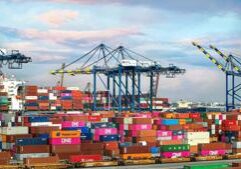
Law professor explains why Trump could win tariff case
The U.S. Supreme Court could side with the Trump administration on a multi-billion dollar case over tariffs despite two lower courts saying the power of the purse remains with Congress.
A law professor who worked on international trade under three presidents said the nation’s highest court could rule in Trump’s favor.
Case Western Reserve University business law professor Juscelino Colares said the Supreme Court could find the power to “regulate,” through tariffs, the “importation” of goods during a declared emergency in the 1977 law President Donald Trump used to levy tariffs. Colares said that while no previous president has used tariffs by claiming an emergency under the 1977 law, a 1975 U.S. Court of Customs and Patent Appeals upheld former President Richard Nixon’s 10% import surcharge based on similar language in the Trading With the Enemy Act, the statute that the 1977 International Emergency Economic Powers Act succeeded.
Should the Supreme Court focus on the emergency nature of the tariffs imposed by Trump under IEEPA, Colares says, the court may allow the administration to continue collecting tariffs as part of the framework deals he’s negotiating, but only so long as he eventually brings the trade deals to Congress for approval or gets express congressional approval for tariff negotiations another way.
“The President can negotiate these as executive agreements and then bring them later for approval,” Colares told The Center Square.
The Supreme Court agreed last week to consider the tariff challenge on an expedited schedule. A victory for Trump would cement the federal government’s newest revenue source – the highest import duties in nearly a century – in place, at least for now. Trump has said a loss could be catastrophic for the U.S. economy.
A group of Democrat-led states, five small businesses, and two private companies sued Trump, saying the president overstepped his authority by imposing tariffs on every U.S. trading partner.
Trump has made tariffs the centerpiece of his economic agenda during the first six months of his second term.
Trump used the 1977 International Emergency Economic Powers Act – which doesn’t mention tariffs – to reorder global trade in a matter of months to try to give U.S. businesses an advantage in the world market. Under the International Emergency Economic Powers Act, Trump imposed import duties of at least 10% on every nation that does business with the U.S.
The challengers argue that Congress, not the president, retains the power to tax. Trump says he has the authority and that his deals around the world benefit all Americans.
Trump’s legal team has identified two emergencies for tariffs under the International Emergency Economic Powers Act. The first is fentanyl smuggling, and the second is high trade deficits with U.S. trading partners.
The Washington Legal Foundation, a nonprofit public-interest law firm, wrote in a friend-of-the-court brief that the case carries high stakes for all Americans.
“Here, the president’s actions affect trillions of dollars’ worth of economic activity, with a direct impact on the purchasing, production, and pricing decisions of every American business that touches, even remotely, international trade,” attorneys Cory Andrews and Zac Morgan wrote on behalf of the foundation. “It is an understatement to call the Question Presented a trillion-dollar question. In 2024, the sum of the nation’s international trade in goods and services was over seven trillion dollars.”
Lawyers for the Washington Legal Foundation said Congress would never grant so much authority with such vague language.
“In sum, the president rests his legal justification on two plucked words, sixteen apart (out of 76 operative words in the relevant subsection), with one of those plucked words given an uncommon meaning,” they wrote.



Mostly Sunny then Showers And Thunderstorms Likely
Latest News Stories

Trump puts spotlight on China, Iran’s top oil consumer
Lawmakers, auditors offer fraud prevention solutions

Illinois unions seek to kill Waymo-friendly bill in Springfield

Will County Animal Protection Services Advises Against Multi-Campus Shelter Model

Executive Committee Advances $15,000 Strategic Plan Initiative
Rich States Poor States: Tax policy largely determines states’ economic competitiveness

P&Z Commission Overrides Staff Denials, Rescuing Special Use Permits for Joliet Wedding Venue and Romeoville Barge Terminal
Will County P&Z Commission Grants Extensions for Joliet Township Solar Farm Ground Cover

P&Z Approves Lockport Bounce House Business Expansion
78 pro-life orgs ask DOJ to stop undermining state laws by favoring aborting drug industry

Illinois Quick Hits: Two of ComEd four released; new trial expected
Will County Treasurer Seeks Policy on Cash Payments as U.S. Mint Discontinues the Penny

Lend a hand this spring at Volunteer Morning programs