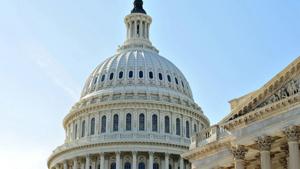
WATCH: Longest-ever government shutdown ends after 43 days
The U.S. House of Representatives voted to reopen and fund the federal government Wednesday night, ending the longest government shutdown in American history.
President Donald Trump will immediately sign the bill into law, capping off 43 days that saw millions of federal workers either furloughed or working without pay, billions in GDP lost, SNAP payments halted, and mass flight delays across the country.
“For six long weeks, Americans have paid the price for a shutdown they neither caused nor deserved,” House Appropriations Committee Chairman Tom Cole, R-Okla., told lawmakers. “This is not how the greatest nation in the world should function. Today, that changes.”
Reps. Thomas Massie, R-Ky., and Greg Steube, R-Fla., were the only Republicans to vote against the legislation, which passed by a 222-209 vote.
The bill, which already passed the Senate on Tuesday, combines two pieces of legislation. One is a Continuing Resolution to keep the government funded until Jan. 30. This will buy lawmakers time to finish passing all 12 appropriations bills providing new funding for all agencies in fiscal year 2026, which began Oct. 1.
The other is a bipartisan minibus which knocks out three of those 12 appropriations bills. It authorizes full-year funds for Military Construction and Veterans Affairs; the Food and Drug Administration, Department of Agriculture, and Rural Development; and the Legislative Branch.
A last-minute provision that Senate Republicans tucked into the Legislative Branch portion, which would allow senators to sue the federal government if their phone records were subpoenaed, caused some uproar in the House.
But given the urgency of the shutdown situation, House Speaker Mike Johnson, R-La., said House Republicans will introduce and fast track standalone legislation to repeal the provision.
Reps. Jared Golden, D-Maine; Adam Gray, D-Calif.; Marie Gluesenkamp Perez, D-Wash.; Don Davis, D-N.C.; Henry Cuellar, D-Texas; and Tom Suozzi, D-N.Y.; were the only House Democrats who voted to reopen the government.
The shutdown began Oct. 1 after Senate Democrats filibustered Republicans’ original seven-week CR to keep the government open and funded. They continued to do so – 14 consecutive times – over demands that any funding deal also extend a pandemic-era expansion of the Obamacare Premium Tax Credit.
Eventually, eight senators in the Democratic Caucus finally provided the necessary votes for the bill to break the filibuster and move on to the House on Tuesday.
“The whole exercise was pointless, it was wrong, and it was cruel,” Johnson told lawmakers Wednesday night. “I think everyone needs to remember this one simple thing: from the very beginning of this whole ordeal, on the Republican side, we operated in good faith.”
Democrats disagreed, with Rep. Brad Schneider, D-Ill., chairman of the New Democrat Coalition, calling the funding bill “morally wrong.”
“The Republican bill does nothing to address the rising cost of healthcare,” Schneider said. “The government needs to be open. Nobody wins in a government shutdown…But we have to make sure that we’re fighting for Americans’ health care, we’re fighting to lower the cost of living for the American people.”



Isolated Rain Showers then Mostly Sunny
Latest News Stories
Ammons pleads not guilty, wants to delay House investigation

Minnesota extends Medicaid provider pause as fraud concerns reach U.S. Senate

Sonderling defends grant shift, vows fraud crackdown to senators

Advocate calls for stronger IDOC oversight after payroll fraud guilty plea

Illinois Quick Hits: FAFSA applications rise with increase in state taxpayer funding

Appeals court: Chicago’s ‘climate disinformation’ case belongs in Cook County

WATCH: Polish leader discusses Ukraine, Russia at Reagan Library

Firefighters from 30 states battle wildfires in Colorado
Democrats wary over DNI nominee’s stances on election security
GOP, Dems compete in Arizona congressional races

Abbott directs state investigation into ICE Houston shooting
Industry leaders: Feds can more effectively combat fraud, but privacy rights at risk