
Chicago tax proposals draw concern over legality, ‘economic death spiral’
(The Center Square) – Chicago Mayor Brandon Johnson’s allies have launched a seven-figure campaign to support his 2026 budget proposal, but opponents say the mayor’s tax plans will send the city into an economic death spiral and could bring about costly litigation.
The Chicago City Council met Tuesday but did not vote on a budget after the council’s finance committee struck down the mayor’s tax-laden revenue package on Monday.
Chicago Board of Education member Norma Rios Sierra, who joined the school board in January after she was appointed by the mayor, spoke during Tuesday’s public comment period.
Rios Sierra threatened layoffs if aldermen did not approve Johnson’s plan to divert $1 billion in tax-increment financing funds to Chicago Public Schools.
“If we do not get that TIF surplus, we’re going to be sending a lot of pink slips for Christmas, and we’re going to put it right back on you,” Rios Sierra told the council.
Rios Sierra said the Chicago Teachers Union created a calculator so aldermen could see the impact their votes would have in their own wards.
Also Tuesday, Black Voters Matter Fund announced a seven-figure ad investment to support Johnson’s spending plan.
BVM promised to “mobilize neighborhoods across Chicago, ensuring that the voices of Black, Brown, and working-class residents are front and center in the budget debate.”
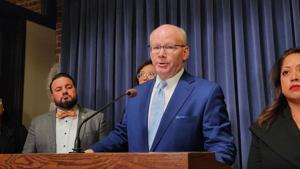
Alderman Brendan Reilly referred to the campaign when he told the finance committee Monday that anti-business tax policies were hurting the city.
“I can tell you there’s no amount of money that’s going to convince us that a head tax is good for Chicago,” Reilly said.
The mayor’s budget includes a $21-per-worker monthly tax on businesses with 100 employees or more.
Reilly said the city’s commercial buildings have lost $400 million worth of value since their last assessment.
“Because of Cook County’s broken property tax system, when commercial buildings are found to be less valuable, the rest of that burden falls on top of homeowners,” Reilly said, adding that he and his colleagues have been hearing from very frustrated homeowners after they received their property tax bills last week. “If you want to accelerate our headfirst dive into an economic death spiral, pass this head tax. That is effectively what you are doing.”
While the head tax proposal has drawn the most vocal opposition, an internet freedom advocate says Chicago’s proposed tax on social media might actually cost the city more than it brings in.
Johnson’s Social Media Amusement Tax would impose a $0.50 monthly fee per active user on digital services with over 100,000 users operating in Chicago.
NetChoice Vice President of Government Relations Amy Bos said the tax would hit residents right in their wallets.
“Those platforms aren’t just going to eat that cost, right? As we’ve seen in other business operations, they’re going to pass that on,” Bos told The Center Square, adding that Chicagoans would see new fees for services they used to receive for free. “Or they’ll lose access to certain features, or some platforms might just pull out of Chicago entirely.”
Bos said the tax would also incite privacy concerns, because platforms would start tracking where users live in order to figure out which users are operating in Chicago.
Citing the Permanent Internet Tax Freedom Act of 2016, Bos said Chicago’s proposal might violate federal law by imposing a “discriminatory tax” on electronic commerce.
Bos said a U.S. District Court in Maryland struck down that state’s digital advertising tax.
“We believe the issue is similar here. Chicago would be inviting similar costly litigation,” Bos said.
Bos said the states of Minnesota and Washington backed off after proposing taxes on social media.
“They reversed course. We’re hoping Chicago takes the same approach,” Bos said.
Even if the tax survives legal challenges, Bos said there are a host of issues with it.
“This tax is going to get stuck in the court, costing the city money instead of raising it,” Bos concluded.
Johnson’s $16.6 billion spending plan also includes an increased cloud tax as well as new taxes on sports betting and boat mooring.
The city council’s next meeting is scheduled for Dec. 10. The council is required by law to approve a budget by Dec. 31. If a budget is not passed by that date, some government programs might be interrupted and the city’s bond rating could suffer.






Mostly Sunny then Showers And Thunderstorms Likely
Latest News Stories

Board Establishes New Regulations and Fees for Wireless Telecommunication Facilities

House passes funding for ICE, CBP, tees up DHS reopening

Florida poised to flip 4 U.S. House seats with new map

Energy industry insiders advise lawmakers on supporting AI growth, protecting ratepayers

WATCH: Students see tuition as a good investment despite loan debt, survey says

California congressman slams nation’s ‘gerrymandering war’
Illinois pauses redistricting effort after Supreme Court ruling

Hegseth pledges housing fix after $2.6 billion used for warrior bonuses

Feds charge Sinaloa governor, others with running drugs to US

House passes three-year spy powers extension with crypto amendment

U.S. gas prices at 4-year high as oil exports hit new record

Government leaders statewide call for cashless bail reform after CPD officer killed