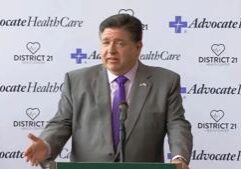
Disability group, coroners press governor ahead of assisted suicide decision
(The Center Square) – A Chicago-based disability-rights organization is seeking a meeting with Gov. J.B. Pritzker’s office as Illinois prepares for possible action on legislation that would legalize physician-assisted suicide in the state.
Senate Bill 1950, which began as a bill about sanitary food preparation, passed as the End-of-Life Options for Terminally Ill Patients Act in the early morning hours of Halloween.
“Very, very simply, this allows a person … age 18 or older who receives a diagnosis of six months or less to live and is mentally competent to make an informed decision to have the option of self-administering a prescription to end their suffering,” said bill sponsor state Sen. Linda Holmes, D-Aurora, during floor debate.
SB 1950 was sent to the governor’s desk Nov. 25. Wednesday, Pritzker was asked about the measure.
“It’s a hard issue, and I don’t want anybody to think that making up your mind about this is very easy,” Pritzker said. “It’s not. I think there’s a lot to consider, but most of all, it’s about compassion. And again, there’s evidence and information on both sides that leads me to think seriously about what direction to go.”
Sebastian Nalls, a policy analyst at Access Living, said the group has formally requested a meeting but has not yet received a response.
“We’ve requested a meeting with the governor’s team to go over the bill,” Nalls said. “At this point in time, we don’t have a timeline on it. We hope that it’s sooner rather than later.”
Nalls referenced other states’ reporting systems, arguing that they do not provide a clear mechanism to track possible abuse.
“Proponents will say there have been no instances of abuse or coercion,” Nalls said. “But there is no mechanism dedicated to reporting abuse, so there’s no way to actually catalog it. There’s a reason why the National Council on Disability has urged states not to pass legislation like this.”
The legislation has also raised concerns from outside the disability community. Fifty county coroners recently issued a public letter warning the proposal would remove “critical safeguards” and prevent independent coroner investigations of deaths involving the medication.
Nalls said those warnings align closely with Access Living’s own concerns about a lack of oversight.
“That’s just another layer of accountability that doesn’t exist in this legislation,” he said. “When coroners say this bill would allow deaths to bypass independent investigation, it reflects the broader problem we’ve identified: there are significant oversight challenges, and very few ways to investigate potential abuse or coercion.”
Asked whether amendments could bring Access Living closer to supporting the bill, Nalls was unequivocal: “No.”
Peoria County Coroner Jamie Harwood said coroners across the state have “grave concerns” about the bill, including how deaths would be recorded and the lack of third-party oversight.
“Our statutory obligation is to determine the cause of death for all deaths within our jurisdiction,” Harwood said. “But under this bill, once a doctor prescribes the medication and the person takes it at home, the coroner’s office is completely taken out of the picture.”
Harwood said the legislation requires the cause of death to be listed as the patient’s underlying terminal illness, not the ingestion of life-ending medication.
“It won’t be listed as an intoxication death, and it won’t be listed as a suicide,” he said. “It will be listed as a natural cause. That takes the truth out of the cause of death.”
The concern, Harwood said, is not about whether individuals should be allowed to choose assisted death.
“Overwhelmingly, none of us are opposed to choice,” he said. “Our concern isn’t whether we’re pro or against suicide. Our concern is that there’s no third-party oversight over the death, and there would never be based on the way the law is written.”
Harwood said he has raised the issue with state Rep. Jehan Gordon-Booth, D-Peoria, whom he described as supportive of his work and aware of his concerns.
“I’m surprised I haven’t heard anything,” he said. “I’m hoping Representative Gordon-Booth can get this in front of the governor. As Speaker Pro Tempore, she’s in a position to reach him directly.”
Pritzker has until Jan. 25 to sign or veto the measure.
Greg Bishop contributed to this report.






Partly Sunny then Chance Showers And Thunderstorms
Latest News Stories
More than $1 billion spent on noncitizen hospital costs in fiscal 2025

IL Senate GOP: Pritzker, not Trump, raised power bills

SC weighs whether Amazon must pay workers for mandatory COVID screenings

Federal judge allows New York wind project to proceed
Goodlander faces federal probe over ‘illegal orders’ video

Pennsylvania lawmakers criticize violent ICE encounters

WATCH: Tax increase talk at Statehouse; Bost’s election lawsuit against Illinois wins standing

Illinois Quick Hits: Indiana governor ‘working hard’ to attract Bears

Meeting Summary and Briefs: Capital Improvements & IT Committee for January 6, 2026

Public Works Shifts Focus to Snow Removal; Spring Leaf Collection Promised

Public Works Committee: $18.8 Million Contract Awarded for Lorenzo Road Bridge Over BNSF Railway

Meeting Summary and Briefs: Will County Board Public Health & Safety Committee for January 7, 2026