
GOP lawmakers silent on Trump’s EO punishing state AI guardrails
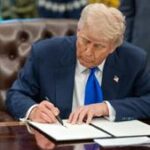
Frustrated with Congress failing to enact national artificial intelligence regulations, President Donald Trump took matters into his own hands Thursday night and signed an executive order strong-arming states into setting industry-friendly regulations only.
Republicans have spoken out against Big Tech and the potential dangers of uncontrolled AI expansion. Yet as of Friday afternoon, not a single AI-cautious Republican member of Congress has condemned the order, with only one commenting on the action at all.
“President Trump is right: we need federal standards to protect kids, creators, consumers, and conservatives across the entire country,” Sen. Marsha Blackburn, R-Tenn., posted on X on Friday. “I look forward to continuing to work with the President to draft the federal framework he has called on Congress to pass.”
While not a moratorium on state-level AI regulations – something U.S. lawmakers voted overwhelmingly to strip out of two major bills this year – the executive order cracks down on states with more restrictive laws.
Under the order, states with AI laws that the Trump administration says “harm innovation” would lose access to crucial broadband funds and could even face lawsuits from the U.S. Attorney General’s newly established AI Litigation Task Force.
The order also directs Congress to “ensure that there is a minimally burdensome national standard” for AI and requires that whatever congressional framework emerges “forbid State laws that conflict with the policy set forth in this order.”
The ultimate goal, the White House says, is to “protect American AI innovation from an inconsistent and costly compliance regime resulting from varying State laws.”
David Sacks, who advises the White House on AI and Cryptocurrency policy, said the executive order “is not that framework itself, or an amnesty or moratorium, but rather a statement of principles and a set of tools for the Administration to push back on the most onerous and excessive State AI laws.”
He added that the order “does not mean the Administration will challenge every State AI law.”
“The focus is on excessive and onerous State laws,” Sacks said. “We look forward to working with Congress to enact a stable and enduring framework that reduces unnecessary regulation, enables innovation, protects core values, and helps America win the AI race.”
Democrats quickly condemned the order, with Sen. Amy Klobuchar, D-Minn., calling it “dangerous, and most likely illegal” and Sen. Ed Markey, D-Mass., dubbing it “an irresponsible power grab.”
Conspicuously silent on the order are the Republicans who spoke out the most against an AI moratorium, including Sens. Josh Hawley, R-Mo., and Ron Johnson, R-Wis., as well as Reps. Chip Roy, R-Texas, and Thomas Massie, R-Ky.
Rep. Majorie Taylor Greene, R-Ga., who previously argued that states “must retain the right to regulate and make laws on AI and anything else for the benefit of their state,” also remained mum as of Friday afternoon.
According to Co-Chair of Congressional Artificial Intelligence Caucus Don Beyer, D-Va., however, “members in both chambers and both parties” are “actively exploring legislative options” in response to the order, which he says violates the 10th amendment.
“This is a terrible idea,” Beyer said in a statement. “Congress has been slow to respond to the AI revolution and in the absence of a strong federal response, states are wisely taking the lead to create guardrails and protect the public. Trump’s attempt to undo this progress without providing any federal regulatory protections would be extremely harmful.”
The executive order will likely draw lawsuits from both Republican and Democrat-led states.





Mostly Sunny then Showers And Thunderstorms Likely
Latest News Stories

Pritzker signs cryptocurrency bills, sparking debate over protection, innovation

Illinois quick hits: Deadly smash and grab reported; resolution honors Charlie Kirk

WATCH: Sides lay out positions on immigration reform amid increased enforcement
Feds, ‘new sheriff’ descend on Chicago suburb, seize illegal vaping items

WATCH: Reaction to Charlie Kirk’s assassination pour in; Freedom Caucus discusses 2026

Illinois quick hits: Freedom Caucus remembers Kirk; new chief judge for Cook County

Illinois quick hits: DOJ seizes illegal vaping products in Bensenville; NFIB optimism index rises
Customs and Border Protection seizes $86.5 million in illegal vapes
WATCH: Pritzker says political violence ‘has got to stop’ in reaction to Kirk shooting
IL Secretary of State candidate talks issues, Giannoulias yet to announce

Illinois quick hits: Universities report increased enrollment; man sentenced for pipe bombs

Bipartisan group of lawmakers aim to increase migrant physician jobs