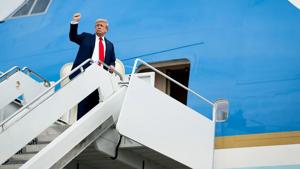
WATCH: Trump outlines AI order, calls Pritzker ‘totally unreasonable’
(The Center Square) – Although it remains to be seen how President Donald Trump’s executive order on artificial intelligence will affect AI laws already passed in Illinois, the president says Gov. J.B. Pritzker is totally unreasonable.
The president signed the order Thursday to provide a central source of approval for AI projects instead of sending them to individual states.
“When they need approvals of things they have to come to one source. They can’t go to California, New York and various other places like Illinois with Pritzker, who’s a totally unreasonable person,” Trump said.
The president’s order states that federal policy must sustain and enhance the nation’s global AI dominance through a “minimally burdensome” framework.
Trump said the U.S. is leading China in the AI race, but there would likely be only one winner. He said AI investors want to be in the United States.
“We have the big investment coming, but if they had to get 50 different approvals from 50 different states, you could forget it, because it’s not possible to do,” the president said.
The order provides for an AI Litigation Task Force to challenge state laws inconsistent with federal policy. It also calls on members of the administration to publish an evaluation of state laws.
On Aug. 1, Pritzker signed Illinois House Bill 1806 to prohibit licensed mental health professionals from using AI to make independent therapeutic decisions. HB 1806 became law immediately upon receiving the governor’s signature.
On Jan. 1, 2026, a law Pritzker signed in August 2024 is scheduled to take effect. House Bill 3773 from the 103rd General Assembly amended the Illinois Human Rights Act to prevent employers from using AI in a discriminatory manner, including using an individual’s ZIP code as a proxy identifier for characteristics. The law also requires notice to be sent when AI is being used in processes related to recruitment, hiring, promotion, renewal of employment, selection for training or apprenticeship, discharge or conditions of employment.
Trump’s artificial intelligence and cryptocurrency czar, David Sacks, said there are over a thousand AI bills currently in state legislatures.
“Over a hundred of them have already passed, 25% of them are in California, New York and Illinois. You’ve got 50 states running in 50 different directions. It just doesn’t make sense. We’re creating a confusing patchwork of regulation, and what we need is a single federal standard,” Sacks said.
Federal taxpayer dollars could be at stake for states with “onerous” AI laws. The order directs the U.S. Secretary of Commerce to specify the conditions under which states may be eligible for remaining funding under the Broadband Equity Access and Deployment (BEAD) Program.
Trump’s order called for legislative recommendations for Congress to establish a uniform federal policy framework. It also directed that the legislation not preempt state AI laws relating to child safety protections, AI compute and data center infrastructure, state government procurement and use of AI, and other topics “as shall be determined.”
The president said the move had Republican support and might have Democratic support “because it’s common sense.”
U.S. Sen. Ted Cruz, R-TX, said the most important economic question in the world is, “Who wins the race for AI?”
Cruz said American values of free speech and individual liberty should impact AI more than China’s values of surveillance and centralized control by the Communist government.
Greg Bishop and Kevin Bessler contributed to this story.




Mostly Sunny then Showers And Thunderstorms Likely
Latest News Stories
Trump seeks rare suspension of the federal gas tax
Trump seeks rare suspension of the federal gas tax

Trump asks court to freeze tariff ruling amid import surge fears

Data center regs proposed as $20 billion, 795-acre Joliet project advances
![Labor stats offer mixed bag for Illinoi]s](https://beecherlocal.com/wp-content/uploads/sites/21/2026/05/68dd7c703171a.image_-1.jpg "Labor stats offer mixed bag for Illinoi]s")
Labor stats offer mixed bag for Illinoi]s

U.S. Supreme Court temporarily extends abortion pill access again
Lawsuit: IL state VRA unconstitutionally lets Dems divide voters by race

Illinois Quick Hits: State grants offered to tackle ‘challenging’ properties
Democrats vow to challenge ballroom security funding in Republican budget bill

Officers mourn fallen Chicago cop as policy debate grows
Trump accuses Schumer of election ‘interference’ with New York task force
Poll site gun ban proposal draws pushback