Plaintiff in redistricting lawsuit predicts Supreme Court fight
The lead California legislator heading up the federal lawsuit challenging congressional redistricting expects the case to land in the U.S. Supreme Court.
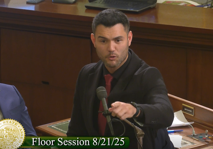
“If this has to go to the Supreme Court, we’re more than happy to take it to the Supreme Court,” Assemblymember David Tangipa, R-Fresno, and lead plaintiff in the case, told The Center Square on Thursday. “It probably will end up there either way, whether we appeal or Gov. Newsom’s team appeals.”
The case, heard this week in U.S. District Court in downtown Los Angeles, ended after two days of testimony and one day of closing arguments. The three-judge panel deciding the case – Josephine L. Staton, Kenneth Kiyul Lee and Wesley L. Hsu – adjourned the court early Wednesday afternoon.
Tangipa previously told The Center Square he believes the judges’ ruling could come by Friday.
During closing arguments on Wednesday, lawyers representing Tangipa and the U.S. Department of Justice, another plaintiff, said the Proposition 50 maps California voters approved in the Nov. 4 special election are illegal. Attorneys argued the newly-drawn maps constitute a racial gerrymander, which runs afoul of the Voting Rights Act of 1965.
Lawyers defending the maps on behalf of Gov. Gavin Newsom and California Secretary of State Shirley Weber said the maps constitute a gerrymander, but not a racial one. Rather, the maps constitute a politically-partisan gerrymander, which does not go against the Voting Rights Act, according to the attorneys.
California voters passed Prop. 50 on Nov. 4 with 64.4% of the vote, with 7,452,945 for and 4,116,810 against. Tangipa filed the lawsuit days later, alleging that the special election to re-draw California’s congressional districts amounted to a “rush-job rejiggering” of district lines. The mid-decade redistricting push was California’s response to Texas’ own mid-decade redistricting effort earlier this year. The Texas effort is designed to pick up five Republican seats in the U.S. House during the 2026 midterm election. The California map is meant to help Democrats gain five seats to counter that.
If the Prop. 50 maps are allowed to stand, the maps would be in effect for the 2026 midterm elections, the 2028 presidential election and the 2030 midterm election. Then the power to draw district maps would go back to the California Citizens Redistricting Commission. California voters approved the creation of the commission in 2008 to draw state legislative district lines before extending that power two years later to include congressional districts.
“In California, we should be able to trust that our elections are fair and transparent,” Assemblymember Alexandra Macedo, R-Tulare and a member of the Assembly Elections Committee, told The Center Square via email Thursday. “Proposition 50 disregards the California Independent Redistricting Commission’s maps and replaces them with new gerrymandered congressional lines that are now being challenged in federal court.”
Democratic legislators who sit on election committees in the California Assembly and state Senate did not respond before press time Thursday to The Center Square’s requests for comment.






Partly Sunny then Slight Chance Showers And Thunderstorms
Latest News Stories

Here’s how to get the $20 credit offered by YouTube TV in Disney dispute
Democrats want call program for immigrant detainees
Flight troubles not likely to end when shutdown does

Trump admin signals support for Paramount bid as Warner Bros. considers sale

WATCH: Trump says Veterans Day is ‘Victory Day’

Lawmakers divided after federal complaint targets student mental health screening law

Cruz, Cornyn file bill to make federal benefit fraud a deportable offense

DHS, USCIS report record job applications under Trump administration

Virginia Beach, Chesapeake rank among best cities for veterans

Normal, IL fire and EMS challenges highlight need for statewide task force

Analysis: Chicago among worst cities to drive in

Meeting Summary and Briefs: Will County Public Works & Transportation Committee for November 2025