Federal court upholds California congressional redistricting
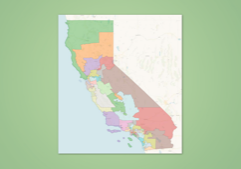
California’s congressional redistricting, designed to pick up five more Democratic seats in this year’s midterm elections, was upheld Wednesday in a federal court in downtown Los Angeles.
A three-judge panel from the U.S. District Court for Central California ruled 2-1 for the defendants, Gov. Gavin Newsom and the state, in a lawsuit filed by plaintiffs including Assemblymember David Tangipa, R-Fresno, and the U.S. Department of Justice.
The suit was the DOJ’s and Republicans’ effort to stop mid-decade congressional redistricting in California and accused the state of racial gerrymandering, which is illegal under the Voting Rights Act of 1965. Defendants countered that the gerrymandering is political-partisan, which is legal.
“We find that Challengers have failed to show that racial gerrymandering occurred, and we conclude that there is no basis for issuing a preliminary injunction,” Judge Josephine Staton wrote in Wednesday’s 70-page ruling.
The ruling followed three days of testimonies and arguments in December in the Los Angeles court, where nine witnesses, including six experts, testified. Staton noted the judges reviewed more than 500 exhibits totaling thousands of pages, along with video and audio evidence.
The lawsuit challenged Proposition 50, the measure that nearly 65% of California voters approved in November. The measure was the Democratic legislative supermajority’s response to Republicans’ efforts to pick up five more seats through redistricting in Texas. All 435 seats are up for election on Nov. 3 in the U.S. House, where the GOP currently hold 218 seats, the minimum number needed for a majority, after the recent death of U.S. Rep. Doug LaMalfa, R-California. Four House seats are vacant.
Racial gerrymandering wasn’t mentioned by opponents when Proposition 50 went before voters, Staton noted in the court’s ruling. She added Tangipa at the time described Proposition 50 as “partisan gerrymandering” and a “power grab” that eliminated five Republican districts and strengthened the Democrats’ seats.
Stanton cited the U.S. Supreme Court case, Rucho v. Common Cause, in which the justices ruled “partisan gerrymandering presents political questions beyond the reach of the federal courts.”
And she said the judges concluded the intent of voters is “paramount.” She said the constitutional amendment enacted under Proposition 50 was not simply authorization of partisan gerrymandering but a measure on a specific map that everyone could critique.
A review of the evidence on Proposition 50 shows the gerrymandering was partisan, not racial, Staton said.
Newsom and state Attorney General Rob Bonta praised the ruling.
“Californians overwhelmingly voted in favor of Proposition 50. Today’s decision upholds the will of the people. It also means that, to date, every single challenge against Proposition 50 has failed,” Bonta said in a statement. “I couldn’t be prouder of my team for successfully defending this ballot initiative in court on behalf of Governor Newsom and Secretary of State [Shirley] Weber. We remain confident in the legality of Proposition 50.”
Newsom said the court confirmed that voters overwhelmingly supported congressional redistricting.
In his dissenting opinion, Judge Kenneth Lee wrote racial gerrymandering was likely predominant in at least one district because of “the smoking gun in the hands of Paul Mitchell, the mapmaker who drew the congressional redistricting map adopted by the California State Legislature.
“Mitchell refused to appear before our court to explain how he drew the map and invoked legislative privilege for staying silent,” Lee said. “But before this lawsuit was filed, he publicly boasted to his political aids that he drew the map to ‘ensure that the Latino districts … are bolstered in order to make them most effective, particularly in the Central Valley.’ “
Lee noted Mitchell bragged on X that the Proposition 50 map would “further increase Latino voting power” and “adds one more Latino influence district.”
Lee also disagreed with Staton and the judge siding with her, Wesley Hsu, and said the court can’t look only at the voters’ intent to the exclusion of “other more probative evidence.”
The Center Square reached out to Tangipa on Wednesday, but did not get an immediate response.
Regardless of who won in the district court, Tangipa in December told The Center Square he thought the case would go all the way to the U.S. Supreme Court.
Bonta later told The Center Square that he thought California would prevail in the Supreme Court, if the case went there, because of justices’ recent ruling favoring Texas’ redistricting. Bonta cited Justice Samuel Alito’s concurring opinion describing the California redistricting as a political-partisan gerrymander.



Mostly Sunny then Showers And Thunderstorms Likely
Latest News Stories

Watchdog says healthcare providers may be misrepresenting child gender treatments as routine care

Everyday Economics: Inflation squeezes household spending

Hurricane season month away; forecast modest

Pentagon seeks $21B for barracks as repair backlog doubles
Meeting Summary and Briefs: Beecher Board of Education for April 15, 2026

Will County Board Approves Tax Abatement Intent for “Project North Winds” Manufacturing Facility

Herscher Rallies From Early Deficit to Edge Beecher 5-4

Illinois lawmaker warns medical records bill could delay care

‘Farm Bill’ may ease cost burden for farmers; Ag groups urge US Senate action
Indiana voters to decide compeititive congressional primary races Tuesday

U.S. debt tops 100% of GDP, ‘deeply troubling’ for economy, national security
Beecher High School Introduces AP Human Geography Course to Tackle Global Issues