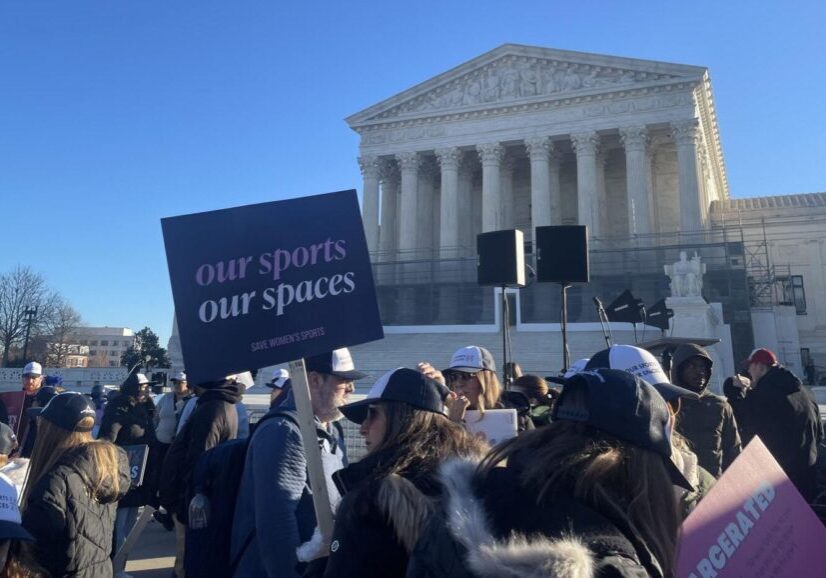
Title IX central to transgender sports cases, advocates say
The U.S. Supreme Court heard arguments in two cases on transgender athletes participating in girls’ and women’s sports. Advocates for state laws banning transgender participation said the definition of “sex” under Title IX will be central to a favorable ruling from the court.
Little v. Hecox and B.P.J. v. West Virginia dealt with whether preventing transgender athletes from competing in girls’ and women’s sports violated Title IX, a federal law prohibiting sex discrimination.
Kim Hermann, president of the Southeastern Legal Foundation, said she hopes the court will provide a clear definition of sex in its opinion. She said Title IX explicitly defines sex but changes from the Biden administration included gender identity into its protections.
“Sex means a man or a woman. It means biological sex. It does not mean gender identity,” Hermann told The Center Square. “It is not a subjective standard; it does not depend on how much testosterone somebody has in their body.”
Hermann is a mother to two children. She is afraid of her children competing against transgender athletes in sports.
“If we showed up to a softball game and there was a biological boy on a team that my daughter was playing against, she would not be playing that game,” Hermann said.
Sarah Parshall Perry, vice president of Defending Education, said the Biden administration’s inclusion of gender identity and transgender status within Title IX made it necessary to have litigation on this issue at the Supreme Court.
“The federal government was perhaps not going to apply and enforce Title IX in a way to protect biological girls,” Parshall Perry said. “State legislators decided they were going to actually step into the fray and legislate in such a way as to do just that.”
In the oral arguments, Justice Samuel Alito questioned Kathleen Hartnett, a lawyer representing the American Civil Liberties Union, over the definition of sex. Hartnett was unable to provide a definition.
Parshall Perry pointed to the exchange as an area where justices on the court appeared willing to uphold state laws banning transgender athletes’ participation in women’s sports.
“For at least purposes of equal protection clause jurisprudence at the Supreme Court, sex has always meant men and women,” Parshall Perry said.
A particular argument advocates closely monitored came from the distinction between Title IX, the federal law preventing sex discrimination, and Title VII, a federal law preventing employment discrimination based on race, sex, religion, color and national origin.
In Bostock v. Clayton County, the Supreme Court defined “sex” under Title VII to include sexual orientation and gender identity. However, advocates for Title IX said the definition does not apply in the same way as Title VII.
“The language in Title IX is different than the language in Title VII; they’re not identical,” Hermann said. “Categorically, they are two different statutes, and Bostock does not apply here. I do think the court is going to have to make that clear, once again, in their opinion.”
While both advocates predicted a 6-3 decision in favor of state bans, they said language from the Biden administration that expanded Title IX protections to transgender individuals still causes problems. Parshall Perry said she would like to see the U.S. Department of Education rescind the Biden administration’s rule and get rid of gender identity from Title IX protections.
“We’re going to be fighting these battles continuously because what we’re seeing in states like Maine or California is they are either relying on faulty interpretations that are still unfortunately actively in the federal register or they’re relying on contrary state law,” Parshall Perry said.






Chance Showers And Thunderstorms
Latest News Stories

As Illinois ends grocery tax locals can replace, food inflation debate continues
North Carolina NYE terror attack foiled by FBI, several police departments

Beecher bids farewell to Chief Lemming following retirement
DeWine defends fraud safeguards at Ohio child care facilities

Illinois quick hits: State keeps more tax revenue, locals get less

Beecher Library Board Approves Annual Financial Report and CD Renewal
U.S. House vote on employee bargaining met with ‘political theater’ criticism

Hog producer: 2025 was strong, but IL legislature needs to address estate tax

Trump to remove National Guard members from Chicago, LA, Portland
Illinois’ compact fluorescent bulb ban begins to take effect

Illinois quick hits: SBA sues Chicago over online betting tax

Illinois Congressman: Millions face higher premiums despite GOP health bill