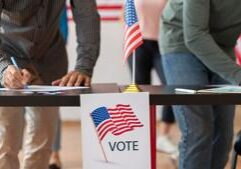
Election security takes center stage as GOP lawmakers push three reform bills
Ahead of the 2026 midterm elections, Republicans in Congress are pushing forward multiple bills that would standardize election security requirements nationwide.
All three pieces of legislation being considered – the SAVE Act, the SAVE America Act, and the MEGA Act – would mandate that states require photo ID and verify the citizenship status of potential voters.
“I think we can trust the outcome of the election, but what I will tell you is that there is still a great concern that in certain pockets of the country, that there’s not strict enforcement of the laws,” U.S. House Speaker Mike Johnson, R-La., told reporters Tuesday.
He praised the SAVE America Act, a bill mirroring the House-passed SAVE Act which requires Americans to present proof of citizenship when registering to vote, necessitate in-person voter registration for federal elections, and require states to remove all noncitizens from their voter rolls.
Since the Senate still hasn’t taken up the SAVE Act after 300 days – despite Republican pressure to do so – House members will vote on the SAVE America Act on Wednesday. The bills are identical except that the latter would also require people to display a valid ID to vote in federal elections.
With valid ID necessary for everything from applying for a job to renting a hotel room, the legislation is “common sense,” Johnson argued.
“There’s only one logical reason that Democrats are opposed to this – they want the people to participate in elections who are not supposed to,” he added. “So the fact that they’re so vehemently opposing this is very telling about their agenda and their motivation.”
Rep. Bryan Steil, R-Wis., made similar arguments during a congressional hearing Tuesday centering around the MEGA Act, which he sponsored.
The bill includes the same requirements as the two others but also prohibits ranked choice voting, ends universal voting by mail, and requires mail-in ballots to be received by the close of polls on election day to be counted.
“The commonsense reforms House Republicans are proposing today will ensure it remains easy to vote, but hard to cheat,” Steil said during the hearing. “Elections should end on Election Day. You need a photo ID to cast a ballot. You must be a citizen to vote. You need an auditable paper trail. And you shouldn’t mail a ballot to people that don’t request them.”
Democrats have labeled every bill as vehicles of voter suppression, saying that federal law already prohibits noncitizens from voting and the bills would simply make it harder for veterans, the disabled, minorities, and women who change their last names to register to vote.
Under the bills, people would not be able to register to vote with only their driver’s license, since noncitizens can obtain that. They must instead present documents proving U.S. citizenship, such as a birth certificate or U.S. passport, which some Americans might not have.
“Let’s be clear up front: This is not about protecting our elections. Republicans aren’t truly afraid of non-citizens voting — which we all know is already illegal, already grounds for deportation. They’re afraid of women voting,” Democratic Whip Katherine Clark, D-Mass., said Tuesday. “They are trying to place more red tape, more paperwork, more bureaucracy between women and the ballot box.”





Mostly Sunny then Showers And Thunderstorms Likely
Latest News Stories

Johnson’s Solo Homer, Combined Shutout Lift Beecher Past Wilmington 4-0

13-Run Second Inning Propels Beecher Past Illinois Lutheran 15-0

Illinois Quick Hits: State gaming board renew Rockford casino license

Arizona GOP pushes to protect Colorado River’s limited water
Republicans challenge Clyde in Georgia’s 9th District

Fort Bragg soldier’s case continues Tuesday in New York
Justice Department drops Federal Reserve probe, kicks to watchdog

Pritzker: ‘Need for speed’ for megaprojects bill with tax breaks

NYC schools probed over claims of antisemitism

Illinois Quick Hits: AFP says tax breaks would be more at Soldier Field

Soldier’s insider trading case puts prediction markets to the test

U.S. will continue blockade ‘as long as it takes,’ Hegseth says