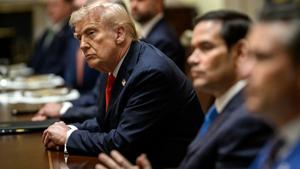
Taxpayer group urges Trump, Congress to confront rising federal debt
A national taxpayer advocacy group is calling on President Donald Trump and Congress to address the nation’s rising debt, warning that interest payments and long-term spending commitments are putting increasing pressure on the federal budget.
The warning comes after the Congressional Budget Office projected that federal debt held by the public will reach 120% of gross domestic product by 2036. The CBO estimates the federal government will borrow $26 trillion between late 2025 and 2036, pushing public debt to $56 trillion.
Debt currently stands at roughly 101% of GDP and is projected to climb steadily over the next decade.
National Taxpayers Union President Pete Sepp said in a Friday state that the growing debt burden is already hurting Americans.
“Paying for past borrowing is already increasing the cost of living for Americans today,” Sepp said. “The problem compounds by the day. Congress and the President must act to address these structural spending problems before mid-term elections this year.”
As debt rises, so do interest payments. The CBO has warned that higher debt levels increase the risk of fiscal problems and could limit lawmakers’ ability to respond to emergencies or economic downturns. Larger debt loads can also drive up borrowing costs if investors demand higher interest rates.
The CBO report noted that debt measured against the size of the economy would be the highest in American history and more than double the 50-year average of 51% of GDP.
Demographic trends may also add to the pressure. As Baby Boomers continue to retire, the number of Social Security beneficiaries is increasing, along with federal health care spending. Meanwhile, economic forecasts only project modest growth.
Sepp said the core problem is long-term structural imbalance.
“The challenge is not temporary spending spikes or short-term economic conditions,” Sepp said. “The yawning mismatch between long-term commitments and the resources available to finance them grows wider every year. The time to act is now.”
National Taxpayers Union pointed to its recent poll conducted by Public Opinion Strategies that found that 89% of registered voters think the country faces an affordability crisis. “The survey also found that 88% believe the $37 trillion national debt will eventually impact them and their families. When asked how to reduce the debt, 54% favored cutting government spending,” NTU said.
“Americans await leadership to identify real and salient solutions to these spending problems,” Sepp said. “They know we cannot afford to keep racking up debt on the nation’s credit card while making interest-only payments anymore.”
Economists and budget analysts have debated how much debt the economy can sustain. Some estimates have suggested risk increases as debt approaches 160% to 200% of GDP. However, the exact tipping point remains uncertain.
Even so, federal projections show continued growth in deficits and debt over the coming decade, increasing pressure on lawmakers to decide whether spending cuts, tax increases, or other fiscal reforms are necessary to stabilize the country’s finances.




Sunny
Latest News Stories

Administration presses law school accreditor over DEI policies
Speaker’s response to staffer assault complaint draws questions on his own conduct
Republicans’ $95B budget resolution passes House

$1.15T Pentagon funding authorization bill passes U.S. House
Lawmakers debate GLP-1 regulation, expansion
Illinois news in brief: Ex-Big Ten Network staffer gets 2 years in embezzlement case

New quantum tenant gets $1.8 million in tax credits

Proposal would term-limit Supreme Court justices without amendment

Pritzker says felon was unlucky to land in his back yard

Chicago council approves ballot question to recoup costs from ICE operations

Anti-ICE ‘extremist’ charged with arson in attack outside NYC federal building

World Cup events safe; terrorism, antisemitism concerns don’t materialize