
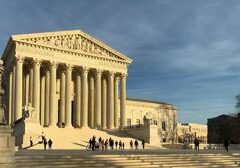
Trump makes history at Supreme Court amid landmark birthright citizenship challenge
President Donald Trump made history Wednesday by attending oral arguments at the U.S. Supreme Court over his executive order seeking to end birthright citizenship, spotlighting a pivotal legal battle with far-reaching implications.
Trump has been urging the Supreme Court to rule in his favor on several key issues. After the court ruled against him on tariffs in February, the citizenship case moved to the forefront. During oral arguments, the president stayed for only part of the session, leaving the courtroom for the White House as an American Civil Liberties Union attorney presented the case against his order.
Trump, a second-term Republican, arrived in a secure convoy. Police blocked off access for non-Supreme Court personnel and redirected traffic, while photographers waited outside the area.
Around 9:40 a.m., police vehicles led Trump’s convoy to the Supreme Court, followed by several black vehicles, armored police vehicles, and an ambulance. Security was heightened as military personnel arrived and vehicles remained at the scene.
Trump left the court about 15 minutes after a lawyer for the American Civil Liberties Union presented the case against Trump’s executive order. On the drive back, tourists responded with gestures of support and opposition to the president. Trump arrived back at the White House at 11:30 a.m.
The birthright citizenship case, Trump v. Barbara, challenges Trump’s first-day executive order denying birthright citizenship to children born in the U.S. after Feb. 19, 2025, whose parents are either illegally in the country or are temporary residents. The central legal question is whether the president’s order violates or reinterprets the 14th Amendment’s guarantee of citizenship to those born in the United States.
The challenge centers on whether the executive order is consistent with the 14th Amendment, which conferred citizenship and voting rights to freed African Americans after the Civil War. Plaintiffs argue the order conflicts with whatr has been interpreted as a constitutional guarantee.
The 14th Amendment reads: “All persons born or naturalized in the United States, and subject to the jurisdiction thereof, are citizens of the United States and of the State wherein they reside.” The case could hinge on the meaning of five words: “subject to the jurisdiction thereof.”
This case directly challenges the president’s authority to alter citizenship policy by executive order, and its outcome could reshape immigration policy, citizenship definitions, and broader U.S. policy.
The Supreme Court is expected to decide the case before the end of its term this summer.



Showers And Thunderstorms Likely
Latest News Stories
Evers, Grisham fly to Brazil for climate change summit as government remains shut down

Upcoming mass flight cancellations worry U.S. air travelers

Pritzker watching redistricting debate as GOP grapples with filibuster
Trump administration finds SNAP fraud

WATCH: Trump says tariffs may cost Americans ‘something’ but keep U.S. safe

Chicago mayor: IL legislature has ‘more work to do’ on tax increases

Commission Grants Green Garden Solar Farm Project Variance Extension

Chicago pension, debt services costs among highest in country

WATCH: DCFS still looking for missing children numbers; Pritzker on elections results
Illinois quick hits: DHS ordered to address ICE facility conditions; Garcia explains retirement decision
Congressional Perks: Luxury cars and mileage result in big costs for taxpayers

Illinois quick hits: $20 million for Alton housing project; alleged migrant assaults reported
WATCH: Illinois DCFS can’t locate documents showing number of missing children
Will County Committee Advances Phased Takeover of Central Will Dial-A-Ride Service
