Groups react to HHS, EPA flagging microplastics for further study
The Environmental Protection Agency designated microplastics and pharmaceuticals as priority contaminant groups Thursday.
The decision prompted diverse reactions from affected industries, health, and environmental advocacy organizations.
The EPA released its draft Sixth Contaminant Candidate List for public comment, which now includes these substance groups as potential drinking water contaminants for the first time in the program’s history.
The Contaminant Candidate List is part of the Safe Water Drinking Act, which gave the government the authority to ensure the safety of public drinking water.
Substances on the list are not currently subject to regulation but are known or anticipated to exist in public drinking water. If a substance makes it onto the final list (beyond the draft), the government is mandated to make a regulatory determination – to decide whether the substance is worth regulating or not – for at least five of the substances on that list.
In addition to the designation, Health and Human Services is launching a $144 million research initiative into microplastics and their effects on human health.
Some environmental groups called the developments a step in the right direction, while also saying they didn’t go far enough.
The Plastic Pollution Coalition, which attended Thursday’s announcement, welcomed the government’s involvement in the issue but hoped for more.
“We appreciate the investment in more research about how microplastics affect our bodies and our health, but we already know enough to act,” said Jen Fela, the coalition’s managing director, in a statement. “We need strong regulatory solutions and innovation to reduce and eliminate these plastics now.”
The group recommended adding microplastics to the Unregulated Contaminant Monitoring Rule, establishing a nationwide data-collection effort to inform regulation.
Beyond Plastics, a group aiming to “end plastic pollution everywhere,” released a similar statement that also mentioned the rule.
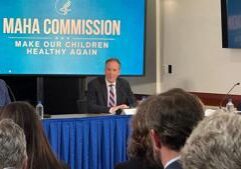
The coalition’s statement directly countered HHS Sec. Robert F. Kennedy, Jr.’s remarks Thursday, where he suggested the data wasn’t yet concrete enough for the government to draw precise conclusions about how to act.
Though citing studies that have claimed to detect a “spoonful of plastic in every human brain” and show a correlation between the presence of microplastics in the body and some dramatically elevated health risks, Kennedy said there wasn’t yet enough evidence for strong solutions.
“We cannot reliably quantify total microplastic burden in individuals, and we can’t distinguish which particle sizes, shapes, components or polymers drive the worst toxicity. We do not yet understand how these particles interact with the immune system, the endocrine system or the neurological system, and we do not have validated methods to remove them safely,” Kennedy said.
Others who were part of the announcement have spent their careers studying the presence of microplastics in oceans and the human body, and have shared similarly jarring observations to Kennedy’s “spoonful” reference.
Marcus Eriksen, cofounder of the 5 Gyres Institute, a non-profit that provides plastic pollution research to the United Nations, said that the institute is working to study the impacts of nanoplastics, particles even smaller than microplastics.
“Now we estimate that there are more nanoplastics among us than there are grains of sand on the beach or stars in the sky combined,” Eriksen said.
Leonardo Trasande, director of the NYU Grossman School of Medicine Center for the investigation of environmental hazards, said that micro- and nanoplastics are part of an “urgent and multi-dimensional threat to human health.”
“There are 16,000 chemicals in plastic. We know nothing about 10,000 and we know so much about a small number of chemicals that tells us frightening details,” Trasande said.
HHS’ new nationwide program is called STOMP for Systematic Targeting of Microplastics and the hope is that it will enable research that will “measure, understand and remove microplastics from the human body,” according to Kennedy.
“STOMP will do in five years what the entire field has been unable to do for decades,” said Alicia Jackson, director of the Advanced Research Projects Agency for Health, an agency within HHS.
Jackson stressed the importance of making STOMP’s findings accessible to all Americans and promised it would build a clinical test “under 15 minutes and under $50” for people to measure their microplastic burdens.
The Plastics Pollution Coalition said, however, that in order to be “truly effective,” the administration’s response to the issue must also include “actions that curb plastic production.”
“Scientists have known for decades that plastic is a material that never breaks down or benignly biodegrades,” it said in a press release. “This crisis demands immediate policy action.”
The American Public Health Association, though frequently at odds with both Kennedy’s HHS and Zeldin’s EPA, shared a short but supportive statement with The Center Square Thursday.
“Ensuring the safety of the water supply is a core public health responsibility. We are pleased to see the administration paying more attention to microplastics in particular,” said Georges Benjamin, the association’s CEO.
The Consumer Brands Association, a group that represents the consumer packaged goods industry, issued a measured response, emphasizing its support for science-based federal initiatives while highlighting the safety standards already in place for consumer products.
“Consumer packaged goods manufacturers are held to rigorous safety standards and oversight that help ensure the essential, everyday products they produce are safe for consumers,” said Laura Rich, vice president of regulatory and technical affairs, in a statement to The Center Square. “We support continued strong, science-based federal initiatives and are committed to partnering with the administration to advance policies grounded in sound science.”






Showers And Thunderstorms Likely
Latest News Stories

Here’s how to get the $20 credit offered by YouTube TV in Disney dispute

Democrats want call program for immigrant detainees

Flight troubles not likely to end when shutdown does

Trump admin signals support for Paramount bid as Warner Bros. considers sale

WATCH: Trump says Veterans Day is ‘Victory Day’

Lawmakers divided after federal complaint targets student mental health screening law
Cruz, Cornyn file bill to make federal benefit fraud a deportable offense

DHS, USCIS report record job applications under Trump administration

Virginia Beach, Chesapeake rank among best cities for veterans

Normal, IL fire and EMS challenges highlight need for statewide task force

Analysis: Chicago among worst cities to drive in

Meeting Summary and Briefs: Will County Public Works & Transportation Committee for November 2025