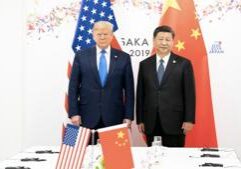
One year later, analysts say strategic trade preferred over tariffs
Analysts and trade experts are calling for the United States to move away from wide-ranging tariffs and embrace strategic trade relationships to counter global adversaries.
The analysts spoke at the American Institute for Economic Research in Washington, D.C., one year after President Donald Trump instituted his “Liberation Day” tariffs in April 2025. The U.S. Supreme Court struck down the president’s authority to institute broad tariffs against other nations in February.
Speakers at the conference said allowing private companies to develop in a free market will advance opportunities for those industries. They argued the Trump administration’s broad tariff policies do not enable a competitive, free market.
“When you allow industry to develop in a free market, you get the best processes, the best ideas,” said Donald Boudreaux, an economics professor at George Mason University. “Those cutting-edge ideas, those cutting-edge technologies are almost certainly going to be handy in the event of military hostilities.”
Boudreaux pointed to the U.S. conflict in Iran. He said the U.S. will not be able to achieve its goals in Iran by sheer force of will or trading capabilities.
Boudreaux was joined by Erik Gartzke, a professor of political science at the University of San Diego. The two argued that China has exploited the United States’ openness and free market system of trade.
They criticized President Donald Trump’s wide-ranging tariffs and said it was not a viable strategy to optimize strategic competition against China. Gartzke said the use of wide-ranging tariffs could sacrifice the United States’ relationships with other allies who could help defend against Chinese threats.
“We’ve stumbled badly by losing sight of the ball and losing an initiative in the game,” Gartzke said. “Now the Chinese can point to the fact that we put tariffs on everything.”
While embracing a free trade mindset that avoids tariffs on allied nations, some analysts warned against threats to national security that could come from trading too freely with adversaries. Theresa Campobasso, senior vice president of Supply Chain Security at Aardwolf Global Solutions, said the United States needs to scrutinize what it trades with adversarial nations, like China.
She said ideal supply chain regulation limits trade when absolutely necessary for national security and takes a very targeted approach.
“A serious framework requires a documented threat mechanism that’s scoped assessment of exposure, a defined intervention matched appropriately to that scope, and then the measurable definition of success,” Campobasso said.
However, Veronique de Rugy, senior research fellow at the Mercatus Center, cautioned against overregulation for the sake of protecting national security. She said the private sector should be trusted to engage in proper security controls among foreign nations.
“It seems that actually any impediment to the private sector and to the American economy is treated as a national security threat and that’s just problematic,” de Rugy said.
The analysts called on developing a national framework to approach security across the country.
“We can come up with a very sound way to define a framework for national security that will be required to decide whether policy is truly worth the cost to trade,” de Rugy said.
The analysts warned against continued tariff costs. Boudreaux said America would become less wealthy and more vulnerable to foreign threats if it does not engage in trade with its allies.
“By misallocating resources over time, the economy becomes less efficient,” Boudreaux said. “There is unquestionably a positive connection between the wealth of the nation and the ability of that nation’s government to supply adequate national defense.”




Mostly Sunny then Showers And Thunderstorms Likely
Latest News Stories

Soldier’s insider trading case puts prediction markets to the test
U.S. will continue blockade ‘as long as it takes,’ Hegseth says

Village Board Approves Zoning Variance for 747 Penfield Street

Will County Takes Jurisdiction of Countyline Road in $1.84 Million Agreement with Kankakee County

Green Garden Township’s Wildflower Farm Granted Third Special Use Extension

Gori seeks quick end to asbestos fraud, lawsuit ‘bounties’ case

Texas Ten Commandments law may reach Supreme Court

Feds reopen probe into LAUSD race-based program
Trump won’t be rushed on Iran as clock ticking for the regime

Multiple House Republicans defy proposed 3-year FISA Section 702 extension
Fetterman wants SNAP to cover hot rotisserie chicken

Advocates warn of looming debt crisis