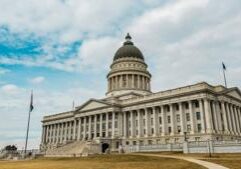
Rich States Poor States: Tax policy largely determines states’ economic competitiveness
No matter what a state offers in terms of natural beauty, work and social opportunities, tax and economic policy — as unglamorous as they sound — will play a role in the state’s attractiveness and success over time, the authors of Rich States, Poor States say.
That’s why Utah, a state perhaps recognized for its natural beauty but known more for its large religious population, has ranked first every year in the American Legislative Exchange Council report evaluating states’ economic competitiveness. It’s also why “flyover states” like Arkansas, Indiana and Oklahoma rank in the top 10 for economic outlook, while states like California, Hawaii, Illinois and New York, despite their stunning vistas or metropolitan attractions, rank in the bottom 10.
Rich States, Poor States ranks states for economic outlook based on 15 economic policy variables, like personal income tax rate, corporate tax rate, property tax, sales tax and state minimum wage. It’s Utah’s continuous improvement across these 15 policy areas that has enabled it to stay at the top in the report’s 19th edition, released Wednesday.
“Utah doesn’t rank badly in any of the 15 variables. Until recently, it was actually above 25 (above the median) on every single one,” Joshua Meyer, director of ALEC’s tax and fiscal policy task force, told The Center Square. “The total state and local sales tax burden has been rising and is now 38th, but the state is 22nd or better on the other 14 variables.”
Utah ranked first for its state minimum wage of $7.25 per hour, which along with other states like Georgia and Wyoming, is the lowest in the country. Though a low minimum wage means a lower baseline pay for more low-wage hourly-paid positions, it also means lower labor costs for employers. It also has a relatively low corporate income tax, public employee population and tax burden overall (after considering property and sales tax).
Arkansas made the top 10 last year for the first time and moved up to sixth from 23rd just five years ago.
“Rich States, Poor States did not find Arkansas to be very competitive for much of the report’s history,” Meyer said, but it “has improved across many variables.”
A core idea behind Rich States, Poor States is that a state’s key economic and tax policies play a real role in its attractiveness as a place to live and raise a family. More people will either move there for a job or choose to move there because of the quality of life they believe is possible for them there. This plays out with Arkansas, according to Meyer.
“The state saw net outmigration as recently as 2015, but has seen net in-migration of more than 80,000 just from July 2020 to July 2025,” Meyer said. “So Arkansas isn’t on the level of Texas or Florida or North Carolina, where many tens of thousands move in on net each year, but people and businesses do seem to be validating the policy direction identified in Rich States, Poor States.”
Meyer also explained why Indiana remained in the top 10 this year, placing seventh.
“When you compare Indiana to, say, Michigan, Illinois, Ohio, Iowa, and Ohio, its economy seems to be the best at delivering for workers,” Meyer said.
Indiana also earned a No. 1 ranking for its minimum wage, which is also $7.25. It’s a right-to-work state, meaning employees can’t be required to join a union or pay union dues as a condition of employment, and it doesn’t utilize an estate or inheritance tax. It also has a relatively low public employee population and property tax burden, among other policy strengths.
“The state has seen net in-migration over the last eight years or so,” Meyer said. “And while that doesn’t sound like much for a top-10 state, it is exceptional when compared to other states in the region. There are a couple that have seen post-COVID in-migration, but Indiana has seen more in-migration and for longer.”
One of the report’s authors is Art Laffer, an economic adviser to former President Ronald Reagan and a primary architect of “Reaganomics.” Laffer is known for saying that people “vote with their feet,” meaning that Americans’ movements are as much — if not more — a reflection of state and local policy as their choices at the ballot box.
Other states that landed in the top ten were Tennessee, Idaho, North Carolina, Arizona, Oklahoma, South Dakota and Florida.
California, Connecticut, Hawaii, Illinois, Maine, Maryland, New Jersey, New York, Rhode Island and Vermont finished in the bottom 10.






Mostly Sunny then Showers And Thunderstorms Likely
Latest News Stories

World’s largest retailer struggles to keep costs down as tariffs hit

Boston judge orders Trump to give back Harvard funding

Arizona congressman backs bill protecting ICE agents

Northwestern president steps down amid federal funding cuts

Feds sue Southern California Edison over Eaton, Fairview fires

WATCH: Trump renames DOD to ‘Department of War’
Push to ban stock trading by Congress follows IL rep’s reported violations

Federal judge strikes down New Hampshire’s DEI ban

Illinois quick hits: Giannoulias orders village to stop sharing data with CBP

CA, Delaware attorneys general concerned about OpenAI

New York AG to appeal ruling tossing Trump’s $454M civil fraud penalty

Chevron petitons Supreme Court to move lawsuits to federal court

Business leaders eye immigration reform