
Pritzker: ‘Need for speed’ for megaprojects bill with tax breaks
(The Center Square) – Gov. J.B. Pritzker says there is a need for speed when it comes to the Chicago Bears and megaprojects legislation that provides tax breaks for the National Football League team.
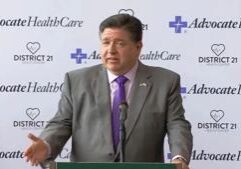
The governor spoke at Northwestern University in Evanston on Friday and was asked about the team wanting changes to House Bill 910.
The megaprojects bill is now in the state Senate after clearing the Illinois House last week.
“I can tell you that there is a need for speed here. We need to move somewhat expeditiously. I realize the Senate has some to work to do and there will be amendments, no doubt about it,” Pritzker said.
HB 910 provides tax incentives for the Chicago Bears and other megaprojects worth $100 million or more.
When asked by a reporter if speed might come at the expense of taxpayers, Pritzker said the Bears have been talking to lawmakers for two years.
“We’re not talking about speed here, or it shouldn’t be a discussion about speed. I think now you’ve got a bill that probably has too many items associated with it or at least some of them that need amending,” Pritzker said.
The governor was asked if he felt pressure with the NFL scheduled to discuss the Bears stadium situation at a meeting next week.
Pritzker said it’s not as if Indiana will be chosen just because Illinois doesn’t have a bill.
“Having said that, if there is not true progress that gets made, if it isn’t obvious to people that the Senate is moving in the right direction, I think that will make it challenging,” Pritzker said.
‘Field of Schemes’ co-author Neil deMause said leagues and commissioners don’t hold guns to the heads of the owners who employ them.
“If (Bears chairman) George McCaskey and the Bears ownership want to punt everything for a year because they think they can get a better deal next year, I have no doubt that the NFL will say, OK fine, let’s go ahead and do that,” deMause told The Center Square.
According to deMause, it’s standard practice for teams to set arbitrary deadlines.
Americans for Prosperity Illinois estimated that the property tax break for the Bears’ $5 billion development in Arlington Heights could reach $330 million per year.
For the proposed $20 billion One Central Development near Soldier Field in Chicago, the property tax break could be $800 million per year.
In both cases and with other megaprojects that qualify under House Bill 910, AFP Illinois said all of that money could be shifted to other taxpayers in surrounding communities.
Pritzker was also asked about the Bears’ push for infrastructure funding from the state and said the team’s request remained around $800 million.
The governor said the infrastructure projects would happen anyway for Arlington Heights and surrounding communities.
“I don’t want to overload this and make it sound like the Bears are the ones demanding all this,” Pritzker said.
Pritzker closed the question-and-answer session by reiterating his earlier statements that the number one question is what’s best for taxpayers.
Jon Styf contributed to this story.



Mostly Sunny then Showers And Thunderstorms Likely
Latest News Stories

Supreme Court affirms court authority in discrimination suit

Illinois ranks 46th out of 50 states for financial transparency

Solutions differ for Chicago Public Schools’ potential $1B deficit

U.S. Supreme Court rules against trucking industry
Exclusive: AGO speculated WA Supreme Court might ‘punt’ on millionaire’s tax

Illinois Quick Hits: Dems look at Chicago for national conventions
Paramount-Warner merger could create 40,000 jobs, report says

Powell secures Democrat nomination in key swing district

Canadian border crimes: Multi-million grandparent, crypto scam; human smuggling
Zinc Leaching and Flooding Concerns Dominate Testimony at Will County Solar Hearing

Meeting Summary and Briefs: Will County Board Special Planning and Zoning Commission for May 12, 2026

Access Will County Dial-A-Ride Reports Massive Growth After Consolidating Paratransit Services
Trade, Taiwan top priorities for Trump, Xi as two leaders wrap first meeting

Critics question unions after $1B in political spending