Constitutional tests await IL Dems’ race-based district plan
Later this fall, Illinois voters appear likely to get the chance to vote on a plan to rewrite the state constitution to explicitly force those who draw legislative districts to take voters’ race into consideration and ensure the creation of “majority minority” congressional and state legislative districts.
However, even if the measure should pass, it would likely need to survive swift and strong legal challenges which would likely argue Illinois Democrats can’t use the state constitution to sidestep the U.S. Constitution’s prohibition on so-called racial gerrymandering.
On April 22, Democrats in the supermajority in the Illinois State House of Representatives advanced on a party line vote the proposed constitutional amendment, currently docketed as House Joint Resolution Constitutional Amendment 28 (HJRCA 28).
As written, the measure would amend the Illinois state constitution to add new race-based criteria to the rules that must be considered by lawmakers and their designated mapmakers when drawing new representative districts every 10 years.
Currently, the Illinois state constitution only requires districts meet three criteria: That the districts be equal in population; that they be contiguous; and that they be “compact.”
However, under HJRCA 28, the rules would be revised to require districts to be drawn to “ensure that no citizen is denied an equal opportunity to participate in the political process and to elect representatives of his or her choice on account of race” and “to create, where practical, racial coalition or influence Districts.”
“Racial coalition or influence districts” are congressional or state legislative districts in which a certain racial minority may not necessarily make up a majority of the population in the district, but still are present in sufficient numbers to elect a representative of their particular race, should voters of that particular race decide to do so.
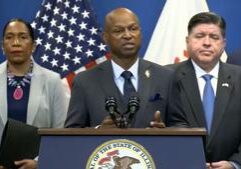
HJRCA 28 was introduced by Illinois’ powerful House Speaker Emanuel “Chris” Welch, a Democrat whose district includes portions of Chicago’s western Cook County suburbs. The measure, which Welch has dubbed the measure the “Illinois Voting Rights Act,” has quickly amassed support of many other powerful progressive state lawmakers, who have joined their name as co-sponsors of the proposed amendment.
Welch, who is black, has said the measure is needed at this time to enshrine in the state constitution racial districting considerations currently considered to be required under the federal Voting Rights Act (VRA).
For decades, Illinois Democrats, in particular, have used that legal provision, known as VRA Section 2, to justify the state’s controversial congressional and state legislative district maps. They have argued that the bizarre shapes of Illinois’ legislative districts are the result of the need to abide by Section 2’s language prohibiting drawing federal or state districts which “results in a denial or abridgement of the right of any citizen of the United States to vote on account of race or color.”
That provision has been interpreted by courts to also protect racial minorities, but primarily black and Latino Americans, against so-called “vote dilution,” or state congressional and legislative districts drawn in a way to dilute the ability of black, Latino and other racial minorities to elect a non-white representative of their choice.
In coming days or weeks, however, the U.S. Supreme Court appears poised to upend that interpretation of Section 2.
Last fall, the high court heard arguments in a case challenging the congressional map in the state of Louisiana. Specifically, challengers assert a district map unconstitutionally created two majority black congressional districts. Supporters of the map have argued those majority black districts are needed to comply with Section 2 of the VRA. Opponents, however, say they violate the 14th Amendment by explicitly making the race of potential voters the deciding factor in how the districts were drawn.
Observers of the court’s proceedings have predicted the Supreme Court’s conservative majority is almost certain to craft a decision reducing the reach of Section 2 and the ability of mapmakers to cite “vote dilution” to justify potential racial gerrymandering. The court could potentially declare the entire provision to be unconstitutional violations of the 14th Amendment’s right to equal protection under the law.
Welch has said Illinois’ HJRCA 28 is being advanced specifically to respond to the court’s expected decision which he asserted would result in the “gutting” of the VRA.
“We’re not going to let that go away,” Welch said in remarks delivered in Springfield concerning HJCRA 28. “Illinois has never hesitated when our most cherished rights are at risk and we will not stand by and accept this affront to our democracy.
The amendment, he said “will ensure Illinois will always recognize the fundamental principle that government of the people, by the people, and for the people must include all the people.”
Welch’s statements are in line with the official position of the Democrat-dominated Illinois state government. At the Supreme Court, for instance, Illinois Attorney General Kwame Raoul signed onto a brief supporting the Louisiana map and urging the Supreme Court to not strike down Section 2 of the VRA.
But the confidence by Welch and other state lawmakers in the state’s ability to use the state constitution to negate a ruling by the U.S. Supreme Court may be misplaced, say observers engaged in practicing and studying constitutional law.
Jason Mazzone, a professor specializing in constitutional law at the University of Illinois at Urbana-Champaign College of Law, said supporters of HJCRA 28 are apparently overlooking a key constitutional principle under America’s federalist system:
“State constitutions cannot authorize or require state governments to do something that the federal constitution (or any other federal law) forbids,” Mazzone said, in an emailed response to questions from The Record about the proposed state constitutional amendment.
Mazzone noted courts have repeatedly agreed that states can amend their state constitutions to “protect rights more strongly” than the U.S. Constitution. He noted, for instance, that Illinois and other states have found firm constitutional footing in enacting provisions to defend abortion rights after the U.S. Supreme Court overturned Roe v Wade and declared the U.S. Constitution doesn’t block states from regulating or outlawing abortion.
“But the converse is not true,” Mazzone said.
Mazzone noted the U.S. Supreme Court has not yet ruled in the Louisiana case, and no one outside the court can truly predict the outcome until it is revealed in coming days.
“But if the Court swings big and rules that the Fourteenth and Fifteenth Amendments prohibit the drawing of district lines so as to safeguard or enhance the voting power of members of racial minority groups, states cannot avoid the ruling by amending their own state constitutions—anymore than states in 1954 could have preserved in their state constitutions racially segregated schooling after Brown v. Board of Education,” Mazzone said.
That opinion was shared by Chris Keiser, an attorney with the nonprofit constitutional legal advocacy organization, the Pacific Legal Foundation. Keiser was the primary signatory on a legal brief submitted to the Supreme Court by the Pacific Legal Foundation in support of the challengers in the Louisiana VRA case.
Keiser said he would expect a swift legal challenge to any attempt by Illinois to enshrine race-based districting criteria in the state constitution, even if Section 2 survives Supreme Court scrutiny.
Keiser noted drawing legislative districts on the basis of race has never been explicitly permitted under either the VRA or the U.S. Constitution. However, he said states like Illinois have long sidestepped the general prohibition on “racial gerrymandering” by asserting they needed to take race into consideration to comply with Section 2 of the VRA.
He said Section 2 has essentially served as a “safe harbor for states.”
Essentially, Illinois and others have been allowed to use the race of voters to draw districts, so long as race was just one of the factors used, and not the predominant factor guiding the making of the map.
But if the Louisiana case goes the way Keiser and the challengers hope, that “safe harbor” will be removed and it will become more difficult for states to justify race-based districting, and particularly the intentional creation of “majority minority” or “coalition” or “influence” districts designed to increase the odds that people of a particular race are elected.
And Keiser said he reads the proposed new criteria laid out in HJCRA 28 as going further than even Section 2 of the VRA, essentially seeking to almost guarantee voters who are black, Latino and other minority races the right to be represented by someone of a certain race, a right that courts have never recognized.
“There’s a good argument that this kind of thing isn’t something Illinois can do now,” Keiser said. “But to this point, states have been able to say they had a compelling interest in complying with the VRA.
“But if that’s taken away, states certainly can’t say they have a compelling interest in complying with their own state constitution” if the state constitution conflicts with the U.S. Constitution, he said.
The Record submitted questions to Welch and the Illinois House Democrats about how and why the Speaker and his fellow Democrats believe the state constitutional amendment could withstand constitutional scrutiny, particularly if the Supreme Court strikes down Section 2.
Spokespeople for Welch and the Illinois House Democrats did not respond to those questions.
HJRCA 28 still must secure approval from a three-fifths supermajority in the Illinois State Senate before advancing to the November statewide ballot. The measure has not yet received a hearing or a vote in that house of the Illinois General Assembly.
Once on the ballot, constitutional amendments must receive approval from 60% of those voting on the question or a majority of those who cast a ballot for any office in that election.
The measure does not need to be signed by Gov. JB Pritzker.



Showers And Thunderstorms Likely
Latest News Stories

Judge sets up high stakes baby formula NEC trial vs Mead Johnson

Trade court to rule on tariff stay by next week

FeaturingBeecher Village Board Adopts FY26/27 Budget Police Expansion and Drone Program

Johnson defends Trump ballroom as ‘a donation to the country’

Vance cuts $1.3 billion in California Medicaid, pauses hospice care
Groups urge House leaders to reject E15 expansion, calling it a hidden tax

Illinois Quick Hits: Home insurance regulations approved by Illinois Senate

Beecher Rallies for Come-From-Behind Win Over Momence

Beecher Cruises to 7-1 Victory Over Lincoln-Way Central
Senate confirms Warsh on narrow partisan lines

Illinois Senate passes bill to regulate auto insurance rates
Exclusive: GOP defends report, points to Walz administration failures on fraud

Op-Ed: The FAA’s O’Hare decision is a win for travelers – and for competition

Bill to prevent fraud on elderly, disabled opposed by financial institutions