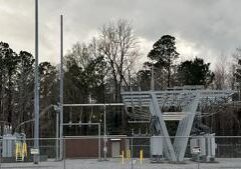
Energy industry insiders advise lawmakers on supporting AI growth, protecting ratepayers
Energy industry experts testified before Congress about what lawmakers should include in legislation looking to support the rapid expansion of artificial intelligence while protecting ratepayers from affected energy costs.
The House Committee on Energy and Commerce held a hearing Wednesday discussing multiple bills that have been drafted and several that have been introduced that aim to enhance the nation’s electrical grid and advance American dominance in AI while protecting ratepayers from rising electricity costs.
Several big players from the energy industry emphasized that legislation addressing these issues should require tech companies building data centers to pay for the “full incremental cost” of their projects, foster more reliable load forecasts and “preserve state and local discretion.”
The growth for the demand in electricity is surging after at least 15 years of “nearly flat electricity consumption,” according to the Energy Information Administration. Now, demand has increased by an average of 2.1% per year for the last five years and is expected to “grow steadily through 2050, with data center energy use as a major factor.”
Data centers are needed to support AI. American leaders, including the president, have consistently emphasized the need for the U.S. to lead the world – and in particular, its geopolitical rivals, China and Russia – in the advanced new technology.
But as much as AI leadership is a national priority, data centers and the tens of thousands of computer servers they host place an outsized demand on the grid. And while they pay for the electricity they use and at least a portion of other costs preparing the grid for their demand, they don’t always pay for all costs associated with connecting them to the grid and serving their full load. Those costs can be spread among the broader consumer base, including residents and businesses.
Nick Myers, chairman of the Arizona Corporation Commission, emphasized in his testimony before lawmakers that any legislation they advance should ensure that growth “pays for itself.”
One draft bill that was discussed Wednesday was called the Ratepayer Protection Act. It would require “each state regulatory authority to consider establishing a large-load standard,” that would ensure that the “full incremental cost of any generation, transmission or distribution upgrade[s] necessary” is covered by the large-load customer.
“That means that when large new loads comes onto the system, the infrastructure required to serve them needs to be funded by those loads – not partially, not over time, in a way that shifts risk to other ratepayers – but fully, with real financial commitments backed by financial security instruments such as letters of credit,” Myers said.
He also warned, however, that lawmakers may want to build more flexibility into how the bill defines large-load customers. It defines them as facilities with a peak demand of 100 megawatts or more.
At a recent workshop Myers attended in Arizona, they defined large-load customers as having a peak demand of 50 megawatts or more, but he said there was more discussion to be had on that point.
“What about the 20-megawatt customer that is the proverbial straw that broke the camel’s back and requires substation upgrades, potential reconductoring and new transformers? We are finding that whether a customer is considered large-load or not may often be context-specific,” Myers said.
Another bill, introduced by Rep. Greg Landsman, D-Ohio, would require the Federal Energy Regulatory Commission to hold a technical conference for relevant federal, state and private parties on strategies and rate structures that can be used to prevent costs of large-load customers from being passed on to others. The commission would have to report to Congress on the conference’s findings.
Myers supported the bill’s expressed intent but also said that states have already had some success finding solutions to some of these issues.
“Various strategies and rate structures to protect ratepayers are already being implemented through state-level traffic design and regulatory oversight. Federal efforts in this area are most effective when they complement those structures, rather than attempting to replace them,” Myers said.
Tom Falcone, president of the Large Public Power Council, echoed Myers’ sentiment.
“Growth has to pay for growth,” Falcone said. But Falcone said three things have to be done for that to happen effectively: Load forecasts need to be reliable, utilities must have more guarantees tied to requested service from data centers and federal policy must “preserve state and local discretion” while supporting best practices.
“Load forecasting is the beginning of the planning process,” Falcone explained, “but those forecasts are inherently uncertain when a very few large customers drive the projected growth. Utilities and regulators need to distinguish between committed load from probable or speculative load.”
An inflated load forecast can drive electricity prices higher unnecessarily. And just as many proposed data center projects don’t always materialize, data centers request that they be provided enough electricity to keep the center fully operational during peak demand. Utilities may plan and conduct many grid upgrades to meet that demand, but that electricity is only needed for certain parts of the day or year.
“Rates and contracts must follow cost causation. Existing customers should not provide a free option to large customers that request service, cause utilities to build infrastructure and then do not use the capacity that they request,” Falcone said.
If a utility builds out a certain capacity due to a data center’s request, but the requested capacity is actually tied to future expansion that is delayed, scaled back or never realized, then ratepayers should be protected from footing the bill for that unused capacity.
“Large-load tariffs and contracts can protect existing customers through minimum demand obligations, deposits, collateral fees and other tools,” Falcone said.
Like Myers, Falcone underscored the need for continued state and local decision-making in these processes and said that the current drafted Ratepayer Protection Act created “duplicative proceedings” or “conflicting standards.”
Nelson Peeler, senior vice president of grid strategy, planning and integration for Duke Energy, also warned against federal policy that didn’t leave room for lower-level decision making.
Federal policy should “avoid substituting national prescriptions for regional judgment. Even with strong planning and customer protections in place, infrastructure cannot move forward efficiently if national environmental permitting processes are unpredictable or protracted,” Peeler said.






Showers And Thunderstorms Likely
Latest News Stories

Embattled Fed governor sues Trump over ‘illegal’ firing

Watch: Cook County gun ban plaintiffs petition SCOTUS; Pritzker hasn’t heard from White House

Illinois quick hits: Man on pretrial release accused of murder; holiday weekend impaired driving patrols

Beecher Library Schedules New Window Installation for Early August
Illinois quick hits: Gun ban challengers petition SCOTUS; man sentenced for COVID fraud

WATCH: Trump: Illinois’ ‘slob of a governor’ should call for help with public safety
Beecher Library Awarded Over $10,000 in State Per Capita Grant
WATCH: Legislator says Illinois’ child welfare agency uses interns, has legal exposure

Economic index shows reduced uncertainty, more stability in Midwest

New law sparks debate over Illinois school mergers, communities fear loss

Illinois in Focus: Rest area burglary arrests made; overdose awareness events planned

Trump-appointed judge blasts administration for campaign against judiciary