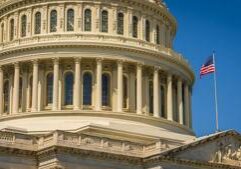
Tax hikes alone won’t fully address US debt, report finds
No tax proposal before Congress would be sufficient on its own to put the federal debt on a sustainable long-term path, according to a new report from the Tax Foundation that finds spending on programs such as Social Security and Medicare is projected to outpace revenues for decades.
The report, “Can Tax Reform Solve the Debt Problem – or Just Slow It?”, released in April by the Washington-based Tax Foundation, simulated nine major tax proposals and found that even the largest tax increases would fail to close the primary deficit over the long run.
The Congressional Budget Office projects publicly held federal debt will reach 175% of gross domestic product – a measure of total economic activity – by 2056, up from about 101% today. Interest costs alone are projected to reach 6.9% of GDP within 30 years, consuming nearly a quarter of the entire federal budget.
The consequences are already being felt: Inflation over the last five years has reduced the purchasing power of the dollar by more than 20%, and higher interest rates have substantially increased the cost of mortgages and other consumer loans, according to the Tax Foundation report.
The Tax Foundation tested nine proposals covering every major category of potential revenue, including taxes on individual income, corporate income, payroll, consumption and wealth, as well as tariffs. It found that all proposals lose revenue ground over time as higher taxes slow economic growth and push taxpayers toward avoidance strategies – and none can close the primary deficit, the gap between what the federal government spends and collects, excluding interest costs.
President Donald Trump’s tariff push, now at least partially tied up in courts after the U.S. Supreme Court ruled in February that his use of emergency powers to impose worldwide tariffs exceeded his authority, could raise billions but wouldn’t be enough, Will McBride, the Tax Foundation’s chief economist and the report’s author, told The Center Square. A Center Square Voters’ Voice poll from March found 42% of voters say American consumers are primarily shouldering the cost of tariffs – not foreign nations.
“The biggest misconception is that somebody else pays it, rather than American consumers and businesses,” McBride told The Center Square.
Social Security and major federal health care programs together make up 48% of the federal budget this year and are projected to surpass 50% by 2032, according to the Tax Foundation report. Both programs are projected to continue growing faster than the economy, driven by demographic aging and rising health care costs. The Social Security trust fund is projected to be insolvent by 2033, at which point benefits would be cut automatically to 77% of scheduled amounts under existing law, according to the 2025 Social Security Trustees Report. Medicare’s hospital insurance trust fund faces the same depletion date.
McBride said congressional working groups are evaluating options for addressing entitlement costs, but that no major legislation has been introduced.
Several Democratic senators have introduced legislation that includes tax increases on high earners, framing the measures primarily as relief for working families rather than deficit-reduction tools.
Sen. Bernie Sanders, I-Vt., introduced the Make Billionaires Pay Their Fair Share Act, which would impose a 5% annual wealth tax on the roughly 938 Americans with a net worth above $1 billion. Economists Emmanuel Saez and Gabriel Zucman of the University of California, Berkeley, estimate the tax would raise $4.4 trillion over a decade, assuming a 10% avoidance rate. The Tax Foundation, using a 33% avoidance rate based on international wealth tax experience, puts the figure at $3.3 trillion. American Enterprise Institute economist Kyle Pomerleau, factoring in avoidance already built into the existing tax system, estimates $2.3 trillion – roughly half the Saez-Zucman projection. Under Tax Foundation modeling, the wealth tax’s revenue impact would drop by more than two-thirds over 30 years as economic growth slows and avoidance increases.
Sanders’ office did not respond to a request for comment.
Several members of Congress have proposed eliminating the Social Security payroll tax cap – which limits the tax to the first $184,500 in wages. The Tax Foundation found that doing so would initially boost revenue but see gains shrink from 0.27% of GDP in 2027 to 0.21% by 2056 after accounting for economic effects. The proposal would also substantially increase marginal tax rates on highly compensated workers, shrinking GDP by more than 1.4% in the long run.
Raising tariffs to a universal rate of 50% would boost revenue by just over 0.65% of GDP initially, falling to 0.61% by 2056 as consumers and businesses shift purchasing away from imported goods. Measured against the first-year conventional revenue estimate, the report found tariff gains would drop by about 46% over 30 years, even without retaliation from trading partners. With retaliation and a major trade war, McBride said, the policy “would unravel due to lack of popular support, based on historical patterns.”
The closest any proposal came to closing the primary deficit was a 5% value-added tax, or VAT – a broad-based tax on consumption used by every Organisation for Economic Co-operation and Development country except the United States. The Tax Foundation estimates a 5% VAT would raise 1.72% of GDP by 2056, still short of the projected 2.2% primary deficit that year, but would substantially slow debt growth – from a projected 175% of GDP to 121% by 2056.
“It should be considered a serious option to raise revenue,” McBride told The Center Square, adding that a VAT alone would not be sufficient to address the underlying drivers of the unsustainable fiscal trajectory – the major entitlement programs.
McBride said he is not aware of any congressional proposal for a VAT.
An October 2025 analysis by the Brookings Institution found that the U.S. could rely more on tax increases than spending cuts compared to other advanced economies, citing the country’s relatively low consumption taxes and below-OECD-average tax levels overall.
Sen. Cory Booker, D-N.J., introduced the Keep Your Pay Act, which would eliminate federal income taxes on the first $75,000 of household income and pay for it partly by raising the top two individual income tax rates to 41% and 43%. The Tax Foundation estimates the bill would reduce federal revenue by $6.7 trillion over 10 years on a conventional basis. Booker’s office did not respond to a request for comment.
Sen. Chris Van Hollen, D-Md., introduced the Working Americans’ Tax Cut Act, which would eliminate federal income taxes for Americans earning below $46,000 and fund the cuts partly through a tiered surtax on income above $1 million. The Tax Foundation estimates the bill would reduce federal revenue by $86 billion over 10 years on a dynamic basis; the Yale Budget Lab and the Institute on Taxation and Economic Policy score it as roughly budget neutral on a conventional basis. A Van Hollen spokesperson said the bill’s aim is to provide tax relief for working families, not reduce the deficit, and that the senator supports examining the defense budget and closing international tax loopholes as deficit reduction tools.
“The most popular proposals, from hiking taxes on the rich to raising tariffs, tend to target a narrow set of taxpayers and produce the least sustainable revenues,” the Tax Foundation report found.
A March 2026 study by the Penn Wharton Budget Model found that gradually adjusting Social Security benefits – including raising the retirement age and adjusting benefit formulas – would produce stronger long-run economic growth than tax increases, with the largest gains going to younger workers and future generations.
Not all analysts agree that entitlement reform should take priority. The Center on Budget and Policy Priorities argued in its analysis of the 2025 Social Security Trustees Report that policymakers should restore solvency “primarily by increasing Social Security’s tax revenues,” noting that the program’s tax base has eroded since 1983 due to rising earnings inequality. The trustees projected the combined Social Security trust fund reserves will be depleted in 2034.
Such tax increases “would create large economic distortions; reduce jobs, wages and standards of living; and yet still fail to put the debt trajectory on a sustainable course,” the Tax Foundation report warned.
“First, reduce the cost of the major health care programs and Social Security so that costs grow at or below the rate of growth of the economy,” McBride told The Center Square. “Second, pursue tax reform that would more efficiently collect revenue, reduce complexity, and spur economic growth.”
The growing national debt is largely the result of Congress spending more money than it collects, along with rising costs for Medicare and Social Security as the U.S. population ages and health care costs continue to increase. Without action, the CBO projects deficits will rise to 9.1% of GDP by 2036 – the largest sustained deficits in the nation’s history.






Showers And Thunderstorms Likely
Latest News Stories
WATCH: IL Department of Human Services’ adverse audit draws legislators’ ire

Illinois prisons to publish annual data on contraband, safety and overdoses
Gallego, others question Meta on policies for kids using AI

Commission enacted to aid young IL farmers facing challenges

Appeals court: Serious Chicago police disciplinary hearings must be public

WATCH: IL child welfare interns debate heats up; state financial audit released

Georgia ICE arrests up 367 percent from 2021, making for ‘safer streets, open jobs

Illinois quick hits: CUB challenges Ameren rate hike plan

Experts call for probe after Microsoft left out China ties in Pentagon security plan

FBI raids the home of John Bolton
After Initial Rejection and Tense Debate, Board Reconsiders and Approves Contested DuPage Township Business

Meeting Summary and Briefs: Will County Board for August 21, 2025

Will County Board Approves New Fee Schedule for Recorder of Deeds
Will County Board Formally Opposes Heavier, Longer Trucks on National Roadways