Democrats vow to challenge ballroom security funding in Republican budget bill
Republicans in Congress will spend the next two weeks pushing forward their $72 billion budget reconciliation bill, attempting to meet President Donald Trump’s June 1 deadline.
While Democrats cannot unilaterally block the filibuster-proof legislation, they intend to make the process as politically damaging as possible for Republicans.
Democrats plan to highlight the lack of affordability-focused measures in the narrowly tailored package meant to primarily fund federal immigration enforcement operations.
They also intend to challenge the bill’s $1 billion earmark for the Secret Service, which would pay for security upgrades in Trump’s White House ballroom, currently under construction.
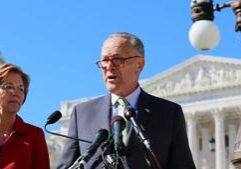
“Americans do not need a ballroom. They need relief. They want their Congress and their President to address the growing cost crisis bearing down on families across the country,” Senate Minority Leader Chuck Schumer, D-N.Y., wrote to colleagues in a Monday letter outlining the party’s strategy.
“That is what today’s Republicans have become: Ballroom Republicans — asking working families to pay the price while Donald Trump pockets the perks,” Schumer said.
Republicans have argued that the recent shooting at the White House Correspondents’ Dinner, which took place in a ballroom of the Washington, D.C. Hilton hotel, proves the need for security at the White House venue.
The budget reconciliation bill specifies that “[n]one of the funds made available… may be used for non-security elements” of the project, referring to the construction of the ballroom itself. Trump initially pitched the ballroom project as being privately financed through donations and not tax dollars.
Due to strict limitations on what lawmakers may include in a budget reconciliation bill, Democrats feel they have a chance to force Republicans to strip the ballroom security funding from the package.
The Senate’s parliamentarian will determine whether the provision violates the Byrd Rule, which forbids extraneous, non-budgetary provisions within a budget reconciliation bill.
“Democrats will fight the Republicans’ reconciliation bill with every tool we have. We will bring Byrd Rule challenges. We will offer floor amendments. And we will force vote after vote to make the choice unmistakable: will Republicans vote to help American families — to lower costs, to restore savage health care cuts, to roll back cost-spiking tariffs — or will they vote to fund Trump’s gaudy ballroom?” Schumer wrote.
Republicans are facing political pressure ahead of the midterm elections to address rising costs and affordability concerns.
Most recently, the ongoing U.S.-Iran conflict has pushed up gas prices and could soon make consumer goods more expensive as transportation costs rise.
Although Congress never declared war on Iran, Trump authorized the current military activities by citing Article II presidential authority. But the War Powers Act of 1973 gives the president only 60 days to conduct military operations without congressional approval, and that deadline has long passed.
Trump has skirted the requirement by temporarily declaring a ceasefire, a move which Secretary of War Pete Hegseth argued effectively resets the 60-day clock.
In his letter, however, Schumer said Democrats will reintroduce the War Powers Resolutions this week that would halt military activities in Iran.
Most Republicans have so far blocked the resolutions. But Democrats hope that the now legally dubious status of the conflict, paired with general public opposition and affordability concerns approaching the midterms, will convince enough Republicans to fold.






Mostly Sunny then Showers And Thunderstorms Likely
Latest News Stories
Will County Considers First Update to Wastewater Ordinance Since 2016
IDOT Plans to Invest Over $1.3 Billion in Will County Roads Through 2031
Committee Advances 50% Increase in Mental Health Levy on 4-3 Vote
Will County Poised to Launch Major Mental Health Initiative Based on Joliet Program’s Success
Looming State Energy Bill Threatens to Further Limit County Control Over Solar and Wind Projects
Controversial Immigrant Rights Resolution Postponed by Will County Board After Heated Debate
Will County’s Gas-to-Energy Plant Reports Nearly $460,000 Net Loss Amid Operational Setbacks
Will County to Draft First-Ever Policy on Artificial Intelligence Use
Will County Sees 50% Drop in Opioid Deaths, But Alarming Rise in Suicides
Will County Board Backs Effort to Rename ‘Stigmatizing’ Chicago Sanitary and Ship Canal
Access Will County Dial-a-Ride on Track for Full County-Wide Service in 2026
Will County Reverses Zoning on Peotone Farmland to Facilitate 10-Acre Sale