
Everyday Economics: The economy is still standing, but the squeeze Is building
This week brings three important reads on the economy: the S&P CoreLogic Case-Shiller Home Price Index, new home sales and the Personal Consumption Expenditures report.
The housing data will matter. But they will mostly confirm what the more timely Zillow data already show.
The national housing market is moving sideways.
Home price growth has slowed. Sales are roughly flat from a year ago. Newly built homes remain one of the few parts of the market where buyers have more choices. Builders have been more willing than existing homeowners to cut prices, offer incentives and meet the market where demand actually is.
That distinction matters.
Housing is not weak everywhere for the same reason. Existing home sales are rising in markets where inventory has improved and prices have adjusted. New construction follows the same basic logic. More available homes, lower effective prices and builder incentives can still bring buyers back. But nationally, housing remains stuck.
The bigger issue this week is inflation.
The Personal Consumption Expenditures price index is the Federal Reserve’s preferred inflation gauge. It is likely to show that price pressure is moving in the wrong direction again. Two shocks are still working through the economy: tariff pass-through and the energy-price spike tied to conflict near the Strait of Hormuz. These shocks do not hit households all at once. They move in stages.
First, businesses face higher input costs. Some absorb those costs for a while. Margins get squeezed. Then, over time, more firms raise prices to protect those margins. That is when the pressure moves from corporate income statements to household budgets. Prices are rising faster than disposable incomes. Consumers may still be spending more dollars, but those dollars are buying less. Real, inflation-adjusted spending is slowing.
And the squeeze is not only coming from prices. It is also coming through interest rates.
Since the conflict with Iran began, the 10-year Treasury yield is up 54 basis points. The 30-year fixed mortgage rate is up 60 basis points. That is a meaningful tightening of financial conditions for households, homebuyers and businesses.
This is why energy shocks are so difficult for the Federal Reserve.
Energy price shocks raise overall prices while weakening the real economy. Industrial production falls. Unemployment rises. Real gross domestic product falls relative to where it would have been without the shock. That is the bad combination: inflation rises while growth weakens. The interest-rate channel is now amplifying the squeeze.
That changes the policy environment.
In March, the Federal Open Market Committee held the federal funds rate at a range of 3.5% to 3.75%. The statement said inflation remained somewhat elevated and that the implications of Middle East developments for the U.S. economy were uncertain. It also kept language pointing to possible “additional adjustments,” which markets interpreted as an easing bias.
By April, the tension was impossible to miss.
The Fed again held rates steady. But the statement said inflation was elevated in part because of higher global energy prices. Three officials dissented because they supported holding rates steady but did not support keeping an easing bias in the statement while inflation remained elevated.
Markets are starting to move in the same direction.
Fed funds futures are no longer simply pricing a delayed cutting cycle. They are beginning to price the risk that the next move could be a rate hike.
That is the dilemma.
The Fed can look through a temporary energy shock if inflation expectations stay anchored. But it cannot ignore a shock that raises inflation expectations, because that makes inflation harder to contain.
The central bank cannot make the oil shock disappear. It can only decide how much additional demand destruction it is willing to tolerate to keep inflation expectations anchored.
That is the risk.
Monetary policy could end up leaning against inflation caused by a supply shock and deepening the hit to activity.
The broader monetary-transmission literature gives a sense of scale. A 1 percentage point increase in the federal funds rate that fades gradually lowers gross domestic product by about 0.4% after roughly 18 months and employment by about 0.3% after roughly two years, on average. The most interest-sensitive parts of the economy are housing, business fixed investment and durable goods spending.
The question is not just whether inflation rises. The question is whether the squeeze begins to show up in the parts of the economy that had been holding up: services, travel, restaurants, recreation and other discretionary categories. Real consumer spending is still growing, but the mix is getting less comfortable. In March, real spending rose just 0.2%, while real disposable income fell 0.1%.
The economy is still standing but consumers are increasingly relying on savings and credit. The squeeze is building.






Mostly Sunny then Showers And Thunderstorms Likely
Latest News Stories
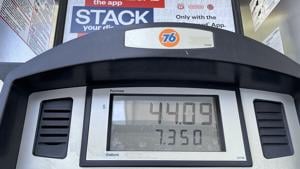
U.S. gas prices at 4-year high as oil exports hit new record

Government leaders statewide call for cashless bail reform after CPD officer killed

Coalition formed to fight railroad merger includes direct competitors

Walk-Off Rally Propels Beecher Past Grant Park in Conference Thriller

Norkus Throws Two-Hit Shutout as Beecher Blanks Grant Park 10-0
Johnson, Irwin Combine for Perfect Game as Beecher Routs Grant Park 14-0

Illinois Quick Hits: Pritzker announces new IBM investment at Quantum Park

ISU’s union says it cheaper to negotiate than paying

Iran conflict, refinery disruption play roles as Illinois gas price passes $4.50.

Rates hold steady ahead of Fed chair transition

Supreme Court skeptical of Syria, Haiti temporary protected status

Whitmer announces 40 jobs in Adrian; Trump administration claims credit