
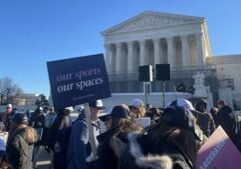
Supreme Court yet to decide high profile cases
Birthright citizenship, transgender athletes in female sports and federal firing powers are among more than two dozen cases yet to be decided by the U.S. Supreme Court as the term draws to a close.
Traditionally, justices on the nation’s high court finalize decisions in cases by the end of June or the beginning of July, leaving only a few weeks before decisions are expected to be public.
Legal analysts say the past year of the court has been defined by President Donald Trump.
“This is very much a term where Donald Trump is looming over the term,” said Amy Howe, cofounder of the outlet SCOTUSBlog, which reports on the U.S. Supreme Court. “In a couple of the cases he is a named party.”
Here are some of the cases remaining on the high court’s docket.
Birthright Citizenship
In April, justices on the high court heard arguments in Trump v. Barbara, a case challenging Trump’s executive order to end birthright citizenship for children born to noncitizen parents after Feb. 19, 2025.
Trump made history by being the first sitting U.S. president to attend an oral argument by attending this case. During oral arguments, the justices appeared deeply skeptical of the president’s executive order.
The concept of birthright citizenship primarily rests on the Supreme Court’s interpretation of the 14th Amendment to include children born in the U.S. to foreign parents. The 14th Amendment reads: “All persons born or naturalized in the United States, and subject to the jurisdiction thereof, are citizens of the United States and of the State wherein they reside.”
Legal analysts have argued that the clause, “subject to the jurisdiction thereof,” indicates that the citizenship of parents is required to confer birthright citizenship.
Other analysts argue that the tradition of the court has been to confer citizenship for individuals, regardless of their parents’ immigration status.
Federal Firing Power
Trump v. Slaughter and Trump v. Cook also seeks to challenge the president’s authority to fire members of federal executive boards, regarding members of the Federal Trade Commission and Federal Reserve, respectively.
In March 2025, Trump fired Rebecca Slaughter, a member of the Federal Trade Commission. Under federal law, federal trade commissioners can only be fired for a certain cause, but Trump did not include a reason when he fired her.
Slaughter sued and asked to stay in her job while lower courts litigated the issue. The Supreme Court did not allow her to continue in her job while the litigation continued.
In August 2025, Trump sent a letter to Lisa Cook, a member of the Federal Reserve’s board of governors. He attempted to fire Cook, citing allegations of mortgage fraud before she became a member of the Federal Reserve.
Cook sued Trump and he asked the Supreme Court to fire her while the litigation continued. Justices on the court did not allow her to be fired while it continued.
“It’s a question, really of the separation of powers,” Howe said. “Whether or not Congress can have these laws that prevent the president from firing people at will.”
Howe said the high court’s allowing Slaughter to be fired while Cook could remain in her job could indicate how the justices plan to rule. She said the perceived independence of the Federal Reserve could play a key role in the court’s decision-making.
If the court upholds the president’s authority, it could undo an almost 90-year-old precedent that prevented President Franklin Delano Roosevelt from firing members of federal boards like the FTC.
“They could say something along the lines of, ‘the FTC of 1935 was very different from the FTC today. The FTC today serves much more of an executive function than the FTC of 1935,’” Howe said.
Transgender Athletes
A high-profile case on the court’s docket that does not involve Trump focuses on state bans of biological men from women’s and girls’ sports. Idaho and West Virginia banned transgender women and girls from competing in women’s and girls’ sports programs.
The laws focus on Lindsay Hecox, a transgender woman in Idaho, and Becky Pepper Jackson, a transgender girl in West Virginia, who challenged the bans in each state.
Lawyers for the states argued that allowing transgender athletes to compete in girls’ and women’s sports violates the equal protection clause and Title IX. Howe said justices appeared favorable of the state’s bans during the oral arguments.
“I do think the trans athletes have a real uphill battle,” Howe said.
Justices on the high court are expected to make decisions in these and many more cases before the term ends by July.






Slight Chance Showers And Thunderstorms
Latest News Stories
County Finance Committee Advances Proposal for Elected Official Pay Raises After 20-Year Freeze
Will County Committee Debates Process for Taking Positions on State Legislation
State Lobbyists Update County on Springfield Action as Legislative Deadlines Approach
Will County Legislative Committee News Briefs
Shanahan Development Agreements Near Completion, Will County to See $282,000 Annual Revenue Boost
County Explores Bond Refinancing Options to Generate Potential Savings
County Approves $150,000 for Medicare/Medicaid Billing Consultant for Health Department, Nursing Home
- « Previous
- 1
- …
- 216
- 217
- 218