Open primary system debated as Californians go to polls
Supporters of California’s top-two open primary system are defending it amid challenges and criticism as voters go to the polls Tuesday in the Golden State’s primary.
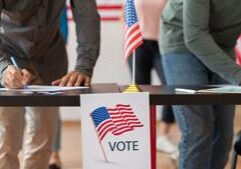
Voters are casting ballots in races varying from gubernatorial and attorney general contests to congressional, legislative and local races. Polls are open 7 a.m. to 8 p.m. As early results become available in key statewide and congressional contests, they will be published Tuesday evening at www.thecentersquare.com/california.
Tuesday’s election is an example of California’s open primaries, which involve people of various parties running together in one race. The top two vote earners, regardless of party affiliation, will advance to the general election on Nov. 3. Under the system, the two candidates in the general election could be a Democrat and a Republican, two Democrats and no Republicans, or two Republicans and no Democrats. Third-party candidates are unlikely to be among the top two vote getters.
California’s open primary system has been operating since voters approved an initiative in 2010. The system includes state and federal offices.
Most states have closed primaries that pick a Republican and a Democrat to run against each other in a general election.
Speaking on Friday in a virtual press conference, John Opdycke of Open Primaries said 70% of Californians want an open system.
“If the Democrats can’t inspire enough voters to get from round one to round two, that’s on them,” said Opdycke. “Same with the Republicans.”
Opdycke added that independents benefit from how California does its primary.
“If this race were held in a closed primary state like New York, you would have candidates, Democratic and Republican candidates, spending millions of dollars and endless time only talking to the party faithful,” said Opdycke.
Chad Peace, legal adviser to the Independent Voter Project, the authors of California’s top-two primary, agreed. Peace added that the election belongs to the voters, not political parties.
“The purpose of the primary is a voter-nominated primary,” said Peace. “It’s not a party-nominated primary like you have in 47 other states.”
Peace stressed that “does not mean the system is perfect or cannot be improved,” but he said it serves voters, and they are what matters.
Nick Troiano, executive director of Unite America, was also on the virtual press call. Troiano said a system such as the one in California provides a stronger, more diverse turnout of primary voters.
“Ninety-two percent of U.S. House seats will be decided not in competitive general elections in November, but in low-turnout party primaries that are happening right now,” said Troiano. “The voters deciding these elections, we know from our research, happen to be older, whiter, wealthier and much more ideologically polarized than the election as a whole, which is no wonder why Congress itself is older, whiter, wealthier and more ideologically polarized than the electorate as a whole.”
This, said Troiano, is the primary problem in U.S. politics today.
According to Troiano, “the good news is that California is one of three states that have abolished traditional party primaries.” With its top two all-candidate primary system, Troiano said every voter has the freedom to vote for every candidate in every election, regardless of party.
“That is just not the case in other states around the country, especially in 16 states where close to 17 million independent voters are entirely disenfranchised,” said Troiano. “So when you compare it to perfect, California’s system is not perfect – no system is – but when you compare it to the status quo in 47 other states, California has one of the most representative, most participatory, most functional election processes in the entire country.”
That, said Troiano, is a system worth defending.
Paul Rieckhoff is the founder of Independent Veterans of America. While serving in the Army during the Iraq War, Rieckhoff said he put on the uniform for all Americans, not just Democrats or Republicans.
“Many of us don’t get a vote on the people who will ultimately go to Congress to determine whether we go to war,” Rieckhoff said.
Rieckhoff went on to challenge reporters to ask opponents of the open primaries their reasons for working to bring back closed primaries.
Opdycke made that same request. So did Jeremy Gruber, senior vice president of Open Primaries.
“This repeal effort is about protecting the political industry,” said Gruber. “It’s an effort by political insiders to restore a system that protects their business model, and they are willing to throw 7 million independent California voters under the bus and deprive them of the right to vote just to save their business model.”
Steven Maviglio is not a fan of the current system. The Democratic strategist would prefer California to go back to its former system. Maviglio is involved with a campaign called Undo The Top Two.
“The California Democratic Party had an open primary, and we favor open primaries, though that is explicitly up to the parties,” Maviglio told The Center Square, answering questions by email. “The ballot initiative repeals the failed experiment of the Top Two.”
“If you read the ballot arguments that were written for it and to pass it, it promised to end partisanship in the state, help balance budgets, get more voter participation, and those failed on all three counts,” said Maviglio.
According to Maviglio, the Libertarian, Green, and Peace & Freedom Party have been completely locked out of the November ballot since the top-two system passed.
On its website, Undo The Top Two states that these parties are opposed to the top two primary system. The California Democratic Party and California Republican Party are also listed as opposed.
To go on a general election ballot before voters, the Undo The Top Two initiative would require petitions signed by voters (unless the Legislature decided to put it on the ballot).
“We’re going to need something around, I think, 750,000 signatures on a petition,” said Maviglio. “We’re hoping it will be on the November 2028 ballot and can be implemented for the following election in 2030.”
Undo The Top Two has a meeting this week with the Office of Attorney General to discuss the campaign. OAG must give the petition a title and summary. A legislative analyst will also determine what the initiative would cost the state, but Maviglio said the “costs will be nothing.”

Mostly Sunny
Latest News Stories
Meeting Summary and Briefs: Beecher Fire Protection District Board of Trustees for May 29, 2025
Beecher Fire District Bolsters Staff with Four New Part-Time Hires
Beecher Fire District Reorganizes Board, Approves New Record System and Community Donations
JJC Trustees Approve Contentious FY26 Budget After Heated Debate, Failed Postponement
JJC’s ‘12x12x12’ Initiative Boosts College Credits, Increases Matriculation Rate
JJC Board Meeting Highlights Tensions Over Legal Bills, Trustee Conduct
Students, Trustees Emphasize Importance of Inclusivity and Flag Raisings at JJC
JJC Embarks on New 10-15 Year Facilities Master Plan Process

Meeting Summary: Joliet Junior College Board of Trustees for June 25, 2025
Beecher Faces $202,000 Revenue Loss, Considers Local 1% Grocery Tax
Beecher Amends Zoning Ordinance to Add Regulations for Solar and Wind Energy
Beecher Police Records Clerk Linda Krug to Retire After 27 Years