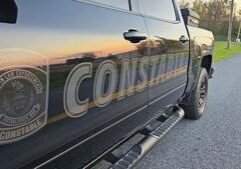
Constables hope to find missing children in immigration search effort
After months of Congress stalling on funding for U.S. Immigration and Customs Enforcement and administrative changes, Pennsylvania state constables who’ve signed agreements to support federal law enforcement and potentially thousands of missing noncitizen children are ready to get to work.
On Friday, the U.S. Senate passed a $70 billion funding bill to support ICE and others border security operations, which includes funding to find hundreds of thousands of missing children.
“Pennsylvania State Constables are the best asset in the commonwealth to assist Immigration and Customs Enforcement with warrants and find missing children,” Damascus Township Constable Chris Lee told The Center Square. “Approximately 700 constables serve 250,000 warrants a year with the overwhelming majority of warrant executions completed without incident. As elected officers we have developed community contacts that enable us to find wanted individuals better than any other agency.”
Under the Biden administration, nearly 400,000 unaccompanied alien children, or UACs, were released into the country after they’d been smuggled to the border and were sent to live with sponsors by federal officials. The program overseeing their care has been marred by decades of allegations of abuse. During the Biden administration, multiple investigations found a worsening crisis: sponsors were unvetted, UACs were sent to non-relatives, child traffickers, sex abusers and residences that didn’t exist, The Center Square reported.
The number of human trafficking aid requests, including for children, surged. The Trump administration began welfare checks of unaccompanied minors through Homeland Security Investigations and ICE, searching for more than 350,000 “missing UACs” it claims the Biden administration couldn’t account for.
Since 2015, Pennsylvania has received nearly 13,000 UACs, according to the latest federal data, The Center Square reported. That number excludes children in forced labor and sex trafficking schemes.
Unlike other states where no constables have signed up, 18 constables in Pennsylvania have signed ICE’s 287(g) agreements to participate in immigration enforcement and help find missing children. The program authorizes state and local law enforcement officers to perform specified immigration functions only under ICE’s direction and supervision. It includes three models: a Jail Enforcement Model (JEM), Task Force Model (TFM) and Warrant Service Officer (WSO) model, The Center Square reported.
Among them is Lee, who was among the first to undergo 287(g) training and receive certification. He says his ICE liaison said there are 300 UACs in his tri-county area that need welfare checks. However, due to issues in Washington, D.C., he and other constables haven’t been able to get out into the field. They are hoping with renewed support from Congress and a new DHS secretary, they will be soon.
There are slightly more than 100 287(g) agreements signed with varying law enforcement agencies statewide. Constables comprise roughly 20%, according to the latest ICE data as of June 4.
East Donegal Constable Paul Castline was also among the first to get 287(g) certified. He leads a team of officers statewide providing professional law enforcement services.
“Pennsylvania State Constables are best suited to participate in 287(g) and especially the TFM “because of the close ties we have to the communities we serve. Constables are elected and trusted by their constituents, and because we live and work with them, we have a level of local knowledge and connection that is difficult to replicate. We understand the issues affecting our neighborhoods, our schools, and the families who live there,” he told The Center Square. “According to public records, Pennsylvania State Constables are responsible for serving the lion’s share of warrants across the commonwealth, handling a workload that exceeds many other agencies combined.
“One of the biggest motivations for many officers within our group is protecting our communities from the dangers associated with illegal drugs, child exploitation, human trafficking, and sex trafficking,” he added. “Many of our officers have already completed the required ICE training and are eager to work alongside the new administration moving forward.”
ICE and HSI are working with local law enforcement to help find missing children. In Florida, for example, a recent operation led to finding 400 UACs, The Center Square reported. In another multi-agency operation in Florida, an additional 200 children were found, The Center Square reported.
In Minnesota during Operation Metro Surge, ICE located 3,364 missing UACs, “children the last administration lost and weren’t even looking for,” President Donald Trump’s border czar Tom Homan said in a news conference in February.
William Penn established constables, sheriffs and magistrates in 1664; they’ve “been in continuous operation since the founding of Pennsylvania,” the Pennsylvania Police Alliance explains. Other law enforcement agencies were established on this model. “When Pennsylvania created its state police in 1905, the legislature explicitly granted them ‘the powers and prerogatives conferred by law upon … constables of this Commonwealth’ — acknowledging that constable authority is the original baseline from which the rest of Pennsylvania law enforcement derives,” Constables Matter explains.
Constables are locally elected but have statewide jurisdiction. They have arresting authority, including for felonies and misdemeanors, execute arrest warrants, make warrantless arrests, use county and local jails, and perform other duties. Unlike other law enforcement agencies that rely on taxpayer money to pay salaries and pensions, constables pay all of their costs, including vehicles, uniforms, K9s, training, costing taxpayers nothing. Constables raise revenue by receiving fees from contracts with municipalities, private entities and private citizens. Constables that choose to work for the courts receive fees that are incurred by defendants, Lee explained to The Center Square. Many constables also receive free training available through state and federal law enforcement agencies like the Institute of Law Enforcement Education, NCTC and county public safety offices.
Because constables are elected officials, they answer directly to voters, Constables Matter explains. Their community involvement “fosters transparency. Independent from rigid hierarchies, political agendas, and special interests, constables avoid the bureaucratic shielding that can obscure accountability and lead to distrust of law enforcement. Constables are a direct, visible, and responsive link between the public and justice.”





Partly Sunny
Latest News Stories

News Briefs from the Will County Board June 18 Meeting
Beecher Library Trustee Kathryn Czarnecki Resigns

Beecher Library Board Approves Staff-Wide Pay Raises, Invests Nearly $450,000 in New CD

Meeting Summary and Briefs: Beecher Public Library District for June 17, 2025
Mental Health Board Awards $5 Million in Grants to Will County Organizations
County Board Approves Major Code Updates, Discusses Employee Benefits
Executive Committee June 12 Meeting Briefs

Beecher School District Approves Future Retirements of Veteran Educators, Hires New Staff and Coach
Beecher School Board Raises Lunch Fees for 2025-26 School Year
Policy Changes, Student Handbook Updates Get Initial Review by Beecher School Board
Meeting Summary and Briefs: Beecher Board of Education for June 11, 2025
Will County to Draft New Harassment Policy Amid Debate Over Board Authority