
Dozens of U.S. lawmakers demand privacy reforms as FISA deadline looms
Congressional leaders are desperate to renew the federal government’s authority to conduct mass electronic surveillance before the authority expires, but dozens of lawmakers in both chambers are bucking a long-term extension unless it includes significant reforms.
Dozens of Democrats and a significant handful of Republicans are insisting that any reauthorization of FISA Section 702, which expires June 12, contain protections for Americans’ Fourth Amendment rights.
Specifically, they want to require warrants for searches of Americans’ electronic data, which FISA Section 702 allows federal agencies to collect.
Republican privacy hawks had already voiced concerns over the issue, but President Donald Trump’s recent appointment of Bill Pulte as the new acting director of National Intelligence has united practically all Democrats against a clean FISA 702 extension as well.
Democrats particularly object to Pulte’s complete lack of intelligencer national security expertise, dubbing the former housing regulator an “unqualified” pick.
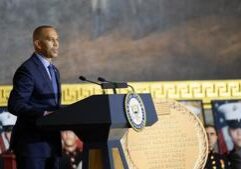
“To get to good faith negotiation [over FISA Section 702 reauthorization], the effort to elevate Bill Pulte as the acting director of National Intelligence should be reversed immediately,” House Minority Leader Hakeem Jeffries, D-N.Y., told reporters Monday. “And then let’s see where we wind up at the end of the week.”
Echoing the sentiments of Democrats in the Senate, Sen. Ron Wyden, D-Ore., a member of the Senate Select Committee on Intelligence, called Pulte’s appointment “the final straw.”
“Pulte has no business overseeing a warrantless spying program for Donald Trump, Democrats understand that,” Wyden posted Monday on social media. “I’ll be fighting like hell between now and June 12 to ensure Congress doesn’t cave and renew Section 702 of FISA without real reforms. Security and liberty aren’t mutually exclusive, and it seems like Congress is finally starting to understand that.”
Although Section 702 technically only authorizes federal intelligence agencies to conduct warrantless electronic surveillance on foreign nationals of suspicion, Americans’ data is often swept up as well.
Not only can intelligence agencies store that data for up to five years, but federal agents can and do routinely search that data without obtaining a warrant, known as “backdoor searches.”
In one of the most infamous known cases, FBI agents scoured the data of 19,000 donors to a congressional campaign. Tens of thousands of American protestors or those simply suspected of “civil unrest” have also had their communications spied upon, and even some members of Congress had their data searched via Section 702, declassified documents show.
So far, the modest transparency reforms proposed by congressional leaders have failed to satisfy privacy hawks.
The Senate tanked a procedural vote Friday that would have allowed leaders to begin debate on a three-year extension. The proposed extension included some privacy reforms, but no warrant requirement.
“FISA is meant to target foreign adversaries, not give the federal government a backdoor into Americans’ communications,” Rep. Mark Harris, R-N.C., said over the weekend. “As Congress works toward the June 12 deadline, I will continue fighting for a warrant requirement and lasting reforms that protect the Fourth Amendment.”
Section 702 was enacted in 2008 to retroactively justify NSA secretly gathering personal electronic communications between U.S. and Afghanistan individuals for years after the Sept. 11, 2001, terror attacks.
With the current U.S.-Iran conflict heightening global tensions and domestic security risks, the Trump administration is arguing that lawmakers should avoid any reforms that could potentially hinder foreign intelligence gathering.
Monday marks the 100th day since the U.S. and Israel launched joint strikes on Iran, triggering the current conflict. Congress, which holds the power to declare war, never authorized the military hostilities.
Both the House and the Senate have bipartisanly passed respective War Powers Resolutions, but even if one clears both chambers, the Trump administration is unlikely to heed it.


Chance Showers And Thunderstorms
Latest News Stories

U.S. rep.: Mexico still not delivering water to South Texas, despite claims

Supporters say will storage option would streamline judicial process

Dallas Fed: Geopolitical conflicts creating uncertainty for U.S. oil and gas industry

Illinois Quick Hits: Pritzker pushes for E15

Village Approves $10,000 Emergency Donation to Replace Deteriorating Fencing at Firemen’s Park

Washington Township Approves $10,000 Sponsorship for Beecher Concert Series Despite Trustee Concerns

Trump addresses nation on Iran strikes; signals conflict nearing end

IL biometrics privacy reforms apply to past cases, too: Appeals court

Artemis II heads to the moon with first crewed mission since 1972

Pro-life org to Trump: Taxpayers should not be forced to fund killing of unborn children

Birthright citizenship advocates confident in SCOTUS hearing

College funding bill draws dissent from big Illinois universities


