
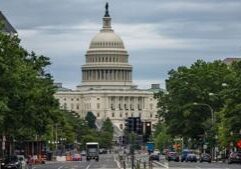
Nonprofit working on gender, climate issues got millions in federal cash
The federal government gave about $2.5 million in two years to a Washington, D.C.-based nonprofit that says it aims to be a “trusted bipartisan source of expertise and insight” on banking and financial technology regulations. But the nonprofit’s mission has expanded into social and public policy issues, like gender bias and climate change, according to an investigation by The Center Square.
The Alliance for Innovative Regulation, a 501(C)(3) organization, says on its website homepage that it combines “research, advocacy, and convenings” of workshops and roundtable discussions seeking to help “regulators and financial institutions navigate this transformation” to global financial modernization. Its research included a 2024 grant from the State Department during the Biden administration to “identify new technologies that can thwart illegal transactions tied to global corruption.”
Yet a deeper dive into the nonprofit reveals that its mission has expanded to issues not directly related to finance.Adrian Moore, vice president of policy for the Reason Foundation, a libertarian-leaning nonprofit, questioned the use of taxpayer money for the type of work The Alliance for Innovative Regulation is doing.“It’s crazy, and it’s very unfair to people who pay for subsidies they disagree with,” Moore told The Center Square in an interview. “Government money should go toward services for taxpayers, not organizations that do policy work.” Two emails to AIR were not immediately returned. The nonprofit had a phone number at a previous address, but a phone call was not returned.
In a 2021 filing, AIR said it promoted “responsible innovation” to address issues including financial exclusion, race and gender bias, predatory practices, human trafficking, and climate change. Further, the nonprofit has an ongoing program to help government regulators continue using statistical tools to assess how many women use banks and financial technology. In 2023, AIR set up and hosted a conference on how cryptocurrency and blockchain could support removing carbon dioxide from the air “at massive scale.””Traditional regulatory tools alone are no longer enough,” AIR says on its website. “To respond effectively, regulators need timely, usable data that reveals where exclusion occurs and whether interventions are working.” In 2024, the nonprofit said it planned to use a federal contract from the Federal Housing Finance Agency for additional purposes. That included an “ongoing initiative to educate and engage U.S. policymakers regarding the need for regulator modernization and to position AIR as a trusted bipartisan source of expertise and insight on matters related to financial and financial regulatory technology.”
That also included marketing a two-day event on combating financial scams by “raising awareness, driving participation, enhancing engagement, and positioning AIR as a thought leader.” In addition, AIR noted it started a YouTube channel, posted more regularly on LinkedIn, and created 18 episodes of a podcast hosted by Jo Ann Barefoot, the nonprofit’s founder and CEO.
Barefoot was a former staffer to the U.S. Senate Committee on Banking, Housing and Urban Affairs and deputy comptroller of currency from the mid-1970s to the early 1980s before going into the private and nonprofit sectors, her Linkedin account shows.
Soaring expenses and debt
AIR received federal funding worth $1.4 million in 2024, the same year the nonprofit ran a deficit of roughly $800,000. Its expenses soared to nearly $5.5 million, a figure twice that of two years earlier.
The increase was driven, in part, by a significant increase in spending on outside contractors, to at least $553,000 in 2024 from at least $102,000 the year before. The two highest-paid contractors were C2 Association Strategies, an Alexandria, Virginia-based association and nonprofit management company, that received $200,700, and Chakra Advisors LLC, a Danville, California-based economics strategy consulting firm that received $143,000.
Barefoot earned $287,983 in 2024. That represented a pay cut from the year before, when she made roughly $312,000, according to the nonprofits tax returns.
The nonprofit has deliberated over Barefoot’s compensation package. In its 2022 tax filing, the nonprofit noted that “salaries for the CEO and executive director were initially set below market rates for a startup nonprofit and were reviewed against comparable organizations.” The filing states that compensation was approved by independent board members and the organization’s seed funder. Beyond executive compensation, AIR said its mission is to help shape discussions about financial regulation and technology.Moore, of the Reason Foundation, described its purpose as “squishy.”You can justify anything with those words,” he added.





Chance Showers And Thunderstorms
Latest News Stories
Will County Land Use News Briefs
County Moves Forward with Veterans Building Renovations, Questions Arise on Pace Building Plans
County Continues Efforts to Reduce Leased Office Space Footprint
County Reports Significant Cost Savings Through In-House Facility Projects
County Legislative Committee Endorses Electronic Recycling Bill, Reviews Transit Governance
Will County Capital Improvements News Briefs
County Finance Committee Advances Proposal for Elected Official Pay Raises After 20-Year Freeze
Will County Committee Debates Process for Taking Positions on State Legislation
State Lobbyists Update County on Springfield Action as Legislative Deadlines Approach
Will County Legislative Committee News Briefs
Shanahan Development Agreements Near Completion, Will County to See $282,000 Annual Revenue Boost
County Explores Bond Refinancing Options to Generate Potential Savings
County Approves $150,000 for Medicare/Medicaid Billing Consultant for Health Department, Nursing Home
- « Previous
- 1
- …
- 190
- 191
- 192