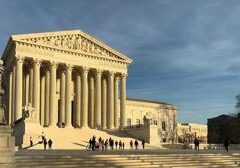
Supreme Court rules against company lawsuit over unlawful regulations
The U.S. Supreme Court, in a 6-3 decision on Thursday, said private companies do not have an automatic right to sue over unlawful contracts.
The case, FS Credit Opportunities v. Saba Capital, focused on a company engaged in “activist investing,” a practice where investment companies identify low performing mutual funds and purchase a large portion to alter the funds’ investment strategies.
Saba Capital, the company at the center of the case, is based in Maryland, where practices of “activist investing” are against the law. Saba sued over the Maryland law, claiming it violated the Investment Company Act, which regulates investment companies.
Lower courts agreed that Saba had the right to sue to challenge the law. However, justices on the high court disagreed and reversed the lower court decision.
Justice Amy Coney Barrett said the Investment Company Act did not provide an automatic right to sue over a law, even if it was deemed unlawful. She said Congress did not expressly create an enforcement action for the law.
“Congress’s decision to create a comprehensive agency enforcement scheme supports the conclusion that private parties generally cannot enforce the ICA,” Barrett wrote in the court’s majority opinion.
Justices Elena Kagan, Sonia Sotomayor and Ketanji Brown Jackson disagreed with the majority’s position. The dissenters said justices in the majority did not fully consider how Congress has legislated on private rights of action.
Brown Jackson wrote there is evidence in the congressional record that lawmakers wished for companies to have a private right to action under the Investment Companies Act. She criticized the majority for not ruling in favor of companies seeking relief from percieved unlawful actions.
“Legislative Committee Reports unequivocally expressed Congress’s ‘wish’ that the statute continue to be interpreted to allow private suits, notwithstanding this Court’s increasing penchant for refusing to recognize implied rights of action,” Jackson wrote.
Barrett said the plain meaning of the language negates evidence in the congresional record of a different intent.
“The phrase ‘a court may not deny rescission at the instance of any party’ is most naturally read to direct a court’s remedial power when a party before it is urging rescission,” Barrett wrote in the majority opinion.






Chance Showers And Thunderstorms
Latest News Stories

Lawsuits seek to shred Taylor Farms over ‘explosive diarrhea’ outbreak

Illinois quick hits: Collinsville man pleads guilty to sex abuse of children

Judge plans to rule next week on Paramount, Warner Bros.

Aldermen say mayor fails to collect revenue he opposes

Texas leading in Iran conflict, drone boat company rescues pilots, attacks Iran

Illegal border crossings remain historically low in June, drug seizures up

Pritzker disputes Trump speech claims

Arizona congressional candidates debate healthcare, ICE
Mullin reveals 250k non-citizens registered to vote in just four states
Walz again questions deportation of convicted sex offender
Trump calls out Michigan elections in primetime address

OBGYN group leader says she posed as teen, ordered abortion drug via mail

Secretary of State dismisses calls for clarity on migrant’s license status