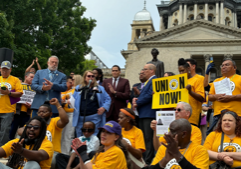
Exclusive: Group warns labor bill allows govt takeover of union contract negotiations
Bipartisan legislation meant to speed up first-time union contracts would promote efficiency but also erode both employee and employer rights, a labor policy group argues.
The Faster Labor Contracts Act, championed by congressional Democrats and supported by 20 House Republicans, mandates government intervention if a first-time union contract is not agreed upon within 120 days.
Ultimately, once time runs out, the business and union would be forced to accept a collective bargaining agreement written by a government panel, rather than directly negotiated by the employer and employees.
Institute for the American Worker President Vinnie Vernuccio called the House-passed bill an example of “gross government overreach.”
“There are better ways out there, things that increase collaboration, increase penalties even, to get people to negotiate,” Vernuccio told The Center Square. “Those are far preferable than government forced arbitration.”
Supporters of the Faster Labor Contracts Act – including the AFL-CIO, the largest federation of unions in the U.S., and the International Brotherhood of Teamsters – say it will ensure employers come to the negotiating table quickly instead of dragging out the process.
The bill would require employers to begin contract negotiations within 10 days of a union’s formation, then allow for up to 90 days of bargaining before the Federal Mediation and Conciliation Service steps in.
Once that happens, the employer and union have only 30 more days to reach an agreement before a government imposed three-person arbitration panel takes over.
The panel, consisting of one union representative, one employer representative and one neutral member, would then write the entire two-year contract without directly engaging with either the employer or the union.
Vernuccio and other opponents of the bill, including conservative political advocacy group Americans for Prosperity, argue that the mandated government arbitration panel would disenfranchise, rather than empower, both workers and businesses.
“It harms workers by preventing them from being able to have a vote on a contract. This is government-imposed arbitration that would lead to contracts covering everything — their wages, their working conditions, their benefits — and workers wouldn’t have a say in the contract [while] being forced to pay the union,” Vernuccio said.
“From the employer perspective, you have these government-mandated arbitrators that may not know the business, may not know the intricacies of what it needs or what it has to do to survive,” he added. “And [the panel] will simply base a contract off of other unionized company contracts, which may not be anywhere near the same as what the newly unionized company faces.”
A union contract written by a third party not only could ignore the needs of the particular workers and business involved, but could also trigger future legal disputes, depending on what the panel decides to include.
“There’s nothing in the bill that limits it to just wages or just working conditions,” Vernuccio noted. “If other companies have negotiated DEI, if they have things that, let’s say, a Christian employer would not want, or if they have things saying you have to support divestment from Israel, there’s nothing preventing those clauses from being forced upon both workers and job creators.”
Although the Faster Labor Contracts Act easily passed the U.S. House, its becoming law is far from imminent. The bill must clear the 60-vote threshold in the Senate, and fewer Republican senators appear supportive of the bill compared to their House colleagues.
The Senate also currently faces a backlog of critical bipartisan legislation, including long-awaited bills supporting federal highway infrastructure and American farmers.
The upper chamber is also wrestling with the House over certain portions of a massive bill to boost housing supply, which President Donald Trump has publicly urged Congress to pass as soon as possible.






Mostly Sunny
Latest News Stories

Barn Fire on Whispering Hills Lane Claims Livestock, Draws Extensive Mutual Aid Response

Will County Public Works Committee Shelves License Plate Reader Agreement Amid Bipartisan Privacy Concerns

Will County Planning and Zoning Commission Overrides Staff to Approve New Lenox Accessory Building Variance

Beecher School District Bolsters Security with Lighting and Keyless Entry Systems

Will County Sheriff’s Office Welcomes Remi, First Electronic Scent Detection Dog
Beecher Board Voices Alarm Over State Bills Threatening Local Zoning and Development Control

Will County Transportation Department Announces Open House for Manhattan-Monee Road Expansion

Will County Community Mental Health Board Faces $5 Million Shortfall in 2026 Grant Requests
Meeting Summary and Briefs: Public Health & Safety Committee for March 5, 2026

Beecher Officials Push IDOT for Immediate Safety Fixes at Deadly Route 1 Intersection

Will County Officials Warn of Zoom Court Scam Targeting Defendants for Fraudulent Dismissal Fees
Will Land Use Committee Evaluates Multi-Million Dollar Buyout for Flooded Harris Drive Homes