
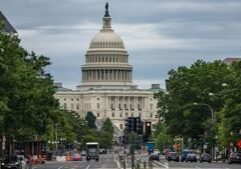
Experts comment on bill banning U.S. lawmakers from insider prediction bidding
Newly introduced legislation to ban members of Congress from betting in prediction markets should be expanded to include members of all three branches of the federal government, a government accountability group said.
Prediction markets like Polymarket and Kalshi, which allow people to trade on the outcome of real-world events, have become a political flashpoint in recent months.
Government watchdogs like Project on Government Oversight have criticized how prediction markets offer U.S. lawmakers, who already engage in stock trading, yet another way to profit off of information not available to the public.
The Stop Lawmakers from Predicting Act, introduced by U.S. Rep. Bryan Steil, R-Wis., forbids members of Congress, their spouses, or their dependent children from betting on the outcome of a specific government policy or action, or “any other event which has come to the attention of a covered individual as a result, directly or indirectly, of the service of a Member of Congress.”
Dylan Hedtler-Gaudette, POGO’s interim vice president of Policy and Government Affairs, told The Center Square that the bill, though narrow in scope, is ultimately “a step in the right direction.”
“If there is an opportunity to [address the issue] piecemeal by banning one cohort of federal officials and then moving on to the next – if that’s what we have to do, then that’s what we have to do,” Hedtler-Gaudette said. “It’s a lot better than the status quo, which is that we have almost no strong conflicts of interest restrictions for anybody in the federal government.”
The legislation builds upon Steil’s Stop Insider Trading Act, which passed out of the House Administration Committee in January but has seen no further advancement in the 119th Congress.
Hedtler-Gaudette believes that bans on both insider trading and bidding are critical for public restoring trust in Congress.
“If you introduce these personal financial opportunities to gain and to self-deal, you create a trust problem, and we already have an issue with the public not having a ton of confidence in what people do in the government,” he said. “When you see things like this cropping up, it corrodes that already pretty dismal trust in the relationship between the governing and the governed.”
As of mid-June, Americans’ approval rating of Congress sits at a dismal 24%, according to Ballotpedia’s Polling Index.
Prediction market bidding by government employees with insider information also poses a danger of influencing policy decisions, Hedtler-Gaudette added.
“The danger that we see with prediction markets is that they just provide too many opportunities to game the system with inside information,” he said. “It creates an uneven playing field that also has the potential to corrupt public policy making. And at the end of the day, government officials, especially elected ones, are there to represent their constituents, and whatever they’re doing – taking votes, conducting legislation, conducting oversight – they’re supposed to be doing it in the interest of the public.”
The Stop Lawmakers from Predicting Act doesn’t include congressional staff and only imposes a civil penalty for violations – a fine of $2,000 or 10% of the value of the prohibited transaction, whichever is greater, as well as the net gain realized from the transaction.
POGO policy analyst Janice Luong, who has written on the issue of insider bidding and petitioned House lawmakers to address it, told The Center Square that the organization ultimately desires a ban that covers employees in all branches of government.
“We agree that public officials and the staff who serve them must act independently of personal financial interests,” Luong said. “They should not use their position, access to non-public information, or official decision-making authority to seek personal gain from trading on prediction markets.”
POGO has also called on Congress to take things a step further and government actions and elections to the list of prediction contracts that are currently prohibited, which includes terrorism, war, assassination, gaming, or other activities “deemed contrary to the public interest”.
A recent analysis by the Anti-Corruption Data Collective tracked “suspicious, highly profitable wagers linked to military activity, notably in Venezuela and Iran,” finding that over $9.3 million has been bet in successful “long shot bets” on military markets on Polymarket.
The coalition published the report following the news that an U.S. Army Special Forces soldier allegedly used classified military intelligence to place winning bets on a prediction market platform. Master Sgt. Gannon Ken Van Dyke, who has entered a not guilty plea, is set to go on trial Dec. 7.
“Given recent developments like the Van Dyke cases and campaign staffers coming out about insider trading, it demands a more comprehensive solution,” Luong said. “Congress can and should go further.”





Showers And Thunderstorms
Latest News Stories

Illinois Gov. Pritzker signs assisted suicide bill

Hochul weighs AI regulations as Trump sets federal rules

EXCLUSIVE: First Nation police chiefs want to participate in border security efforts
Justice Department sues Fulton County over election records

USPS electric fleet push sparks cost, security and job concerns
WATCH: Use of Guard debated; Trump singles out Pritzker on AI; Property tax ruling

Illinois quick hits: Chicago Fed president explains vote; Treasurer encourages Bright Start gifts
EXCLUSIVE: Canadian groups, First Nation police support stronger border security

More than 9,500 commercial truckers taken off U.S. roads nationwide

Meeting Summary and Briefs: Beecher Public Library District for October 2025

New Lenox Used Car Dealership Approved by Land Use & Development Committee

Resident Raises Safety Concerns Over Stalled Foundation on Orchard Lane

Land Use Committee: Monee Solar Projects Granted Extensions; Battery Storage Plans Dropped

P&Z Commission: New Women’s Recovery Center Proposed for Patterson Road Receives Support
