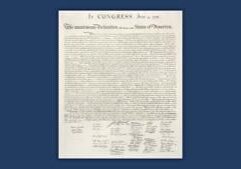
Op-Ed: What is the Declaration of Independence?
I frequently answer constitutional questions from individuals who want to know more about the relationship between the Constitution and the Declaration of Independence. Most of them understand that the Constitution is a statement of positive law—that is, man-made law—but they ask whether the Declaration is law as well.
During the 18th century, an official declaration was an announcement of a particular event, often after the event had occurred. In addition to the announcement, a declaration might explain the event or justify action being taken.
For example, in cases of offensive war, a government issued a declaration to announce the commencement of hostilities and to present its view of why it was justified in fighting. During the summer of 1775, the Second Continental Congress issued a “Declaration of the Causes and Necessity for Taking Up Arms.” This document explained why armed resistance against Britain had arisen and why it was necessary.
When Congress proposed the Bill of Rights to the states, Congress added a preamble explaining that the bill included both “declaratory and restrictive clauses.” The declaratory clauses (now the Ninth and Tenth Amendments) merely declared—that is, clarified—what was already true about the Constitution: that the federal government was one of enumerated and limited powers, and that its lists of specific rights did not entitle the federal government to otherwise exceed those limited powers.
The Declaration of Independence also was an announcement. When it was approved (July 4, 1776) and released to the public (July 8), Congress already had voted for Independence (July 2). The Declaration did not create a new legal situation; it explained why it had arisen.
The Declaration is superbly organized. It begins with a title: “The unanimous Declaration of the thirteen united States of America,” and then proceeds in five identifiable parts.
The first part is the preamble. A preamble in a legal or official document states the reason for the document and the purposes or intent behind it. Sometimes it consists of a set of “Whereas” clauses, and sometimes—as in the Declaration and the Constitution—it forms a single unit. The Declaration’s preamble consists of these familiar words:
“When in the Course of human events, it becomes necessary for one people to dissolve the political bands which have connected them with another, and to assume among the powers of the earth, the separate and equal station to which the Laws of Nature and of Nature’s God entitle them, a decent respect to the opinions of mankind requires that they should declare the causes which impel them to the separation.”
This paragraph tells us the reason for the Declaration.
The next part contains premises and assumptions. It is a statement of natural law and natural rights, and adds the prudential conditions under which a people can “throw off” an oppressive government. It reads in part:
“We hold these truths to be self-evident, that all men are created equal, that they are endowed by their Creator with certain unalienable Rights, that among these are Life, Liberty and the pursuit of Happiness.—That to secure these rights, Governments are instituted among Men, deriving their just powers from the consent of the governed,—That whenever any Form of Government becomes destructive of these ends, it is the Right of the People to alter or to abolish it, and to institute new Government, laying its foundation on such principles and organizing its powers in such form, as to them shall seem most likely to effect their Safety and Happiness . . .”
The third part of the Declaration is the list of grievances. It begins as follows:
“Such has been the patient sufferance of these Colonies; and such is now the necessity which constrains them to alter their former Systems of Government. The history of the present King of Great Britain is a history of repeated injuries and usurpations, all having in direct object the establishment of an absolute Tyranny over these States. To prove this, let Facts be submitted to a candid world.”
Ensuing is a detailed list of 28 grievances and sets of grievances. They are stated as grievances against the king. Many commentators have argued that the principal fault for many of these grievances actually lay with Parliament or the ministry rather than with the king. But the king was the official representative of his country. He had the power to conduct foreign policy, he appointed the ministers who planned colonial policy, and he had sent troops (including Hessian troops) to America. Moreover, he could have vetoed or otherwise blocked oppressive parliamentary bills. Instead, he had contemptuously rejected recent colonial petitions and declared the colonies outside his protection.
The fourth part of the Declaration was an apologia, or defense, of America’s conduct. It also suggested that the British people bore some of the blame for what had happened. This section reads in part as follows:
“In every stage of these Oppressions We have Petitioned for Redress in the most humble terms: Our repeated Petitions have been answered only by repeated injury . . . Nor have We been wanting in attentions to our British brethren. We have warned them from time to time of attempts by their legislature to extend an unwarrantable jurisdiction over us. . . . We have appealed to their native justice and magnanimity, and we have conjured them by the ties of our common kindred to disavow these usurpations . . . They too have been deaf to the voice of justice and of consanguinity . . .”
The fifth and last part contained what lawyers call the “operative words”—language that does not merely explain or justify, but actually create (or declare) a legal event:
“We, therefore, the Representatives of the united States of America, in General Congress, Assembled, appealing to the Supreme Judge of the world for the rectitude of our intentions, do, in the Name, and by Authority of the good People of these Colonies, solemnly publish and declare, That these United Colonies are, and of Right ought to be Free and Independent States; that they are Absolved from all Allegiance to the British Crown, and that all political connection between them and the State of Great Britain, is and ought to be totally dissolved; and that as Free and Independent States, they have full Power to levy War, conclude Peace, contract Alliances, establish Commerce, and to do all other Acts and Things which Independent States may of right do. And for the support of this Declaration, with a firm reliance on the protection of divine Providence, we mutually pledge to each other our Lives, our Fortunes and our sacred Honor.”
Next installment: The Declaration of Independence – Its Debt to History and Meaning.
Rob Natelson, a former University of Montana constitutional law professor, is Senior Fellow in Constitutional Jurisprudence at the Mountain States Policy Center, an independent research organization based in Idaho, Montana, Washington and Wyoming. Online at mountainstatespolicy.org. Rob authored the book “The Original Constitution,” and Justices of the U.S. Supreme Court have cited his constitutional research repeatedly.





Slight Chance Rain Showers then Mostly Sunny
Latest News Stories

New Lenox Used Car Dealership Approved with Conditions

Meeting Summary and Briefs: Beecher Fire Protection District for Nov. 2025

Op-Ed: How one puppy mill-teliant retailer is preempting local laws

Illinois quick hits: Chicago school board raises property tax levy

Illinois lawmaker welcomes possible Marine deployment after Supreme Court ruling
Meeting Summary and Briefs: Beecher Village Board for December 22, 2025

County Board Approves Women’s Residential Treatment Center in Joliet
White business owners are biggest share of Illinois’ diversity-preferred contract group

Beecher Firefighters Log Over 9,700 Training Hours; New Truck Expected Soon
Meeting Summary and Briefs: Will County Board for December 18, 2025

Village Clerk Janett McCawley Retires After 35 Years

Undersheriff Brian Conser Retires After 29 Years of Service