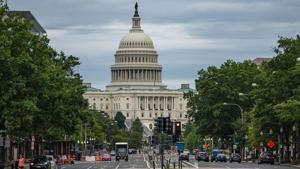
Over 7 million student loan borrowers have 90 days to switch repayment plans
Major changes to federal student loans will begin July 1, with most prospective federal student aid applicants facing only two repayment plan options from that day forward.
The new plans replacing PAYE and ICR plans are a tiered Standard Repayment Plan and the income-driven Repayment Assistance Plan (RAP). Borrowers currently on PAYE or ICR plans will have until July 1, 2028, to transition to one of the new plans.
The Standard Repayment Plan, which currently lasts 10 years, will be modified to allow borrowers to pay a fixed monthly payment, based on the loan amount instead of income, over a period of 10 to 25 years.
Lower-income borrowers could choose the Repayment Assistance Plan and pay a lesser percentage of their adjusted gross income, capped at 10%. Any remaining loan balance after 30 years would be forgiven.
The government would also waive the loan interest portion for RAP plans if on-time monthly payments do not cover interest, ensuring that borrowers who make regular payments don’t see their outstanding balance go up.
Additionally, July 1, 2026, begins a 90-day countdown for the roughly 7.5 million borrowers currently enrolled in the Biden administration’s now defunct SAVE plan.
Those loan holders must transition to either the Income Based Repayment plan – which will only be available for loans taken out before July 1, 2026 – or one of the two new repayment plans. Otherwise, they will automatically be placed on one of the new plans.
Republicans argue that the new plans will not only save the federal government $278 billion by 2034 but also simplify and streamline the federal student loan borrowing and repayment process. Democratic opponents and higher-education groups have criticized the post-graduate borrowing caps, arguing they will impact a large group of students wanting to continue with specialized degrees.
The changes are a result of congressional Republicans’ “One Big Beautiful Bill,” also known as the “Working Families Tax Cuts Act,” that became law last year.
That budget reconciliation bill also authorized the Secretary of Education to establish an accountability framework for educational institutions offering programs that don’t provide students with a return on investment in employment opportunities.
Additionally, the legislation made changes to how much federal aid post-college students can borrow, changes that also take effect Wednesday. The GRAD Plus loan program will no longer be available and will be replaced by Direct Unsubsidized Loans.
Graduate student borrowing will be capped at $20,500 per year and $100,000 over a lifetime, unlike the GRAD Plus loans that allowed students to fully cover the cost of attendance. Professional students, including those in law and medical schools, will only be able to borrow $50,000 per year and $200,000 over a lifetime.
As of March 2026, the U.S. Department of Education holds roughly $1.7 trillion in outstanding student loans owed by roughly 43 million borrowers, and roughly a third of those borrowers are behind on payments, according to Federal Student Aid.






Sunny
Latest News Stories

Michigan lawmakers spar over Rx Kids program amid oversight concerns
GOP rep: New budget shows ‘addiction’ to taxes

Retirees face $5,500 average cut to annual Social Security benefits in 2032

Illinois Quick Hits: Comptroller Mendoza announces run for Chicago mayor

Georgia doctors face scrutiny as they cozy up to injury lawyers

Beecher Hears Nantucket Cove Concerns Over Vacant Lots, Streetlight

Wiener, Gallagher, Gray lead in congressional races
Waters, other incumbents ahead in LA congressional races
Desmond, Wilpert ahead in District 48 race to succeed Issa

Candidates advance in redrawn congressional districts
Kiley, Pan neck to neck in Congressional District 6 race
Bass, Pratt lead Los Angeles mayoral race