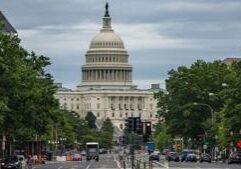
GOP hardliners vow to blockade must-pass bills unless voter ID demands met
Despite the looming 2026 midterm elections and the growing list of congressional responsibilities, a persistent group of Republicans are vowing to obstruct all U.S. House business until leadership effectively forces the Senate to take up a voter ID bill.
Led by Rep. Anna Paulina Luna, R-Fla., the conservative House members have twice derailed what many consider must-pass bills by trying to use them as a vehicle for advancing Republicans’ SAVE America Act.
The House recessed early Wednesday after the group tanked a rule to advance the National Defense Authorization Act, a critical Pentagon funding authorization bill. As of Thursday, the hardliners say they won’t abandon their strategy, no matter the collateral damage, when the chamber returns on July 13.
“We are coming up on America’s 250th birthday, and we have feckless leadership in the Senate refusing to pass the SAVE America Act,” Luna posted on social media Thursday, lambasting colleagues who “are more concerned about putting Senators in a ‘tough spot’ on the NDAA than passing SAVE America.”
“So yes, 1,000%, the rule will go down until you attach the SAVE America Act. I don’t care who in this chamber hates me for it,” Luna said, adding that she is “not the only one” with the same intentions.
“We should be doing everything to pass SAVE America. Add it to reconciliation. Add it to NDAA. Add it to FISA. Add it to every must pass bill.”
As Senate Majority Leader John Thune, R-S.D., has made clear numerous times, however, the House lawmakers’ efforts to force the upper chamber to pass the bill are mathematically destined to fail.
Senate Democrats have unanimously made clear that they will filibuster any legislation, no matter how critical, that contains provisions from the SAVE America Act, which they deem an act of “voter suppression.”
The bill, currently languishing in the Senate after passing the House, mandates that Americans display a valid ID to vote in federal elections and requires people to present proof of citizenship when registering to vote.
It also necessitates in-person voter registration for federal elections and directs states to remove all noncitizens from their voter rolls.
Democrats argue that the in-person registration and proof of citizenship requirements would unduly burden Americans who are disabled, live in remote areas, or don’t have access to the correct documentation.
Under the legislation, people would not be able to register to vote with only their driver’s license, since noncitizens can obtain that. They would instead need to present documents proving U.S. citizenship, such as a birth certificate or U.S. passport.
Republicans counter that for Americans without access to documentation, the bill allows potential voters to issue a sworn attestation, under penalty of perjury, to their status as a U.S. citizen.
Once their state verifies their citizenship and confirms their eligibility, those Americans’ votes would be counted. Existing law for voter registration in federal elections does not require the state to officially review or verify citizenship attestations, which Republicans argue is an election security risk.
President Donald Trump has supported – and in some cases instigated – Republican rebellion against party leadership over the SAVE America Act, which he believes will make voter fraud nearly impossible.
Congress has only eight scheduled workdays until recessing again, this time for the entire month of August.
The legislative backlog lawmakers will then confront – mere weeks before early voting for the midterm elections begins in some states – includes the NDAA, the federal highway bill, the federal farm bill, FISA 702 reauthorization, and the 12 annual government funding bills.




Mostly Sunny
Latest News Stories

Highland Liquors Cleared for Video Gaming Expansion Following Zoning Approval
Lawmakers spar with Fairfax County leaders over sanctuary policies

Advocates call on tax reform to reduce national debt
Supreme Court allows mail-order abortion drugs

McCuskey, coalition of AGs urge SEC to review OpenAI
Springfield strains for balanced budget; Illinois revenue forecast shifts down

DOJ targets healthcare fraud in California, Arizona, Nevada

Beecher Holds Off Iroquois West in High-Scoring 12-10 Thriller

Illinois Quick Hits: University of Chicago to offer free tuition

Human capabilities focused in student, teacher artificial intelligence guide
U.S. House to vote on bills targeting fraudulent, foreign election donations

Responses due in Virginia redistricting appeal