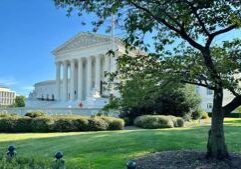
Parents applaud denial of child app purchases case
Parental rights organizations applauded the U.S. Supreme Court’s decision to withhold blocking a Texas law preventing minors from making app store purchases.
Justices on the high court declined to block the App Store Accountability Act, a law that requires app stores and digital platforms to verify a user’s age and obtain parental consent before a minor can download apps. The high court also declined to block a law that required social media companies to verify the age of a user and restrict minors’ access to content considered harmful.
Students Engaged in Advancing Texas, an activist group that challenged the law, said the restrictions limited access to news and educational content. The students argued Texas’ law violated their First Amendment rights.
“Every day the law is enforced, Applicants are denied their basic rights to organize, advocate, express ideas, and discover new perspectives through the most important medium for human communication,” lawyers for the group wrote in a petition to the high court.
The Child First Policy Center, a Utah-based advocacy organization, celebrated the high court’s denial. The group said Texas’ law should be the standard across the United States.
“The Supreme Court just sided with parents,” the organization wrote. “Age verification. Parental consent. Before kids download apps. This is the standard every state should have.”
Lawyers for Ken Paxton, the Texas attorney general who implemented the law, said it is designed to prevent children from accessing harmful content or making purchases.
“Just as States have long protected minors from alcohol, cigarettes, and other harmful products, S. B. 2420 protects children against dangerous modern products,” lawyers for Paxton wrote.
The U.S. House Committee on Energy and Commerce also applauded the Texas law. The congressional committee said the act prevents corporations from taking advantage of minors through app store purchases.
“The App Store Accountability Act protects children and empowers parents with the ability to decide what apps their kids should be able to access on their smartphone,” the committee wrote in a statement.
The high court’s denial follows Free Speech Coalition v. Paxton, a case challenging laws that required age verification for individuals accessing sexually explicit material, including pornography in Texas. Justices on the high court, in a 6-3 decision, said the Texas restriction was in line with the U.S. Constitution.
“The First Amendment leaves undisturbed States’ traditional power to prevent minors from accessing speech that is obscene from their perspective. That power includes the power to require proof of age before an individual can access such speech. It follows that no person – adult or child – has a First Amendment right to access such speech without first submitting proof of age,” Justice Clarence Thomas wrote in the court’s majority opinion.
However, the International Center for Law and Economics criticized the high court’s decision not to review the App Store Accontability Act. Ben Sperry, a senior scholar of innovation policy at the center, said Texas’ law is not aligned with the First Amendment.
“Minors have a right to participate in the marketplace of ideas, including as purchasers and receivers of speech, like apps,” Sperry wrote. “This would likely lead to considerable collateral censorship not only for minors, but also adults who do not wish to provide the necessary means to have their age verified.”






Partly Sunny
Latest News Stories

Lawmaker calls for department reform supporting Illinois families with disabled children

Lawyers’ ‘misleading statements’ hang cloud over college finaid class action

Ceasefire impact holds across markets despite varying reports on the Strait of Hormuz

SEC chairman returns ”first principles’ to public markets, supports Texas exchange
Complaint filed against AMA Foundation for racially discriminatory scholarships

Democrats vow to hold Bondi in contempt for refusing Epstein deposition

Commonwealth LNG signs supply deals with five major buyers

Lawmakers hear debate over data centers including revenue, headaches

Illinois quick hits: Madigan corruption appeal to begin Thursday; Attorney General asks lawmakers for additional $15 million;
Deficit watchdog urges Congress to cut more, spend less than Trump’s budget request

Lawmaker pushes sales tax pause on gas as questions cloud ‘fragile’ ceasefire

Groups warn Middle East truce may not ease economic fallout