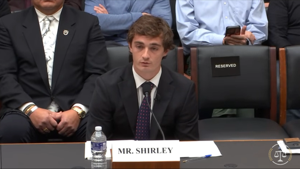
Concerns raised that KIDS Act threatens Americans’ online privacy, free speech
Legislation meant to protect American teens and children online recently passed the U.S. House with strong bipartisan support, but civil liberties groups are warning that the bill could have unintended consequences.
The Kids Internet and Digital Safety (KIDS) Act, which passed the House in a bipartisan 267-117 vote, is a compilation of bills that, among other things, require companies to implement protective measures for minor users.
Those include barring children under the age of 17 from accessing sexually exploitative content, financial scams, and content involving “the promotion of the distribution, sale, or use” of alcohol, narcotic drugs, tobacco and gambling.
It would also generally prohibit platforms from collecting information on minor users for targeted advertising, ban market and product research on minor users, require AI chatbot disclosures, limit platform design features that encourage compulsive usage, and mandate that platforms install parental controls.
Advocates of the 114-page legislation argue that it provides a multi-pronged approach to addressing safety concerns for children online. Rep. Brett Guthrie, R-Ky., the sponsor of the KIDS Act, called it “the strongest approach to protecting kids online that Congress has ever seen.”
But critics like Joe Mullin, a senior policy analyst at the online civil liberties advocacy group the Electronic Frontier Foundation, are concerned that the protective measures come at the expense of Americans’ rights to privacy and free expression.
While the bill package does not outright mandate that companies verify users’ ages, it creates requirements that depend upon companies knowing the age of users on their platforms. The new protective measures apply when a website or app “knows or should have known” a user is under 17 years of age, putting companies at legal risk if they do not verify all users’ ages.
“The fact that basically a website or app, no matter how big or small it is, could get in trouble if a user is a minor — and the knowledge standard is ‘knows or should have known a user’s age,’ and that’s a really low knowledge standard — that’s also going to be a problem for adults, because you’re going to have to start proving that you’re an adult,” Mullin told The Center Square.
Those new requirements will therefore likely lead to widespread adoption of strict age verification measures on major online platforms, such as requiring all users to give up sensitive personal information like drivers’ licenses or passports or submit to facial recognition analyses.
Companies would store that information in massive databases, which are vulnerable to breaches and hackers, Mullin noted.
“They’re prone to exploitation — not only could a foreign hacker get a hold of it, a foreign government could get a hold of it, a criminal hacker domestically or abroad could get a hold of it,” Mullin said. “Once you’re able to crack into a database with 45,000 IDs, there’s a lot of mischief you can do…There’s real privacy benefits that we’re going to be giving up if we accept an age-gating internet.”
Another concern is that because there is currently no federal data privacy law, companies will create highly detailed profiles of millions of adult Americans and sell potentially sensitive information to data brokers, who in turn can sell that to federal intelligence agencies.
“It actually creates a problem when you say ‘this tracking ad is really dangerous and harmful to a 17-year-old, but as to anyone who’s 18 or over, it’s perfectly fine,” Mullin said. “There’s no all-encompassing federal privacy law, so once someone’s 18 or over, it’s like a free-for-all right now.
“If the KIDS Act passes, in a way that can actually make it worse, because with surveillance advertising, the tracking will get better,” he added. “They will know exactly what age you are, because they’ll have to.”
Mullin also highlighted potential dangers the legislation poses to free speech. In particular, the provision preventing minors from seeing content that promotes the sale or use of narcotics, gambling, alcohol, and other age-restricted products “is really open to interpretation,” he said.
“When you say sale or use, that could be a discussion about it, it could be a forum where someone says, ‘I’m concerned about my alcohol use,’ or ‘I’m concerned about the alcohol use of someone in my family’…the idea that you would have to scrutinize everyone who tries to use a forum like that, it will have an effect on people’s right to speak out and also to get information,” Mullin said.
“So if you have a friend you’re worried about, can you discuss addiction and recovery, can you talk about a friend who’s drinking too much? That’s all clearly lawful speech, including speech for minors.”
There are ways the government could protect minors online without jeopardizing millions of Americans’ speech and privacy, Mullin argued, such as banning surveillance advertising for everyone, which would eliminate the need for age verification.
“There’s no reason Congress couldn’t do that. But there’s a reason we’ve never seen that bill introduced, and it’s because they won’t stand up to pressure from companies that like to use that business model.”
Parents should and often do also take a major role in protecting children online, Mullin added, and Congress could change certain laws to make it easier for parents to do so.
“Some of the solutions are so boring that I think lawmakers don’t really like to hear about them, and they also cost money,” he said.
“But they could make the market for parental controls more competitive by doing things like reforming the Computer Fraud and Abuse Act. The reason that there’s not a whole array of apps for parents to choose from, like making TikTok safe for your kid, is because TikTok is allowed to sue over that. So we need to reform the law that lets companies attack their competitors.”
Ultimately, Mullin argued that the federal government shouldn’t be involved in actively enforcing online protective measures “beyond a very minimal degree.”
“I think we have a lot of lawmakers that are being talked to right now by people with some legitimately tragic stories that they’re blaming on things that happen on the internet, but they’re just not in touch with how median Americans use these things,” Mullin said.
“We’re not opposed to content moderation for minors, but it should happen within the family. And it’s definitely not in any of our interests for them to start collecting age information on everyone.”






Patchy Fog then Sunny
Latest News Stories

Pursuit following railroad theft ends in New Lenox; one suspect at large

Waste Management Commits to Expanded Litter Patrols Around Landfill

Meeting Summary and Briefs: Will County Ad-Hoc Ordinance Review Committee for Jan. 13, 2026
County Approves $22 Million in Road Projects for Lorenzo Road and Mills Road
Landfill Committee Advances Plan to Purchase Fourth Compressor for RNG Plant
Ad-Hoc Committee Retains Noise Ordinance Despite Enforcement Frustrations
Will County Commits $15M to Transfer Sanitary District Operations to City of Joliet

District 200-U Board Approves 2026-2027 Academic Calendar

Prairie View Landfill Expansion Plans Take Shape as Consultants Navigate Design Challenges
County Committee Proposes Federal Study on “Legacy Pollution” Near Joliet and Romeoville Refineries

Beecher School Board Authorizes Dismissal of Tenured Employee
County Authorizes Condemnation to Advance Francis and Marley Road Improvements