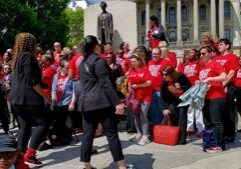
Court: Parents can’t sue teachers unions over illegal strikes
(Legal Newsline) – Parents do not have legal rights to sue teachers unions for calling illegal strikes, which allegedly lead to learning loss and other economic and societal harms, an Illinois state appeals court has ruled.
And the appeals court said the unions may also be allowed to turn around and demand payment from the parents who sued them for allegedly attempting to use the courts to punish unions for their “speech” publicly defending their allegedly illegal labor actions.
On July 8, a three-justice panel of the Illinois First District Appellate Court upheld a Cook County judge’s decision tossing a lawsuit brought against the Chicago Teachers Union by parents of Chicago schoolchildren over the CTU’s attempt to thwart Chicago Public Schools’ efforts to reopen schools following the Covid pandemic in late 2021 and early 2022.
The parents had filed that lawsuit in Cook County Circuit Court in 2024, seeking up to $250 million from the union for allegedly causing learning loss, income loss and general headaches for CPS students and families when the union executed a labor action to protest CPS’ return to full-time, in-school learning.
The lawsuit accused the CTU, as well as former CTU President Jesse Sharkey, current CTU President Stacy Davis Gates, and the American Federation of Teachers, of allegedly conspiring to engage in the labor action, which the lawsuit called an illegal strike, because the CTU asserted CPS did not do enough to protect them from the spread of Covid during that time.
The plaintiffs have been represented in the action by attorneys Patrick Hughes and Daniel Suhr, of the firm of Hughes & Suhr LLC, of Chicago.
The lawsuit centered on CTU’s actions amid CPS’ planned return to in-person learning, as the school system became one of the last in the country to restore normalcy to public education for hundreds of thousands of students in the country’s third largest city, after enduring over a year of disruption during the Covid-19 pandemic.
The slow return to in-person learning was heavily credited not only to state and local public health restrictions imposed on all levels of society by Gov. JB Pritzker and Chicago Mayor Lori Lightfoot, among others, but also to heavy resistance by the CTU, with the support of allies in the national teachers union. The CTU, for instance, notably posted on social media that calls to return to in-person learning were “rooted in sexism, racism and misogyny.”
However, those delays in returning to in-person schooling likely affected low income racial minority students the most, according to the complaint, leading to substantial learning loss.
The complaint cited academic analysis demonstrating that such learning loss further leads to substantial income loss later in life.
That damage was allegedly exacerbated by a labor action lasting five days, from Jan. 5-11, 2022, in which the CTU refused to return to the classroom to teach students until it secured certain concessions from CPS.
CTU notably did not describe the action as a “strike,” instead repeatedly referring to the refusal to report to classrooms, as ordered by CPS, as a “remote learning action.”
The lawsuit, however, said the action by any name amounted to an illegal strike. They noted both former Mayor Lightfoot and CPS referred to the action as “an illegal work stoppage.”
The work stoppage ended when the CTU and CPS negotiated a settlement.
The parents, however, were never given the chance to lay out the case in the courts, nor make the CTU answer for the allegedly illegal action.
Rather, Cook County Judge Daniel J. Kubasiak agreed with the CTU and other defendants in finding that Illinois law doesn’t permit anyone other than public school districts, like CPS, to bring legal actions against teachers unions, like the CTU, over allegedly illegal strikes.
And those actions, the judge said, must originate only before the Illinois Education Labor Relations Board.
The parents appealed the ruling, but the appellate justices backed up Kubasiak’s reading of the law.
In the ruling, the justices brushed aside the parents’ “public nuisance” claims, saying they amounted solely to an attempt to sidestep “the exclusive jurisdiction of the IELRB” and bring their claims in court.
“Here, the conduct being regulated is a Chicago public teachers’ strike,” the justices wrote.
And that, the justices said, means the case invokes the state law governing teacher strikes. And that law, the justices said, gives only public school districts the authority to challenge illegal teacher work stoppages in court.
The justices further rejected the parents’ attempt to argue that this interpretation of that state law unconstitutionally strips parents of their rights to sue teachers unions that harm their families through illegal actions.
The justices pointed to prior court decisions affirming that only a public school board of education is constitutionally empowered to sue teachers unions for calling illegal strikes, no matter how those labor actions may harm students or their families.
In their ruling, however, the justices said Kubasiak’s ruling contained one error. They said the judge improperly refused to hold a hearing on whether the American Federation of Teachers should have been allowed to potentially countersue the parents for suing them at all.
That claim rested on Illinois’ law forbidding so-called Strategic Lawsuits Against Public Participation, or SLAPPs. The AFT essentially asked the judge to determine if the parents’ lawsuit amounted to an illegal SLAPP action intended to punish the AFT for speaking out in support of the CTU’s demands to be allowed to continue to stay home and avoid teaching students in person until such time as the teachers’ union agreed the danger of Covid had sufficiently passed.
In their ruling, the appellate justices agreed Kubasiak should yet hold further proceedings on that question.
Should the AFT prevail, the parents and potentially their counsel could be forced to pay the unions’ legal fees in the case.
The appellate decision was authored by Justice Leroy K. Martin. Justices Bertina E. Lampkin and Jesse G. Reyes concurred in the ruling.
The decision was issued as an unpublished order, which may limit its use as precedent.




Sunny
Latest News Stories
Meeting Summary and Briefs: Village of Beecher Board of Trustees for July 28, 2025
Peotone Schools to Launch “Go Big Blue” Unity Initiative
Peotone FFA Alumni Propose Privately Funded Greenhouse to Expand Program
Will County Committee Forwards Overhauled Purchasing Code Amid Debate on Local Contractor Preference
Finance Officials Clarify How Will County Tracks Assets, From Vehicles to Desks
Will County Treasurer Confirms Free Online Tax Payment Option, Warns Against High Credit Card Fees
Committee Highlights ‘Lack of Teeth’ in County Code Enforcement Process

Meeting Briefs: Will County Ad-Hoc Ordinance Review Committee for July 22, 2025
Crete Township Wins Approval for New Digital Sign at Community Center
Will County Planners OK Oversized Garage Near Naperville, Overriding Staff Recommendation
Green Garden Landscaping Business Gains Permit Amid Strong Neighbor Support
Meeting Briefs: Will County Planning and Zoning Commission for July 15, 2025