
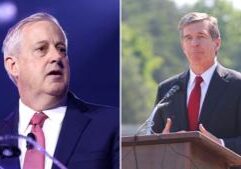
Election 2026: Cooper poll lead tightened to 4 points
Republican Michael Whatley’s latest ad campaign paints Democrat Roy Cooper in the same light as other national figures in his party just as a new poll Monday brings the race tighter.
Cooper’s lead is 48%-44% in the sampling from Public Policy Polling, less than half a point from a statistical tie. Cooper, the former two-term governor with 38 years in public office across five decades, held a 92%-69% advantage in name recognition.
The poll sampled 759 voters Friday and Saturday and carries a +/- 3.6% margin of error. This Senate race is considered pivotal to Republicans keeping the majority in the chamber, and could set spending records between $500 million and $1 billion.
Absentee ballots will go into the mail for those making requests seven weeks from Friday. North Carolinians will choose a U.S. senator, all 14 members of the U.S. House, and all 170 members of the General Assembly.
The same pollster had Cooper ahead 47%-40% in March.
As recently as a June 1-10 sampling by the Center for North Carolina Politics & Public Service at Catawba College in conjunction with YouGov, Cooper led Whatley 48%-34%.
Early advertising campaigning from Whatley and supporters has painted Cooper as “soft on crime.” Not unexpected, Cooper’s time as a lawmaker in the General Assembly that began with a 1986 win and continued through terms in the Senate, four in the attorney general’s office and two in the governor’s office ending Dec. 31, 2024, have brought him the label “career politician.”
Republicans say he’s an automatic vote for the likes of New York Sen. Chuck Schumer, California Sen. Adam Schiff and Massachusetts Sen. Elizabeth Warren.
Cooper supporters and Democrats have continued to hammer away at Whatley as a “longtime oil lobbyist” and have criticized his performance and role in Hurricane Helene recovery. He was asked to participate in its leadership by second-term Republican President Donald Trump when he made his first trip from the White House after Inauguration Day.
Cooper’s favorable polling was 47% to 45% unfavorable. Whatley’s favorable polling was 31% to 38% unfavorable. Not sure for each candidate was 31% on Whatley and 8% on Cooper.
Before Monday’s release, the latest sampling was released July 1 by the New York Times and Siena Research Institute at Siena University. That poll gave Cooper a 50%-43% advantage. Respondents, queried June 15-27 had a disapproval rating for Trump of 55% and approval rating of 40%.
The latter is notable because Monday’s poll had Trump at 52% disapprove and 42% approve – a solid gain of 5%. As the former pick of Trump to be chairman of the Republican National Committee for his 2024 election campaign, Whatley is inextricably tied to the president and the obligatory headwinds that come with these midterms.
Elsewhere in the Public Policy Polling analysis, Democratic incumbent Anita Earls and former state Rep. Sarah Stevens were statistically tied within the margin of error. Earls led 44%-42%.





Sunny
Latest News Stories

Illinois quick hits: Former police chief convicted of bribery; man sentenced for fraud

WATCH: Chicago mayor: ‘Wicked’ people want chaos; critics rip mayor
WATCH: Chicago mayor warns of budget ‘chaos,’ end-of-life options bill on gov’s desk

Ogalla Blasts New State Solar Legislation
Committee Postpones Vote on Brandon Road Fill Operation After Tree Clearing Allegations
Beecher Schools to Publish Curriculum Maps Online; Board Discusses Future Foreign Language Mandates

Meeting Summary and Briefs: Will County Planning and Zoning Commission for December 2, 2025
Metra Announces No Fare Hikes; Highlights Bridge Projects in Joliet and Mokena
Committee and Parents Discuss Safety Concerns at Daycare Drop-Offs

Rent collusion suit tossed vs manufactured home community operators
Illinois quick hits: Planned vigil opposes physician-assisted suicide; NFIB urges veto of energy bill
Beecher Transportation Committee: Adjust Daycare Transportation Schedule to Address Overcrowding
Beecher Board Approves 2025 Tax Levy with 2% Increase

Library Temporarily Increases Book Budget Following Distributor Closure