Senate panel sits on AI jobs-data bill 8 months on
A bipartisan U.S. Senate push to make the federal government track AI’s effect on jobs has gone unanswered for four months, and the bill meant to force companies to report AI-related layoffs has sat without a vote in committee since November.
“I have not received a response to the letter,” Sen. Mark Warner, D-Va., told The Center Square on Monday, referring to a March 6 letter he and Sen. Josh Hawley, R-Mo., sent pressing the Bureau of Labor Statistics and Census Bureau to add AI-specific questions to major labor surveys.
The letter cited language in the fiscal 2026 appropriations act directing BLS to study AI’s effect on job loss and creation.
The senators’ bill, the AI-Related Job Impacts Clarity Act, would require companies to report AI-related layoffs. It has sat in the Senate HELP Committee without action since it was introduced Nov. 5, 2025. Asked about the holdup, Warner said, “The chairman determines the committee schedule.”
Hawley’s office did not respond to a request for comment by press time.
The senators’ letter and bill predate Monday’s “We Must Act Now” statement, in which more than 200 economists and AI researchers – including 16 Nobel laureates – warned that AI could disrupt the economy fast. Organized by Stanford University’s Digital Economy Lab, the statement calls on leaders to build “incentives, guardrails, and institutions” to prepare for AI-driven job losses – but the four-sentence letter names no dollar figure, no legislation and no agency responsible for acting.
Federal budget forecasters are only beginning to grapple with the same question. CBO’s February outlook built in a modest AI productivity boost – 0.1 percentage point a year – while cautioning that “considerable uncertainty” surrounds both the pace of adoption and the resulting productivity gains, meaning the effects “could ultimately prove larger or smaller” than the baseline assumes.
A new working paper by former CBO Director Douglas Elmendorf and economists Karen Dynan and Louise Sheiner complicates the outlook: even in their most severe scenario – permanent job displacement, unemployment up 2 points, income flowing almost entirely to capital owners – faster growth shrinks federal debt rather than expanding it.
The paper’s other scenarios range from AI simply boosting growth broadly with no job losses, to growth that lifts incomes only for the top quintile, to a middle scenario where AI displaces about 3 million workers at any given time – roughly double the scale of the “China shock” of the 2000s – but new jobs also emerge. The harder question, they argue, is political: whether Congress lets existing programs erode relative to the economy, or steps in to support displaced workers.
Treasury did not respond to a request for comment by press time.
The companies building the technology previously warned of widespread layoffs. Anthropic CEO Dario Amodei warned in May 2025 that AI could eliminate half of entry-level white-collar jobs and push unemployment to 10-20%.
This month, he described something different: “If you automate 90% of the job, then everyone does the 10% of the job,” he said, adding that the remaining work “expands to be 100% of what people do” at 10 times the productivity.
OpenAI CEO Sam Altman, who once said entire job categories would be “totally, totally gone,” told an audience in Sydney in May that he was “pretty wrong” about AI’s near-term economic impact and “delighted to be wrong.”
Both companies have confirmed confidential IPO filings this year; Anthropic’s most recent funding round valued it at $965 billion. Anthropic and OpenAI did not respond to requests for comment by press time.
“We cannot afford to wait until AI has fundamentally transformed our economy before we begin preparing for its impact on American workers,” Warner told The Center Square.
He’s introduced three bills this year aimed at closing the data gap – the AI-Related Job Impacts Clarity Act, the Workforce Transparency Act and the Economy of the Future Commission Act. None has moved out of committee.


Patchy Fog then Sunny
Latest News Stories
Will County Board Members Demand Transparency in Cannabis Tax Fund Allocation
Homer Glenn Residents Push Back on 143rd Street Widening as Officials Signal “Tentative Agreement”
Will County Forges 2026 Federal Agenda Amid D.C. Policy Shifts, ‘Big Beautiful Bill’ Impacts
Health Department Seeks $1 Million Levy Increase to Prevent “Weakened System”
County Rolls Out New “OneMeeting” Software to Improve Public Access

Meeting Summary and Briefs: Will County Board Finance Committee for August 5, 2025
Will County PZC Approves Rezoning for Truck Repair Facility on Manhattan Road Amid Resident Concerns
Key Stretch of Bell Road on Track for Thanksgiving Reopening, Committee Approves Additional Funds
Will County Leglislative Committee Opposes Federal Push for Heavier, Longer Trucks
Will County Reports Progress in Opioid Fight, Highlights New FDA Labeling Rules
In-House Staff Completes Major Renovations at Will County Adult Detention Facility
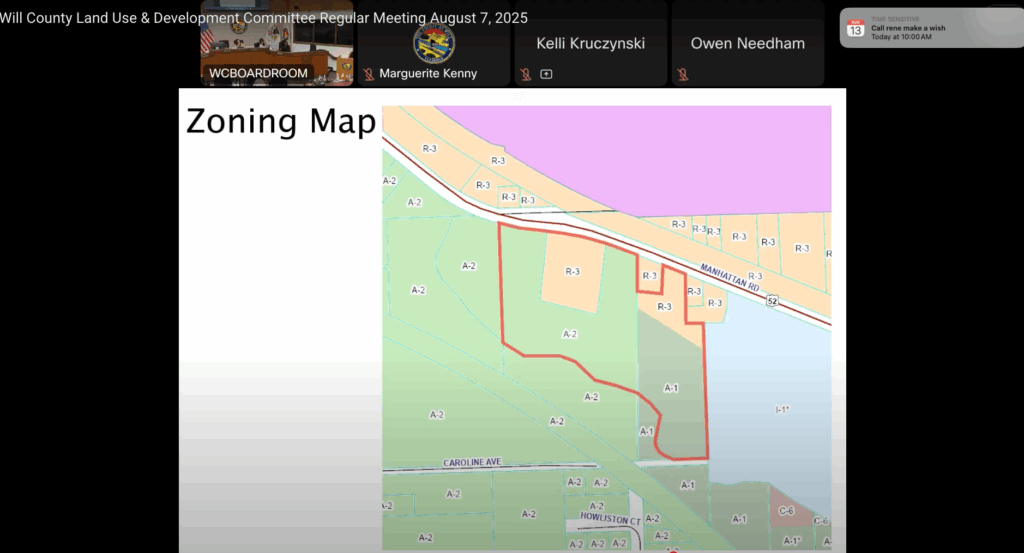
Will County Advances Truck Repair Facility Plan on Manhattan Road Despite Resident Objections
PZC Grants Variance for Oversized Garage in Joliet Township, Reversing Staff Recommendation