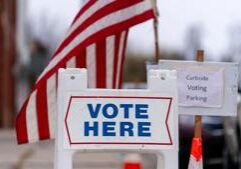
U.S. House passes election campaign financing bill
The U.S. House passed a bill Monday that would restrict funding of state and local political races and ballot proposals to American citizens only.
The Stop Foreign Funds in Elections Act, sponsored by U.S. Rep. Brian Fitzpatrick, R-Pa., aims to prevent foreign money from influencing how U.S. elections are conducted and what proposals make it to the ballot.
“Foreign funds should not be influencing or financing ballot measures, referenda, or recall elections,” Rep. Brian Steil, R-Wis., who spoke in support of the bill, told lawmakers ahead of the Monday vote.
“Current law already prohibits foreign money in federal elections, and this bill broadens that nonpartisan, commonsense prohibition to similar state and local elections,” he said. “Elections should be decided by Americans, and they should not be influenced or funded by foreign nationals.”
As recently as 2024, foreign billionaires moved money through nonprofit “dark money” groups like the Sixteen Thirty Fund to support progressive ballot initiatives related to abortion access and automatic voter registration in multiple states, including Ohio, Arizona and Nevada.
With the midterm elections quickly approaching, the Republican-controlled Congress has amped up attempts to reform or restructure campaign financing and election laws, arguing that both federal and state-level election rules are inadequate to protect election security and prevent fraud.
A vocal handful of Republicans have even blocked the advance of critical bills over the past couple of weeks over demands that leadership use any means necessary to pass the SAVE America Act. The legislation would require people to show proof of U.S. citizenship when registering to vote in federal elections, require voters to show photo ID when casting a ballot in a federal election, and mandate states to remove noncitizens from voter rolls.
Democrats have called the legislation an act of voter suppression, arguing that instances of illegal voting are rare and that stronger proof of citizenship requirements can disenfranchise rural and low-income Americans.
Republicans deny the accusations, calling legislation like the SAVE America Act a “common sense” step toward increasing election security.
The SAVE America Act, which has already passed the House, has little chance of becoming law unless Republicans get rid of or significantly modify the Senate filibuster, which imposes a 60-vote threshold for passage of most bills.
Senate Majority Leader John Thune, R-S.D., has already ruled out that possibility, which he says does not have enough caucus support.


Sunny
Latest News Stories
WATCH: IL Department of Human Services’ adverse audit draws legislators’ ire

Illinois prisons to publish annual data on contraband, safety and overdoses
Gallego, others question Meta on policies for kids using AI

Commission enacted to aid young IL farmers facing challenges

Appeals court: Serious Chicago police disciplinary hearings must be public

WATCH: IL child welfare interns debate heats up; state financial audit released

Georgia ICE arrests up 367 percent from 2021, making for ‘safer streets, open jobs

Illinois quick hits: CUB challenges Ameren rate hike plan

Experts call for probe after Microsoft left out China ties in Pentagon security plan

FBI raids the home of John Bolton
After Initial Rejection and Tense Debate, Board Reconsiders and Approves Contested DuPage Township Business

Meeting Summary and Briefs: Will County Board for August 21, 2025

Will County Board Approves New Fee Schedule for Recorder of Deeds
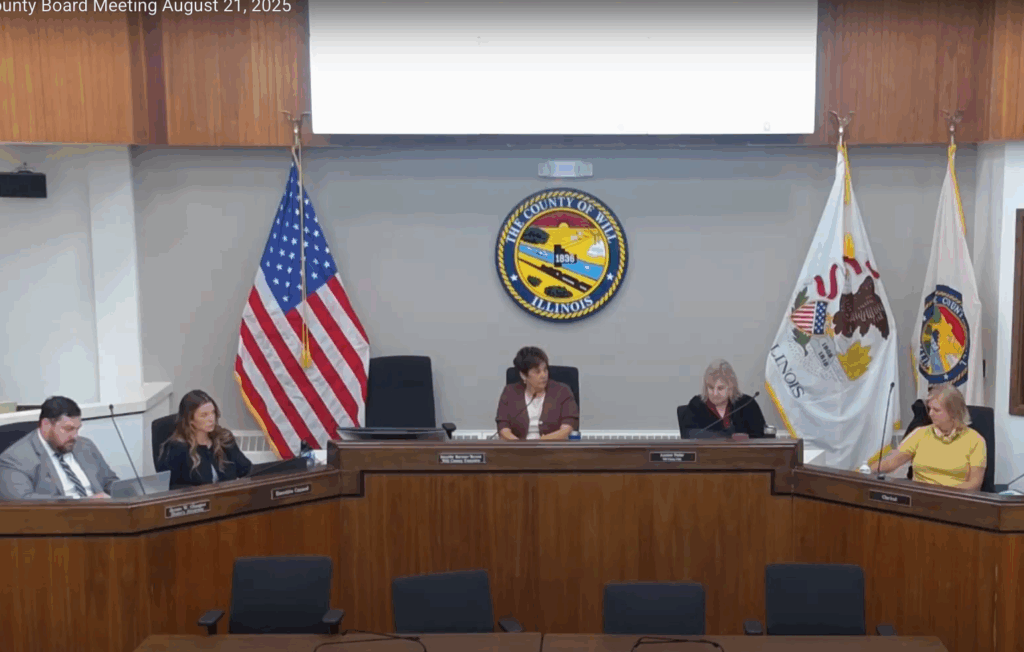
Will County Board Formally Opposes Heavier, Longer Trucks on National Roadways