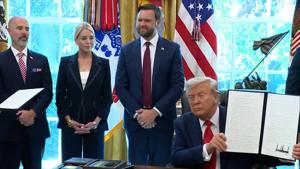
Democrats tank advance of national defense bill in U.S. Senate
U.S. Senate Democrats blocked a critical Pentagon funding authorization bill from advancing Tuesday, a show of rebellion against the Trump administration resuming military hostilities in Iran despite Congress ordering a halt.
The vote to move forward the Senate edition of the fiscal year 2027 National Defense Authorization Act failed by 10 votes, only a week after the House’s version failed to advance due to Republican infighting.
The legislation would authorize a historic $1.1 trillion for programs and operations under the Department of Defense and $41 billion for the Department of Energy’s nuclear weapons program.
The House and Senate must ultimately meld their respective NDAA versions, which currently have the same $1.14 trillion funding topline, into a final product that will pass both chambers. At present, that appears unlikely to happen anytime soon.
“One, it’s a bloated budget to a Pentagon that continues to fail to pass an audit,” Sen. Chris Van Hollen, D-Md., said on social media. “Number two, [it has] no restraints on Trump’s illegal war against Iran, essentially giving a green light to that illegal war that’s been disastrous for the American people.”
Congress never authorized the initial U.S.-Israeli strikes on Iran in February, nor any of the administration’s military actions that followed.
President Donald Trump initially invoked the War Powers Act of 1973, which gives the president 60 days to conduct military operations without congressional approval. When that date passed, Trump declared a temporary ceasefire – which he argued reset the clock – despite continued military hostilities.
By the time the U.S. and Iran signed the 60-day peace framework in mid-June, enough Republicans in both chambers of Congress voted to pass a War Powers Resolution, a measure meant to prevent the president from further unauthorized military action.
With the ceasefire having collapsed, the Trump administration is restarting military assaults and again using the argument that it is legally able to do so under the War Powers Act, despite a legal order from Congress not to continue.





Patchy Fog then Sunny
Latest News Stories

Arizona, Nevada pay less at the pump than California
EEOC celebrates 200 days of protecting religious freedom under Trump

U.S. mining operations discarding rare minerals at center of trade talks

Duffy warns states to enforce English proficiency requirements for truckers

Illinois quick hits: Chicago businesses at 10-year low; school admin survey closes soon

Pritzker unveils Illinois LGBTQ hotline amid debate over transgender athletes

WATCH: Trump ends funding for cashless bail policies, hedges on Guard deployment to Chicago

Hochul pushes back on Trump’s cashless bail funding threat

Education Department finds GMU Violated Title VI
Redistricting opponents immediately appeal to CA voters

Former Transportation Secretary urges state taxpayer funding for Chicago transit

Illinois quick hits: Education tax benefits available; Giannoulias orders license plate reader to shut off access to CBP