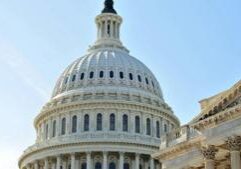
Former CBO chief: Congress isn’t grappling with AI’s fiscal impact
Former Congressional Budget Office Director Douglas Elmendorf says he’s seen no sign Congress is grappling with AI’s effect on federal taxes and spending, even as lawmakers debate AI safety and national security.
Elmendorf, who led CBO from 2009 to 2015, co-authored “How Might Fiscal Policy Respond to the Rise of Artificial Intelligence?” – a National Bureau of Economic Research working paper published this month with Harvard economist Karen Dynan and Brookings Institution economist Louise Sheiner.
The paper models how AI could reshape the federal budget under four scenarios, from broad productivity gains to major, permanent job displacement. In an interview with The Center Square, he described the findings – and where he thinks the fiscal policy conversation is still missing.
Federal debt currently stands at 101% of GDP and is projected to reach 175% by 2056 under CBO’s own baseline, according to the paper. But even in the most severe scenario the authors modeled – permanent job displacement, income shifting almost entirely to capital owners – federal debt would still be 49 percentage points lower than that baseline, landing around 126% of GDP, rather than growing further, according to the paper’s estimates.
Elmendorf was careful to clarify how that finding should be read.
“We’re not showing in the paper that faster growth from AI necessarily makes the budget better off,” he said. “We’re saying it can make the budget better off if no actions are taken to respond to the disruptions. That’s not what I think would happen as a political matter, not what I would recommend as a citizen.”
“If I were writing a forecast down now myself, I would put in a bigger boost from artificial intelligence” than CBO’s current assumption of a 0.1 percentage-point annual productivity gain – on top of the 1.1% average annual productivity growth CBO already projects over the next three decades – Elmendorf said, while cautioning that “I don’t think anybody can know” the real number. He said the bigger lesson for policymakers isn’t the growth rate itself, but the uncertainty surrounding it, which is why the paper frames AI’s fiscal effects as a case for insurance-style policy now, before the scale of disruption is clear.
Asked which of the paper’s policy options he’d prioritize – expanded unemployment insurance, wage insurance, a sovereign wealth fund, universal basic income, higher capital taxes – Elmendorf pointed to something more familiar: worker training and job placement.
“I would focus on the worker training and job placement because they’re problems that we already have had for decades and should do and can do more about,” he said.
Elmendorf specifically pointed to reviving and broadening the Trade Adjustment Assistance program, which offered training, job placement help and wage support to workers who lost jobs to foreign trade before its authorization lapsed in 2022. Congress appropriated $633.6 million for the program in fiscal 2021, the last full year before the lapse, when it served 107,454 workers, according to a Congressional Research Service analysis and Progressive Policy Institute data.
He argued for expanding it to cover job loss from any cause – not just AI or trade – rather than building a separate AI-specific program.
“I think efforts to determine why people have lost their jobs are generally not very successful, and also not very relevant,” he said. “We should appropriately worry about people who lose their jobs for a whole variety of reasons outside their control.”
The AI-Related Job Impacts Clarity Act – the bipartisan bill from Sens. Mark Warner, D-Va., and Josh Hawley, R-Mo., that The Center Square reported this week has stalled in the Senate Health, Education, Labor and Pensions Committee since November – would require companies specifically to report AI-related layoffs. Elmendorf’s skepticism doesn’t extend to opposing more data collection broadly; he said he’s “generally in favor of collecting more data” and considers it “generally helpful for policymakers and for analysts.” His reservation is narrower: distinguishing AI-caused job loss from other causes, he said, is difficult to do well.
“We were surprised when we set out to write the paper that there had been so much speculation about what effects AI might have, and not as much work on how fiscal policy might respond to AI,” Elmendorf said. He and his co-authors are hoping to spur that discussion – on the fiscal side, he said, Congress is “definitely behind.”






Patchy Fog then Sunny
Latest News Stories

Supreme Court upholds executive authority in immigration cases
DeWine vetoes absentee voter photo ID

U.S. jumping into action to assist Venezuela following massive earthquakes

Parents warned of YMCA camps’ transgender-inclusive policies for cabins, restrooms

Chicago’s potential ‘teen takeover’ solutions cost taxpayers

Congressional proposal aims at ‘loophole’ for ideology policies

Illinois Quick Hits: Opioid overdose deaths decline in Cook County

WATCH: How data centers rescued a struggling central Washington community
Oppenheimer’s grandson supports nuclear energy bill
Trump expresses frustration with NATO as Rutte praises the president

Ex-fire chief sues Los Angeles mayor for defamation
Over $10 billion U.S. taxpayer dollars spent on improper SNAP payments in 2025