
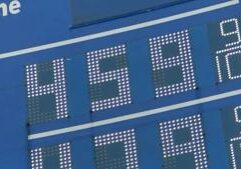
Decades of policy choices makes gas more expensive for Blue states: Report
Policies made decades ago cause gas prices to be on average higher in Blue states than Red states, with a 55 cent gap per gallon, a new report from the Institute for Energy Research shows.
Manager of policy and communications at the Institute for Energy Research Alex Stevens told The Center Square that his organization’s report “reveals that the stark difference in gasoline prices across the country is not merely a product of global market forces but is heavily driven by deliberate, long-term state-level policy decisions.”
“In 2026, states under unified Democratic control (the governorship plus both legislative chambers) averaged $3.69 per gallon, while unified Republican states averaged $3.14 per gallon,” Stevens said. “This is a gap of $0.55 per gallon.”
“Over the past five years, average gas prices rose $0.86 per gallon in Democratic states compared with $0.62 per gallon in Republican states, a $0.24 difference,” Stevens said.
Steven said “most of that gap is driven by just four states: California, Hawaii, Washington and Oregon.”
“When those four are excluded, the difference shrinks to only $0.09 per gallon,” Stevens said.
“The gap is the result of decades of accumulated policy choices, not simply of which party holds power today,” Stevens said. “A state’s total years of Democratic control since 2001 predict higher 2026 gas prices more accurately than whether it is currently led by Democrats or Republicans.”
Stevens outlined to The Center Square the types of policies that cause high gas prices, emphasizing that “taxes are the single most direct policy lever.”
“Each additional dollar in state gasoline taxes raises prices by $ 0.89, and Democratic-controlled states tax fuel much more heavily,” Stevens said.
“Programs that impose a tax on carbon emissions significantly increase fuel costs,” Stevens said.
“For example, Washington’s Climate Commitment Act and Clean Fuel Standard added an estimated $0.41 to $0.48 per gallon to the state’s gasoline prices,” Stevens said. “Similarly, California’s rising cap-and-trade allowance prices have doubled the carbon costs embedded in its fuel.”
Beyond taxes, Stevens said that “mandating specialized, lower-emission fuel blends limits supply flexibility.”
This is observed in “California’s unique CARB fuel blend,” which “combined with its regulatory hostility toward oil production and refining, adds about $0.44 per gallon,” Stevens said.
Further, Stevens noted that “policies and regulatory environments hostile to traditional refining have caused West Coast refineries to shut down or convert to renewable diesel (such as Marathon’s Martinez refinery and Phillips 66’s Rodeo refinery).”
“Because the West Coast lacks major pipeline connections to the Gulf Coast, this lost capacity cannot easily be replaced, driving regional prices up,” Stevens said.
Stevens told The Center Square: “Interestingly, we found that simply producing crude oil within a state does not make its retail gasoline cheaper once taxes and regional refining logistics are factored in.”
“State-level energy policies and refining capacity, rather than local extraction, dictate pump prices,” Stevens said.
Stevens said the price premium on the West Coast is not a permanent geographic destiny, as many people claim.
“After stripping out taxes and geographic isolation, the West Coast premium was modest ($0.20 to $0.44 per gallon) between 2017 and 2021,” Stevens said. “However, it roughly doubled in 2022 and has reached $0.91 per gallon in 2026.”
“This increase in the premium coincided with the new climate programs in Washington, the rise in cap-and-trade allowance prices in California, and the loss of refining capacity outlined in the report,” Stevens said.
“Additionally, high-cost energy policies hurt consumers in neighboring West Coast states,” Stevens said. “Even after excluding carbon program states (California, Washington, and Oregon) from the data, a West Coast premium of $0.52 per gallon persists in states such as Nevada and Arizona.”
“This is because those states rely on California’s pipelines and refineries, meaning California’s restrictive regulatory policies and carbon programs are exported to neighbors who never voted for those policies,” Stevens said.
Institute for Energy Research’s report stated that the political signal in gasoline prices is real, but it is a signal of accumulated policy choices: fuel taxes, carbon taxes, and regulatory environments built over decades, rather than of who happens to hold office right now.”
“For policymakers, that is the actionable point: the levers that explain the gap are specific and identifiable, and the largest of them, state fuel taxes and transportation carbon taxes, pass through to consumers nearly dollar for dollar,” the report said.






Patchy Smoke
Latest News Stories
Committee Rejects Troy Township Solar Projects Amid Strong Local Opposition
Controversial DuPage Township Rezoning for Outdoor Storage Advances
Residents Allege Health Crises, Violations from Peotone Grain Facility

Health Department May Seek Property Tax Increase to Maintain Critical Services
Crete Township Solar Project Approved Despite Township Objections
Health Department Opens Second Breast Milk Depot in Bolingbrook
Lockport Township Solar Farm Gains Committee Approval
Health Department Plans Back-to-School Fair July 12

Meeting Briefs: Will County Land Use & Development Committee for July 3, 2025

Meeting Summary and Briefs: Prairie State College Board of Trustees for March 25, 2025
Will County Public Health & Safety Committee July 3 Meeting Briefs
Prairie State College Board Accepts Positive FY2024 Financial Audit

Will County Seeks Asian Carp Provision in Federal Legislative Agenda

Will County’s Major Capital Projects Hit Key Milestones, VAC Buildout on “Aggressive Schedule”