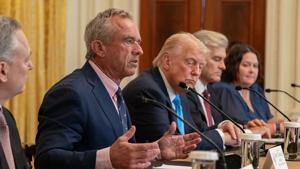
Fraud enforcement, weaponization swirl around Blanche’s nomination
A marathon Wednesday confirmation hearing for Todd Blanche, President Trump’s nominee for attorney general, touched on fraud enforcement, the anti-weaponization fund, documents associated with Jeffrey Epstein and executive independence.
Blanche testified before lawmakers on the Senate Judiciary Committee Wednesday as he seeks to take over the post formerly led by Pam Bondi, who was fired by President Donald Trump in April.
Lawmakers on the committee grilled Blanche about the U.S. Department of Justice’s “anti-weaponization fund,” a nearly $1.8 billion allocation designed to pay legal fees incurred by individuals who were politically prosecuted. The fund came from a lawsuit settlement over the leak of President Trump, Donald Trump Jr. and Eric Trump’s tax returns.
The president left open the possibility that individuals charged with crimes related to the Jan. 6, 2021, attack on the U.S. Capitol would receive funds from the anti-weaponization fund.
Sen. Mazie Hirono, D-Hawaii, said the weaponization fund was meant to attack and discredit individuals with whom the president disagrees. In a testy exchange, she asserted Blanche could resurrect the fund at any time since a legal agreement had not been signed to withhold it.
Blanche strongly disagreed and proclaimed the fund was “dead.”
“When you answer that there’s no fund, that is not rescinding the order because you can resurrect that order at any time,” Hirono responded. “So actually, your answer is no, you have not rescinded that order.”
Sen. Thom Tillis, R-N.C., a key vote for Blanche’s confirmation, pressed him on setting up language in a law to prevent the administration from reviving the fund. Blanche said he supported such an effort.
“The only reason I think that a Democrat would be opposed to this is because they like to milk this thing for what it is,” Tillis said. “I want to stick a fork in it.”
Several lawmakers praised Blanche’s efforts to prosecute fraud in federal programs.
Sen. Marsha Blackburn, R-Tenn., highlighted the Fraud Accountability Act, a piece of legislation that would push for the deportation and denaturalization of individuals in the country who committed fraud schemes.
“It’s taxpayer money and they want their money to be used wisely,” Blackburn said.
Blanche said the department has clawed back more than $11 billion in federal program fraud over the last three months as it has undergone a change in its focus on fraud since Trump took office. He said the department has worked with the FBI, DHS, and inspectors general to pursue fraud and dedicate more resources to securing prosecutions.
“The focus on these fraud cases and the focus on every U.S. attorney having multiple prosecutors focused on going after fraud cases is something new and it’s something that is important to President Trump,” Blanche said.
Several lawmakers also questioned the department’s handling of documents associated with convicted sex offender Jeffrey Epstein, and the ability of the agency to remain independent from Trump’s influence.
The DOJ released more than three million documents associated with Epstein. However, lawmakers pushed for him to release the up to six million originally promised. Blanche said a large portion of the six million documents were entirely unrelated to the convicted sex offender and should not be included.
He also admitted to mistakes in the redactions of some documents that either exposed the identities of Epstein’s victims or improperly redacted names of those who conspired alongside Epstein.
“There were mistakes that were made, and so approximately 1% of the redactions had to be fixed after we released the Epstein files,” Blanche said.
Lawmakers cast doubt on Blanche’s ability to meaningfully distance himself from the president’s influence. Sen. Cory Booker, D-N.J., said Blanche’s former work as Trump’s personal lawyer had an undue influence on his tenure as deputy and acting attorney general.
He said prosecutions of Federal Reserve Governor Lisa Cook, former FBI director James Comey and New York Attorney General Letita James are examples of lacking independence.
“When a president routinely pressures public officials for his own personal benefit, the Department of Justice has to remain independent,” Booker said.
In a heated exchange, Blanche denied an improper conflict with the president and committed to upholding the Justice Department’s independence.
Senators will weigh Blanche’s nomination over the next several days. On Thursday, former Attorney General John Ashcroft, president of the federal law enforcement officers foundation Jon Adler and former DOJ pardon attorney Elizabeth Oyer will testify before the Senate committee on Blanche’s nomination and qualifications.





Areas Of Smoke
Latest News Stories
As Trump considers rolling back some tariffs, trade groups want in

WATCH: Newly released Epstein emails discussing Trump ‘prove nothing,’ says Leavitt

Small business leader warns swipe fees are squeezing local stores
WATCH: White House exploring options for $2,000 tariff rebate checks
Pritzker disagrees with Durbin on vote to end shutdown

SNAP benefits still in limbo as government shutdown likely nears end
WATCH: China to control chemicals used to produce fentanyl, Patel says

Pritzker open to conversation with Trump on alderman’s immigration proposal
Unions, faith leaders back bipartisan immigration reform bill

Expert: Illinois’ outdated tax law leaves homeowners, taxpayers on the hook
Report: Biden gave away billions of tax dollars for ‘climate justice’ without public consent

Procedural technicalities, appeals court stymie CDL rule change