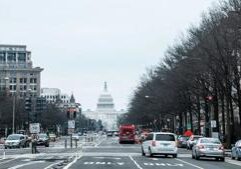
Industry leaders: Feds can more effectively combat fraud, but privacy rights at risk
The federal government faces fraudsters utilizing technology more powerfully than ever before to take advantage of taxpayer-funded programs and steal taxpayer dollars. But it must be careful which tools it uses to reduce or eliminate fraud, as the wrong ones could put personal liberties at risk, witnesses warned at a congressional hearing Wednesday.
Fraud in government assistance and benefits programs has become a focus of the Trump administration, particularly since more than $9 billion in taxpayer dollars were fraudulently spent in Minnesota and other states has been revealed. Numerous hearings have been held on Capitol Hill for months focusing on fraud identification and prevention; the Treasury Department has developed new initiatives to combat fraud involving federal funds, and combatting fraud has become a political talking point for Republicans looking to maintain their majorities in the U.S. House of Representative and Senate.
A House subcommittee held another fraud hearing Wednesday, this time focusing specifically on useful tools and guardrails for digital identification verification and methods the government can employ to prevent digital IDs from being used against Americans.
“Government programs rely on identity verification to confirm that the individual applying for benefits services [is] who they say they are,” said Rep. Pete Sessions, R-Texas.
But after looking into some of those federal digital programs that rely on identity verification, the government found there are loopholes that could be exploited. And even as the government moves to integrate emerging artificial intelligence technologies into its operations, fraudsters are moving at an even faster pace, according to some industry leaders.
Jordan Burris, vice president and head of public sector strategy at Socure, an AI-powered digital identity verification, fraud prevention, and compliance platform, described the fraudulent use of AI in the U.S. as a “national crisis.” Socure is one of several vendors partnering with government agencies to strengthen security for digital identity verification services.
“The moment that we’re in is unlike any other in the sense that AI is being used as an accelerator for attacks that typically would take weeks to occur, and further, it’s also becoming more cost-effective for the adversary to launch those attacks,” Burris told lawmakers.
Using AI technology, fraudsters can now steal identities and attempt to move money into a new account in less than 48 hours – a venture that may have taken weeks not that long ago, according to Burris. According to Socure’s research, “AI-generated attacks are up 8,000% year-over-year, with crypto exchanges among the most targeted platforms in the world.”
“One fraud ring we profiled created nearly 25,000 synthetic identities and launched more than 35,000 attacks in just 30 days,” Burris said. “The adversary has changed.”
Burris and the others called to testify before the committee had many recommendations for how the government could improve its digital identification tools – like replacing self-attestation with verified data “wherever the risk is high,” according to David Maimon, head of fraud insights at SentiLink, an identity verification and fraud prevention software company.
Maimon pointed out that this was a vulnerability that existed before the pandemic and still has not been fully addressed today. While he offered several recommendations to improve government programs, he said the federal government still lacks key capabilities it needs to combat the type and scale of fraud seen today.
“The federal government already has some of the tools it needs. What is missing is the authority, the coordination and the sustained investment to use those tools before the money moves, not after,” Maimon said.
“None of this requires slowing down help for legitimate applicants,” he added.
But another witness – Jay Stanley, a senior policy analyst for the American Civil Liberties Union’s Speech, Privacy and Technology Project – warned of the dangers of one potential tool in the fight against digital fraud.
“A digital ID system would be a disaster for individual liberties if it’s not done right,” he told lawmakers. “If any such system is to become standardized, it must be built with great care and awareness of big potential downsides.”
Stanley said that some states and the federal government are moving toward using mobile driver’s licenses as a form of digital ID, but there are flaws in its implementation and better alternatives exist.
“We may create a digital ID to solve government fraud or identity theft or other problems, but there’s a horde of others waiting in the shadows who will instantly pounce on this infrastructure to use it for their own purposes once it’s created,” Stanley said.
Americans have indicated their discomfort with how much tracking happens online, and this would make that problem much worse, according to Stanley.
“A digital ID system, if not built carefully, could send a report back to the government every time you show your ID – a record of every beer purchase, bank and doctor’s office visit, and online, every website you visit,” Stanley said.
“We have to ensure America does not become a checkpoint society, and that digital IDs don’t become virtual ankle monitors-something that tracks us, but we can’t turn off or escape.”





Areas Of Smoke
Latest News Stories

Over 7 million student loan borrowers have 90 days to switch repayment plans

Pritzker signs 62 new laws, many not in effect until 2027
Federal workforce shrank by 256,000 in 2025. Deficit barely moved.

Illinois Quick Hits: Ruling supports Illinois mail-in ballot laws

Election 2026: Singular goal to win elections, different ideas to get there

Democratic group calls for U.S. social media ban for kids under 16
Colorado Dems seek to flip longtime GOP congressional seat

EXCLUSIVE: 14 state AGs confront insurance giant for prioritizing climate activism

U.S. Supreme Court agrees to hear Washington parental rights case
IL Dems blast Trump refusal to sign housing bill

Op-Ed: Illinois manufacturers are in dire need of legal reform

Chicago officials pick apart parking meter deal, buyer’s ICE deportation ties