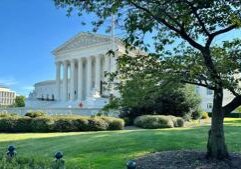
U.S. Supreme Court to hear Alaska plane confiscation case
The U.S. Supreme Court agreed to hear a case over whether an Alaskan pilot’s plane can be seized after he transported alcohol into a town where it is illegal.
The high court agreed to hear Jouppi v. Alaska, a case that focuses on bush pilot Kenneth Jouppi, whose plane was confiscated after one of his passengers attempted to bring a six-pack of Budweiser beer to Beaver, Alaska, where alcohol is prohibited, court documents read.
Across Alaska, villages may enact “dry” laws that make it a state crime to send or transport alcoholic beverages. Jouppi’s lawyers argued that seizing Jouppi’s plane, valued at $95,000, is a violation of the excessive fines clause in the Constitution.
The lawyers also said Jouppi was aware of the rule against transporting alcohol, but did not think it was appropriate to search his passenger’s bags.
“No law required him to search their belongings, and, in his view, it would be ‘invasive and demeaning’ to do so,” a petition to the high court reads.
The Alaska Supreme Court ruled against Jouppi, arguing that he knew one of his passengers was transporting the beer. The state court also argued that planes are always subject to forfeiture when involved in violations of village “dry” laws.
“Given that many communities are accessible primarily by air, the legislature provided that any airplane used to illegally import alcohol into a dry community was subject to forfeiture,” lawyers for Alaska wrote to the high court.
Jouppi’s lawyers argued that the Alaska Supreme Court went too far in allowing his plane to be taken over the six-pack of beer. The lawyers said the court sought maximum punishment for a misdemeanor crime, one of which Jouppi was not previously guilty.
“Forfeiting Jouppi’s airplane was a severe economic sanction,” the lawyers wrote. “While Jouppi’s conduct was ‘serious,’ it ‘was not nearly as egregious as other conduct that could result in mandatory forfeiture of a plane under the applicable statutes.'”
Lawyers for Alaska said the state troopers who served him a warrant on the transportation of beer claimed it was obvious that his passenger was bringing alcohol.
“Jouppi would ‘have to be blind not to know what was on [the plane], and absolutely ignoring whatever he was putting in that airplane,'” lawyers for Alaska wrote.
The lawyers also pointed to statistics regarding the dangerousness of alcohol and the lack of police presence throughout villages in Alaska. They argued Jouppi’s crime is extremely serious.
“In rural areas, nearly 80% of violent crimes and more than half of property crimes were committed under the influence of alcohol,” lawyers for Alaska wrote.
The high court is expected to hear the case in the fall, likely bringing clarity to the excessive fines clause of the Constitution.



Partly Sunny
Latest News Stories
Coloradans react to ruling against ban on conversion therapy

Illinois Quick Hits: Chicago city workers owe more than $19M

Attorney expects conversion therapy ruling to impact Illinois ban

White House govt funding request for 2027 cuts $73 billion
Dems sue over Trump’s executive order on mail-in ballots

GAO again warns Congress about nation’s ‘unsustainable fiscal path’

Millionaire’s tax proposal draws mixed reviews as deadline approaches
U.S. fighter jet shot down over Iran; frantic search and rescue underway

Universities warn state funding delays are wasting millions in taxpayer investment
Trump seeks 44% increase to boost military budget to $1.5 trillion

Illinois Quick Hits: Loyola student’s alleged killer faces federal firearm charge

U.S. adds 178k jobs in ‘strong’ March report amid Iran conflict

Will County Kicks Off Comprehensive Land Resource Management Plan Update with Focus on Proactive Zoning and Environmental Justice

Infighting and Calls for Resignation Disrupt Will County Board Meeting