
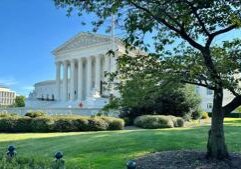
U.S. Supreme Court to hear Alaska plane confiscation case
The U.S. Supreme Court agreed to hear a case over whether an Alaskan pilot’s plane can be seized after he transported alcohol into a town where it is illegal.
The high court agreed to hear Jouppi v. Alaska, a case that focuses on bush pilot Kenneth Jouppi, whose plane was confiscated after one of his passengers attempted to bring a six-pack of Budweiser beer to Beaver, Alaska, where alcohol is prohibited, court documents read.
Across Alaska, villages may enact “dry” laws that make it a state crime to send or transport alcoholic beverages. Jouppi’s lawyers argued that seizing Jouppi’s plane, valued at $95,000, is a violation of the excessive fines clause in the Constitution.
The lawyers also said Jouppi was aware of the rule against transporting alcohol, but did not think it was appropriate to search his passenger’s bags.
“No law required him to search their belongings, and, in his view, it would be ‘invasive and demeaning’ to do so,” a petition to the high court reads.
The Alaska Supreme Court ruled against Jouppi, arguing that he knew one of his passengers was transporting the beer. The state court also argued that planes are always subject to forfeiture when involved in violations of village “dry” laws.
“Given that many communities are accessible primarily by air, the legislature provided that any airplane used to illegally import alcohol into a dry community was subject to forfeiture,” lawyers for Alaska wrote to the high court.
Jouppi’s lawyers argued that the Alaska Supreme Court went too far in allowing his plane to be taken over the six-pack of beer. The lawyers said the court sought maximum punishment for a misdemeanor crime, one of which Jouppi was not previously guilty.
“Forfeiting Jouppi’s airplane was a severe economic sanction,” the lawyers wrote. “While Jouppi’s conduct was ‘serious,’ it ‘was not nearly as egregious as other conduct that could result in mandatory forfeiture of a plane under the applicable statutes.'”
Lawyers for Alaska said the state troopers who served him a warrant on the transportation of beer claimed it was obvious that his passenger was bringing alcohol.
“Jouppi would ‘have to be blind not to know what was on [the plane], and absolutely ignoring whatever he was putting in that airplane,'” lawyers for Alaska wrote.
The lawyers also pointed to statistics regarding the dangerousness of alcohol and the lack of police presence throughout villages in Alaska. They argued Jouppi’s crime is extremely serious.
“In rural areas, nearly 80% of violent crimes and more than half of property crimes were committed under the influence of alcohol,” lawyers for Alaska wrote.
The high court is expected to hear the case in the fall, likely bringing clarity to the excessive fines clause of the Constitution.





Slight Chance Rain Showers then Mostly Cloudy
Latest News Stories

Illinois unemployment rate tops national average; state ends 2025 with fewer jobs

Illinois Quick Hits: Iowa wants Illinois’ counties

County Authorizes Financial Study of Homer Glen Law Enforcement Contract

Will County Public Works Debates Future Bridge Needs as 159th Street Closure Looms

Capital Imp Committee: Veterans Assistance Commission Set to Move into New Facility

Capital Imp Committee: Health Dept Elevator Repair Costs Significantly Lower Than Estimates

Meeting Summary and Briefs: Beecher Fire Protection District for December 18, 2025

Legislative Committee Adopts 2026 Federal Legislative Agenda

Poll: Majority prefer Trump’s immigration policies over Biden’s

Illinois eyes smarter park funding: handicap accessibility gets priority

Nation’s first primary states to begin early voting

Vermont EV buses prove unreliable for transportation this winter

